





Compare ten Angular development companies for new applications, plus three verified AngularJS migration providers for legacy systems. This is an editorial shortlist, not a census and not a paid ranking.
This is an editorial shortlist. See how we rank companies.
Official support for AngularJS 1.x ended in January 2022. For new applications, choose modern Angular. For an existing AngularJS application, choose a team with an explicit migration service and agree the maintenance period, security responsibilities and replacement plan before signing.
AngularJS migration evidence: what the public pages actually prove
Checked on October 3, 2026. A modern Angular portfolio does not prove AngularJS 1.x migration experience. The three providers already discussed below publish different kinds of evidence. Use this grid to decide what to request before a paid discovery. Vendor case studies are self-reported; they do not independently establish delivery quality, current staffing or your project’s outcome.
| Provider | Official evidence and version boundary | Proof still needed |
|---|---|---|
| Rangle | Its current Angular service page explicitly offers AngularJS-to-Angular migration, assessment, a roadmap, refactoring and dependency updates. The migration article dated November 20, 2023 discusses enterprise AngularJS work. However, its Google case is Angular 2 to Angular 4, not AngularJS 1.x to Angular. | A reference for a comparable 1.x application, starting and target versions, migration stages and named delivery lead. An old Angular 11+ mention in the migration article is not a target-version recommendation for 2026. |
| Leobit | Its service page names AngularJS migration and Angular/.NET assessment. The lending-platform case explicitly describes AngularJS-to-Angular 8 work across borrower, broker and mortgage-comparison applications, alongside backend modernization. That is specific legacy-migration evidence, not proof that Angular 8 is an appropriate new destination. | A dated project timeline, the release now in production and supported target version for your contract. The retrieved case does not give a clear completion date for each front-end migration. Ask for a comparable reference and an exact handover scope. |
| ScienceSoft | Its Angular service page offers team augmentation and a dedicated Angular team. The page mixes Angular and Angular.js terminology; a framework name or a dated Angular testimonial does not establish the exact migration method, supported 1.x version or maintenance SLA. | An explicit AngularJS migration statement of work, a matching 1.x case and source/target versions. With augmentation, your lead manages developers; with a dedicated team, clarify the vendor PM’s scope. Neither model alone settles architecture or release authority. |
For every firm, settle repository ownership, access to CI and deployment accounts, third-party license costs, security triage and the right to keep working builds after exit. Public marketing pages do not replace those contract terms. Ask who can approve a release and who can roll it back before comparing quotes.
Choose a migration route before choosing a team
A new Angular application brief starts with product requirements and the supported target framework. An AngularJS-only brief starts with keeping a specific 1.x application working: dependency versions, browser behavior, critical business routes and a support bridge. A migration brief needs both, plus a cutover plan. Do not buy a new-build proposal when you need legacy maintenance, or buy maintenance expecting it to include migration.
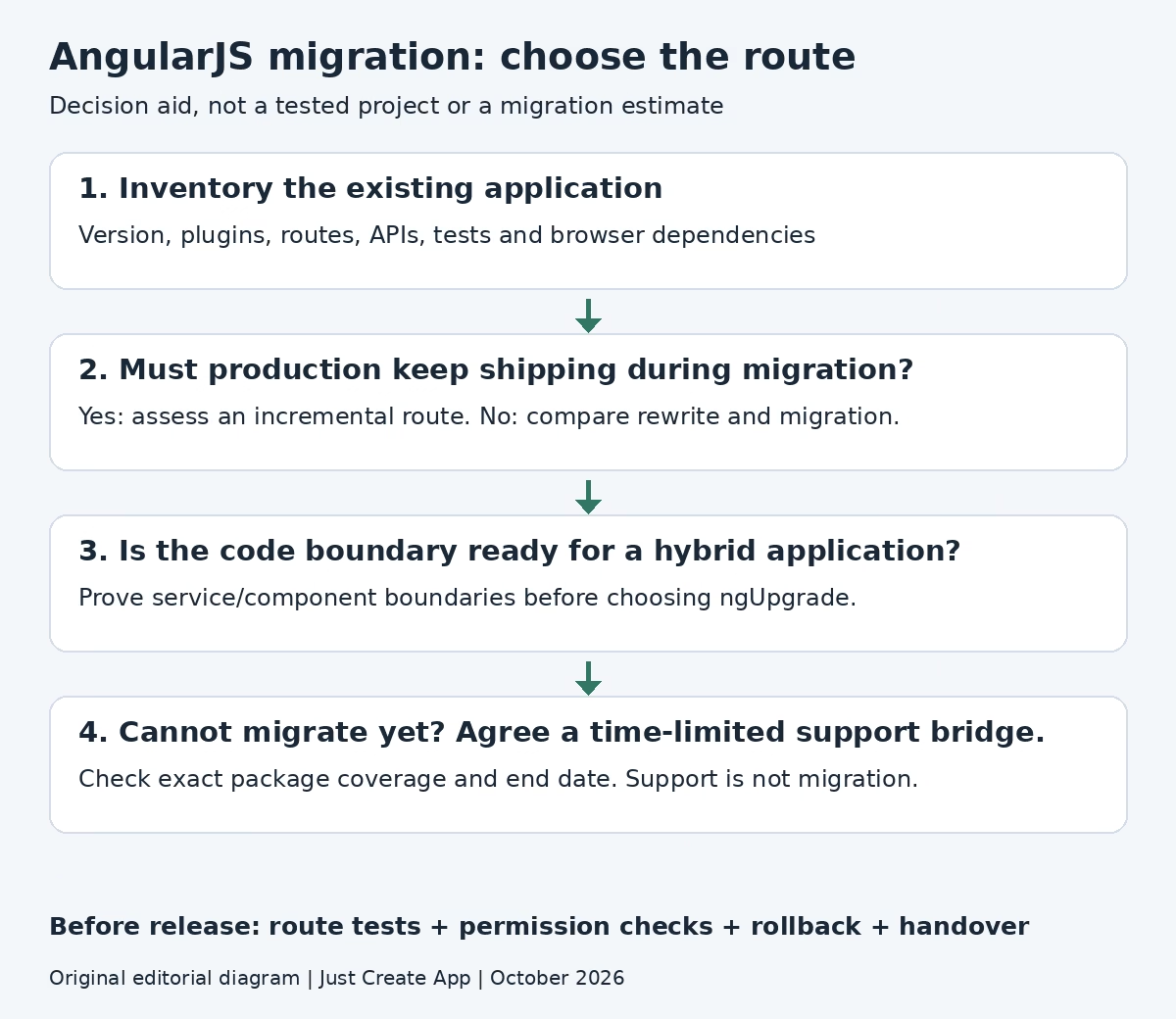
- Inventory versions, plugins, routes, APIs, tests and browser dependencies.
- Decide whether production must keep shipping during migration. Compare an incremental route with a rewrite against that constraint.
- Prove component and service boundaries before choosing a hybrid application.
- If migration must wait, define the support bridge, package coverage and end date. Support is not migration.
Angular’s UpgradeModule documentation describes bootstrapping a hybrid application with AngularJS services. That is a technical route to evaluate, not a promise that your plugins or routes will work unchanged. Ask the team to demonstrate one representative route, its authentication path and its rollback before committing the whole application to a hybrid design.
If migration must wait, evaluate extended support separately. HeroDevs’ former-XLTS configuration documentation distinguishes packages compatible with open-source AngularJS 1.8.x and a separate 1.5.x configuration. It also notes an Internet Explorer caveat. XLTS and HeroDevs merged in September 2023; do not count them as two independent options. Confirm exact versions, dependent libraries, browsers, patch delivery and exclusions in the current contract. A patched framework is not evidence that the whole application is secure or compliant.
A dependency inventory specimen for the discovery brief
The following is a synthetic worksheet, not a customer system or a tested migration. Replace each example with repository evidence. “Unknown” is a finding to investigate, not a box to mark as passed.
| Inventory item | Illustrative entry | Evidence to collect |
|---|---|---|
| Framework and plugins | AngularJS 1.8.x; routing and UI plugins not yet checked | Exact lockfile versions, install source, support entitlement and dependency tree |
| Business route | Order approval must stay available | Route owner, permission roles, API contract and existing regression tests |
| Browser dependency | Older warehouse browser: compatibility unknown | Real browser/OS versions and a repeatable smoke test on that device |
| Release boundary | Replace one route before the rest | Build artifact, feature flag, monitoring owner and rollback procedure |
Accept the first slice with evidence, not a progress percentage
- Record the baseline commit, lockfile and environment. Capture failures that already exist before the migration.
- Choose a representative route with authentication, form validation and an API call. Define expected behavior with the business owner.
- Keep before-and-after test commands, actual logs and build artifacts. If a test fails, record the failure; do not rewrite it as a successful result.
- Check the route on agreed browsers and devices, including keyboard navigation and error states. Compare behavior against the baseline.
- Demonstrate rollback in a non-production environment and identify the person who can approve cutover. Transfer repository access, runbooks and open defects at handover.
No migration code or before/after build result is claimed here. A provider-specific timeline should follow inspection of your application, not a generic promise. For deployment ownership and incident response questions, also compare the DevOps consulting shortlist.
Does a migration case prove current Angular support?
No. A case can establish that a firm describes a past migration, but its old destination version does not prove a supported target today. Ask for the version and support window written into your own proposal.
Who should own the migrated code and release decisions?
Agree ownership, access and release authority in the contract. Team augmentation, a dedicated team and a project engagement divide management differently. None automatically proves that your business owns all deliverables or can deploy without the vendor.
Ask for a migration plan you can accept, not only an Angular quote
A legacy AngularJS replacement and an update between modern Angular versions are different projects. A company can be capable at new Angular development without having a credible plan for your 1.x application. Require the proposal to name the starting framework, target version, migration route and the evidence that each stage is ready to ship.
Angular’s release and update policy says multi-major updates should be performed one major version at a time, subject to the supported-version requirements it describes. The official update guide is version-specific. Ask the supplier to use the route for your actual application, not a generic promise to jump to “the latest Angular”. For an AngularJS system, this modern-version update route is not a substitute for an architecture and migration plan.
What the first paid discovery should deliver
- A dependency inventory. List the framework version, third-party modules, build tooling, test tooling and deployment route. Identify abandoned components and custom integrations before estimating the application only by screen count.
- A route-by-route scope. Name the user journeys that move first, which remain in the legacy system and how authentication and navigation work during the transition. State whether the proposal is an incremental migration, a rewrite or a limited maintenance contract.
- A testable pilot. Choose one meaningful journey with data loading, editing, errors and permission checks. Ask for tests and a staging demonstration. A decorative new landing screen does not prove that the hard business workflow can migrate.
- Acceptance and rollback rules. Agree what must match the existing system, what intentionally changes and who accepts the result. Include accessibility, performance, reporting and browser support where relevant. Decide how to return to the old release if a production issue appears.
- Ownership and maintenance. Specify who owns the repository, deployment credentials, documentation and dependency updates. Define responsibility for the legacy portion during migration and the handover after launch. Avoid a proposal where the gap between old and new systems belongs to nobody.
Questions that make two proposals comparable
Ask each firm to price the same discovery and pilot scope, identify its assumptions and separate migration work from product redesign. Compare the named team, testing approach, dependencies, milestones and post-launch support before comparing the headline rate. A low hourly rate with an undefined replacement scope is not a useful estimate.
Have the supplier show which risks it has included and which require a decision from you. Common decisions include preserving behavior versus redesigning it, extending the legacy system during migration, and replacing a third-party component. Put each assumption into the statement of work. That makes later changes visible instead of turning them into unexplained delays.
The shortlist above helps find teams with relevant public evidence. The pilot is where you check whether a team can work on your application, explain the trade-offs and leave you with a system someone else can maintain.
The 10 firms
The modern Angular shortlist below is separate from the legacy AngularJS section. Public service and project links are evidence of a stated capability, not a guarantee of your project outcome. We do not publish invented numeric totals; the weights live on how we rank companies.
| Company | HQ | What they ship in Angular | Public proof | Best fit |
|---|---|---|---|---|
| Rangle | Toronto, Canada | Angular practice, AngularJS → Angular migration, Google-facing work | rangle.io/services/angular | Migration / greenfield specialist |
| Valor Software | Austin, USA | ngx-bootstrap and other Angular open source; product teams | Valor Software | Component libraries / Angular-literate delivery |
| Netguru | Poznań, Poland | Angular product and platform work for named brands | netguru.com/services/angular-development | Greenfield product |
| N-iX | Europe / Americas | Angular team augmentation; NgRx, Angular Material | n-ix.com/angular-development-services | Staff aug / enterprise |
| DOOR3 | New York, USA | Enterprise Angular with .NET (Ansell GuardianOne) | door3.com/our-work/ansell | US enterprise modernization |
| Leobit | Lviv, Ukraine | Angular + .NET; published AngularJS → Angular path; 65 Angular projects on their site | leobit.com/technologies/angular | Migration / .NET shops |
| ScienceSoft | McKinney, Texas, USA | Angular 2+ staff aug; named Angular 9 portal work; AngularJS → Angular as a listed service | scnsoft.com/software-development/angular | Staff aug / migration |
| SoftServe | Austin, USA / Lviv | Enterprise Angular in published stacks (e.g. Angular 7 on a GCP innovation platform) | SoftServe GCP / Angular 7 case | Large-scale enterprise |
| The Software House | Gliwice, Poland | Angular 2+ web front ends on named products (WieBetaaltWat; eSky Angular 2) | tsh.io/portfolio/wiebetaaltwat-case-study | Product teams / greenfield web |
| Kellton | India / US | Current-Angular engineering writing (Angular 21: zoneless, signals, Vitest) | Kellton Angular 21 guide | Version upgrades (weaker case-study proof) |
Firm notes
1. Rangle
Rangle is the clearest Angular specialist on this list. The public Angular service page describes architecture, delivery, and AngularJS-to-Angular migration, and names work with organizations such as Invesco and Synaptive. Hire Rangle when Angular is the product, not a line on a 40-framework brochure – especially if an old 1.x app has to move without a big-bang rewrite.
Before selecting Rangle, ask for a phased assessment covering routing, shared authentication and design-system dependencies. Agree which parts remain on AngularJS during transition and who owns regression testing. Its migration service is stronger evidence for this brief than a generic frontend technology list, but the delivery schedule still needs a project-specific statement of work.
2. Valor Software
Valor maintains ngx-bootstrap, a widely used Angular component library, and lists that work on the company site. Owner Dima Shekhovtsov is a Google Developer Expert. That is checkable Angular 2+ engineering, not a keyword dump. Best fit is teams that need Angular component work, open-source fluency, or a squad that already lives in the Angular ecosystem.
Ask which ngx-bootstrap components and versions the proposed team has maintained, and whether your application uses Bootstrap, Angular Material or a custom design system. Component-library experience helps with shared UI work; it does not by itself establish experience with your regulated workflow, backend or support requirements.
3. Netguru
Netguru publishes a dedicated Angular development service, not an “AngularJS 2016” leftover URL. The official service page describes Angular frontend delivery, performance work, testing and maintenance. Its examples of companies using Angular are not proof that Netguru built those companies’ applications. Hire Netguru for a greenfield Angular product or a redesign where UX and delivery process matter as much as the framework version.
Best fit is a product team buying design and frontend delivery together. Ask for a recent Angular reference, the production version and the proposed test strategy. Separate a new build from an AngularJS rescue: an Angular services page alone does not confirm the latter.
4. N-iX
N-iX’s Angular page describes team augmentation, NgRx, and Angular Material, and claims a large Angular bench. That is a staff-aug shape: they are a fit when an in-house Angular codebase already exists and the bottleneck is senior capacity, not a vendor who will own the product roadmap.
For an augmentation engagement, keep architecture decisions and acceptance criteria with your internal lead. Confirm seniority, team continuity and overlap hours for the engineers actually assigned. A large firm or technology bench does not mean every available developer has handled the same migration or product domain.
5. DOOR3
DOOR3 is a New York consultancy. The Ansell GuardianOne write-up is the proof: an enterprise Angular front end on a .NET stack, not a directory blurb. Hire DOOR3 for US-facing modernization where Angular sits next to existing Microsoft systems.
The named Ansell project makes DOOR3 worth considering for enterprise workflows and a Microsoft backend. Ask what part of that project the proposed team delivered and how the pattern transfers to your application. A portfolio reference is not a promise of identical delivery time, scope or commercial terms.
6. Leobit
Leobit’s Angular technology page lists dozens of Angular projects and a stated AngularJS → Angular offering, often beside .NET. That combination is common in legal, ops, and internal tools. Hire Leobit when the backend is already Microsoft and the front end is the part that aged.
Its stated legacy migration service is relevant when .NET and Angular need to evolve together. Ask for the frontend and backend migration sequence, compatibility tests and rollback plan. Distinguish an AngularJS-to-Angular move from a simple version upgrade: they require different scopes and estimates.
7. ScienceSoft
ScienceSoft’s Angular page is explicit about Angular 2+ delivery, team augmentation, and migration from AngularJS to Angular. A published client note describes Angular 9 portal work (LTA Nams, 2020). The same page still lists “Angular JS” in a skills laundry list – treat that as honesty about legacy, not as the thing they should be hired to greenfield in 2026.
Compare augmentation with a managed dedicated team before requesting a quote. ScienceSoft describes both models publicly. In either model, ask for evidence against your current Angular version and domain. The dated portal testimonial supports historical experience, not an assertion that the same engineers or version are assigned today.
8. SoftServe
SoftServe is a large digital-engineering firm, not an Angular boutique. Inclusion rests on public case materials that name Angular in the stack – for example an innovation platform moved to Google Kubernetes Engine with Angular 7 and .NET Core. Hire SoftServe when Angular is one slice of a broader enterprise program (cloud, data, many teams), not when you need a five-person Angular specialist shop.
Treat the 2019 platform case as historical architecture evidence, not proof of a current Angular release. Request a newer reference and identify responsibility for the frontend, cloud environment and deployment pipeline separately. This is a broader engineering engagement rather than a legacy maintenance commitment inferred from the Angular name.
9. The Software House
The Software House (Poland) publishes product case studies that name Angular on the front end. WieBetaaltWat used Angular for the web app beside native mobile. A separate eSky write-up describes a move to TypeScript and Angular 2. Hire TSH for product-team delivery where Angular is the web layer, not a slide in a 50-technology deck.
The named web product is useful evidence for buyers comparing a web frontend alongside native mobile delivery. Ask how API contracts, accessibility and release coordination were handled. Verify the version and engineers for a new engagement; an older case does not establish present-day staffing or support terms.
10. Kellton
Kellton’s strongest current Angular proof this week is an engineering guide to Angular 21 (zoneless change detection, signals, Vitest) – not a named product case study. That clears “they still write about Angular 2+,” and it is weaker on public work than Rangle or Valor. Consider Kellton for a version-upgrade conversation only after reviewing a relevant production case and the proposed engineers, not on the blog post alone.
The guide is useful for understanding an upgrade discussion, but writing about a framework is weaker than a named implementation. Ask for a recent upgrade case, a dependency audit and a test-backed release plan. Keep the proposal conditional until the production experience is established.
AngularJS development companies for maintenance and migration
An AngularJS development company in 2026 should be evaluated for legacy support and migration, not as a default supplier for a new 1.x application. AngularJS, sometimes written Angular JS or Angular.js, is different from Angular 2+. The official AngularJS site states that support ended in January 2022. A vendor’s migration service is not a promise of ongoing security patches for the retired framework.
Rangle: an explicit AngularJS migration practice
Rangle’s AngularJS migration page describes assessment, migration planning and training for teams taking ownership of the new codebase. Its Angular service page also lists code refactoring, dependency updates and performance work. This is a strong starting point for a legacy web application that needs a staged move rather than a full interruption of delivery. Ask what remains on 1.x at each milestone, whether hybrid operation is appropriate, and what support is included before the old routes are retired. Do not assume its migration offering includes indefinite AngularJS maintenance.
Leobit: AngularJS migration alongside .NET
Leobit’s official Angular page explicitly lists migration from AngularJS to Angular and frontend consulting, assessment and review. The same page emphasizes Angular with .NET, making it a relevant option for a legacy business application with a Microsoft backend. Ask for an assessment that separates frontend replacement from backend changes, plus a plan for API compatibility and regression testing. Its published migration capability is a reason to request a proposal, not evidence that your system can move within a fixed number of weeks or at a standard price.
ScienceSoft: migration with a choice of team model
ScienceSoft’s Angular services describe team augmentation and a dedicated team model. Ask for explicit AngularJS-to-Angular migration scope; the page mixes framework terminology. Its LTA Nams testimonial refers to Angular 9 portal work in 2020; treat that as dated project evidence, not a current version recommendation. This provider is worth comparing when you need either developers managed by your own lead or a vendor-managed team. Clarify who owns the migration architecture, acceptance tests and release decisions. AngularJS in a skills list does not establish a maintenance SLA, emergency cover or third-party extended-support entitlement.
How to compare offshore, nearshore and local Angular teams
Location queries such as AngularJS development company USA, UK, India or Sydney are best answered through the assigned team, not the firm’s headquarters alone. Confirm where the engineers work, working-hour overlap, contracting entity, data access and escalation route. Nearshore and offshore describe a delivery relationship, not a quality rating. Ask to meet the actual Angular developer or technical lead before buying a team.
For custom AngularJS web application development, make the first deliverable an inventory of modules, third-party packages, authentication flows and deployment dependencies. For mobile requirements, clarify whether the brief means a browser app, a hybrid app or a native application; Angular experience alone does not answer that. If considering alternatives to AngularJS, compare modern Angular, React or Vue against your team’s skills and product needs rather than preserving 1.x by default.
Angular vs AngularJS
AngularJS is the 1.x framework (controllers, digest cycle, ng-app). Official support ended in January 2022. Angular (2 and later) is a different framework: TypeScript, components, then standalone APIs, then signals. They share a name and a migration story, not an architecture.
Migrate incrementally (ngUpgrade) when the 1.x app still earns money, routes can be straddled, and you can freeze new 1.x features. Confirm the specific migration method with the selected provider; an Angular service page alone is not proof that it offers an incremental hybrid migration. Rewrite when the 1.x code is a tangle of scopes, the UX is being redesigned anyway, or the team cannot staff 1.x. A rewrite is a product project; it is not “an upgrade button.”
How to hire
Ask every shortlisted firm these, in writing, before a statement of work:
- Which Angular version is in production on a named project you can discuss – 1.x, an old 4–8 app, or current (standalone / signals)?
- Standalone components and signals – can they show a repo or screenshots, or are they still NgModule-only?
- Tests and CI – unit tests (Karma, Jest, or Vitest) and a pipeline, not “we test manually.”
- SSR – Angular Universal / analog-style SSR if SEO or first paint matters; many internal tools should skip it.
- AngularJS plan – ngUpgrade, strangler rewrite, or “we would not take the work.” A firm that still sells AngularJS as the destination fails this list.
FAQ
How did you choose these companies?
This is an editorial shortlist scored from public sources against a written rubric. We do not claim to have hired every firm, and rank is not for sale. Read how we rank companies.
Is this an AngularJS list or an Angular list?
Both intents are covered separately. The ten-firm shortlist focuses on Angular 2+; the legacy section compares three providers with explicit AngularJS migration services. AngularJS 1.x is no longer officially supported and is not recommended for a new application.
Can a company pay to be on this list or move up?
No. Rank is not for sale. Corrections with a public URL can change facts; a wire transfer cannot. See how we rank companies.
What does Angular work cost?
This page does not publish rate cards. Public “$22–$150/hr” tables on other blogs are usually unsourced. Ask for a fixed scope or a team shape against the hiring questions above.
Related shortlists
Same scorecard, other stacks: React development companies, Next.js development companies, and the method page how we rank companies.








Leave a Reply