



DevOps consulting companies differ in what they sell: a cloud transformation project, a managed platform service, a software delivery product or engineers joining your own team. This shortlist compares those models so you can match the provider to the problem rather than buy a familiar name.
This is an editorial shortlist. See how we rank companies.
For AWS-focused infrastructure work, start with nClouds and compare Vention or IT Svit for broader delivery support. CloudBees is a software-delivery platform vendor; Toptal and Aspired are talent options. These are different engagements, not interchangeable ranked winners.
Compare DevOps companies by the work you need owned
Checked October 3, 2026. A tooling license, an implementation project, a managed operation and an individual engineer solve different problems. The examples below are evidence of publicly offered services, not guarantees of staffing, response time or results. Get the operating model and exclusions in the proposal.
| Need | Current official examples | Acceptance evidence |
|---|---|---|
| Assessment and a defined project | Veritis describes assessment, a roadmap, CI/CD implementation and managed services. Vention describes DevOps consultation, CI and infrastructure work. Separate the initial project from any later operations contract. | A dated current-state inventory, prioritized risks, one implemented pipeline, test results, infrastructure code and an exit plan. Specify what is delivered rather than paying only for an assessment deck. |
| Continuing operations | nClouds managed services describes AWS operations and cites Woflow’s migration followed by continuing Managed DevOps. Alpacked describes an operational phase with incident troubleshooting and 24/7 on-call availability. Those are vendor claims, not your SLA. | Coverage calendar, escalation roster, alert ownership, response and restoration definitions, restore-drill records and responsibilities for cloud bills, application bugs and third-party outages. |
| A delivery platform and adoption help | CloudBees professional services focuses on adoption of its platforms: discovery, implementation, migrations, upgrades and enablement. Its long-term consultants and technical advisors have different hands-on scopes. | License and service costs separated, plugin compatibility, administrator training, permissions and a plan for exporting configuration. Platform support does not automatically cover your application incidents. |
| People joining your team | Toptal’s DevOps talent page is useful for individual specialists. Its separate services page also offers single engineers or cross-functional teams with project oversight. Confirm which engagement you are buying instead of treating the brand as staffing-only. | The assigned people, working hours, management lead, replacement terms and documented deliverables. A talent match is not proof of a staffed overnight incident service. |
Squadex recheck: the original domain currently serves a Provectus-branded AI systems page. This confirms the existing historical warning, not a current standalone Squadex DevOps offer. The old screenshot remains historical evidence only. Confirm the present contracting entity and service scope before procurement.
A release is not finished when the pipeline turns green
A useful handover follows a release from commit to customer impact. GitHub’s environment documentation distinguishes deployment reviewers, branch restrictions and environment secrets; availability depends on the repository and plan. Google’s SRE canary guidance explains comparing a limited release with a control before wider rollout. These are practices to evaluate, not proof that a vendor implements them.
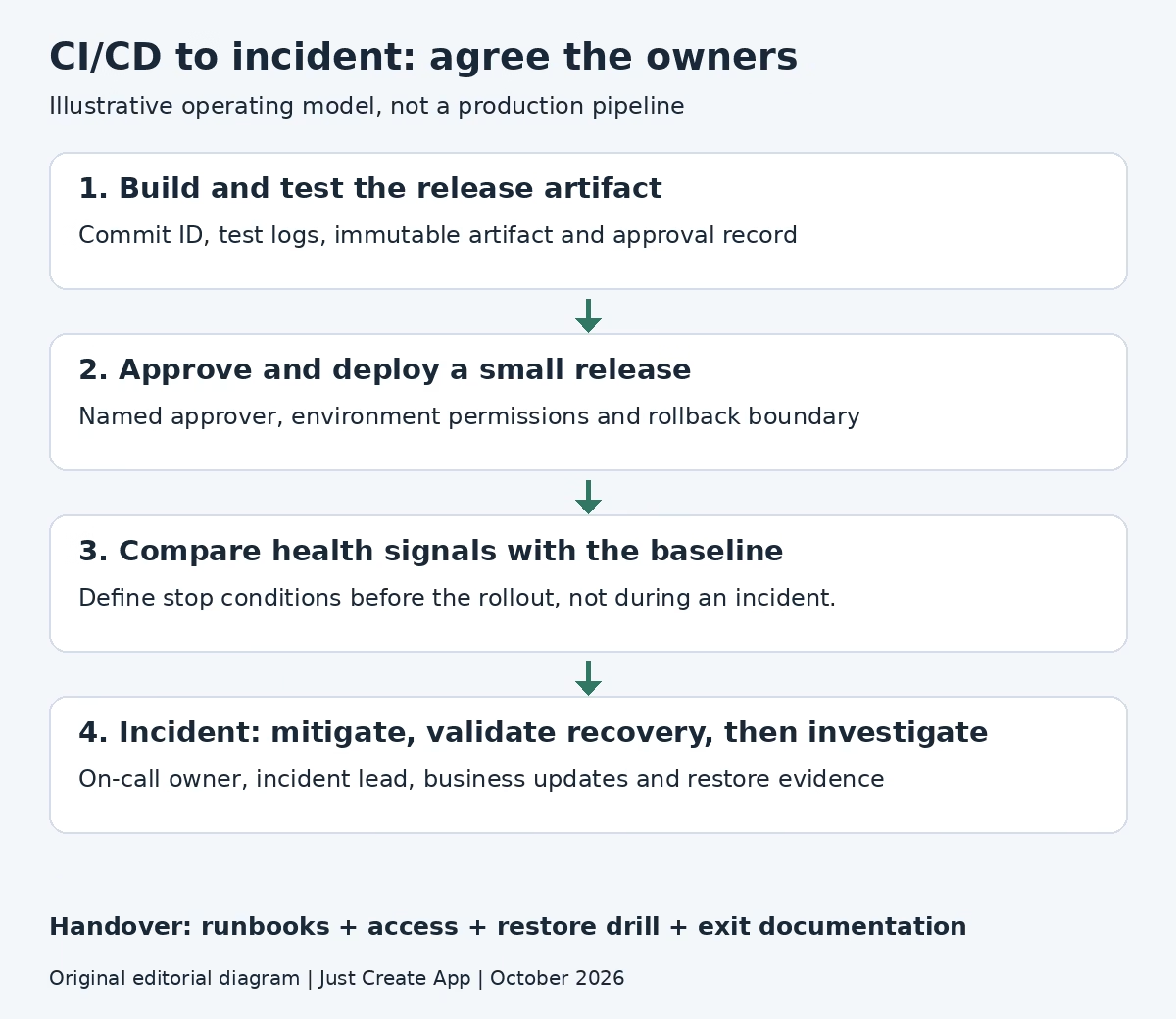
- Build an identifiable artifact and retain test logs.
- Name the release approver and restrict deployment access.
- Compare health signals with a baseline and define stop conditions.
- During an incident, name the on-call owner and incident lead. Mitigate impact, validate recovery and then investigate.
Sample acceptance scorecard: use evidence, not invented scores
This is an original procurement worksheet. No listed provider has been scored with it, and no production recovery drill was run for this article.
| Checkpoint | Artifact to inspect | Pass condition to agree |
|---|---|---|
| Deployment evidence | Dated run ID, commit and artifact identifier, actual test log | The agreed application builds and deploys repeatably in the specified environment; failures are recorded. |
| Change approval | Environment rules and an approval audit trail | Only authorized roles can approve or bypass a release, with the exceptions documented. |
| On-call ownership | Coverage roster, escalation test and incident communication plan | An alert reaches the agreed role; absence and handover are covered. Agree response separately from resolution. |
| Restore test | Non-production restore log, timestamps and data-validation result | Recovery meets the agreed recovery-time and recovery-point objectives. Merely having a backup is not a pass. |
| Exit readiness | Runbooks, repository access, infrastructure state and open-risk register | Your team can operate the system with the agreed access, without undocumented vendor-only accounts. |
A recovery drill you can put in the statement of work
Use a non-production environment and synthetic records. Record the service owner, approved drill window, baseline health, restore source and abort condition. Restore the selected artifact or backup, verify a representative customer flow and data integrity, record actual elapsed time and missing data, and compare them with the agreed objectives. A rollback that restores code may not reverse a database change. Require a separate data migration/recovery plan where needed.
Google’s incident-response guidance separates assessing impact, mitigating it, root-cause analysis and follow-up. Apply that distinction to the contract: who communicates with your business, who can take emergency action, and who writes and follows up the post-incident report?
Can one DevOps consultant provide 24/7 operations?
Do not assume it. An individual specialist can improve tooling or support a team, but continuous cover needs a roster, escalation and absence handling. Verify these in the engagement rather than relying on a DevOps job title.
Does a successful deployment prove disaster recovery?
No. Build/deployment, rollback and data restore are separate checks. Ask for actual restore results and data validation against your agreed objectives.
For local support and office responsibilities, compare the Chicago IT consulting guide; for legacy application cutovers, use the AngularJS migration evidence guide.
What is DevOps?
DevOps is a software development methodology that emphasizes communication, collaboration, and integration between software developers and information technology (IT) professionals.
The goal of DevOps is to improve the speed and quality of software delivery while also reducing the risk of software failures.
DevOps is a relatively new term, but it has its roots in the Agile software development methodology. Agile focuses on delivering working software quickly and efficiently. DevOps takes this a step further by also focusing on the operations side of things, such as infrastructure, monitoring, and security.
In order to achieve these goals, DevOps teams typically use automation to automate repetitive tasks and improve efficiencies. They also use data-driven insights to constantly optimize their processes.
Benefits of DevOps Consulting
DevOps helps in combining software development (Dev) and information-technology operations (Ops) to shorten the time it takes to deliver applications and services. Let’s look at the benefits of DevOps consulting:
- DevOps consulting fosters better collaboration between development and operations teams, leading to more efficient workflows.
- With DevOps practices, businesses can accelerate their product release cycle, bringing new features and products to market more quickly.
- Continuous integration and delivery, integral to DevOps, enhance the quality of software by enabling more frequent and thorough testing.
- Automation of repetitive tasks in the development process reduces human error and increases overall efficiency.
- Continuous deployment and faster updates in response to user feedback result in higher customer satisfaction and loyalty.
- Scalability and Reliability: DevOps consulting helps organizations build scalable and reliable systems, ensuring smooth handling of increased loads and user numbers.
If you want some core IT consultation you may check the list of IT consulting firms in Dallas.
DevOps consulting shortlist: nine current options and one historical entry
Many top DevOps consulting companies can help you with your digital transformation. Here are some of the best:
1. Squadex: historical entry, current service needs confirmation
The original Squadex link now serves a Provectus-branded page rather than a current Squadex service offering. Its working historical screenshot is retained below, but this is not a verified active standalone DevOps consultancy recommendation. If you previously used Squadex, confirm the present contracting entity and whether the team and services you need are still offered. Do not use an old company screenshot or directory entry as proof of current staffing, support or cloud partnerships. Compare a current proposal with the active providers below before putting this historical name on a procurement shortlist.

2. nClouds: AWS consulting and managed cloud
nClouds’ official consulting page describes AWS migration, infrastructure optimization, FinOps and DevOps work. It references named projects including Violet Grey and Woflow, giving buyers a starting point for checking AWS experience rather than relying on a generic cloud claim. It is most relevant when AWS architecture and operating support are central to the brief. Ask whether the proposal is a one-off migration, a continuing managed service or assistance to your internal platform team. Establish on-call cover, account access, incident responsibilities and ownership of infrastructure code. Do not assume the same depth on Azure or Google Cloud from an AWS-focused page.

3. CloudBees: governed software delivery and Jenkins
CloudBees is a software-delivery platform vendor, not simply an agency supplying generic DevOps engineers. Its public site describes governed delivery, Jenkins modernization and software-release controls, and names Acquia as a customer example. Consider it when the main problem is enterprise CI/CD governance, fragmented Jenkins environments or a platform deployment. Compare product licensing and implementation support separately. Ask which services are included, what runs in your environment and who will maintain pipelines after rollout. A platform can support controls, but it does not by itself establish your organization’s compliance or replace the operating team.

4. Vention (formerly iTechArt): engineering-led DevOps
The old iTechArt entry is now Vention. Its official rebrand announcement and current DevOps service page are the appropriate references for procurement. Vention describes strategy, CI/CD, cloud engineering and infrastructure automation across AWS, Azure and Google Cloud. Its Dialogue example discusses a multi-account AWS environment, making the page useful for buyers who want delivery evidence alongside service descriptions. It fits a broader software engineering engagement where application and deployment work must be coordinated. Ask for the proposed engineers, overlap hours, repository ownership and handover process. A vendor case study does not promise the same schedule or cost for another application.

5. Qentelli: enterprise delivery and quality engineering
Qentelli’s current IT and software page describes platform engineering, intelligent DevOps, quality engineering and observability. This is relevant when delivery bottlenecks involve both pipelines and the testing operating model, rather than infrastructure alone. Its published capability casebook offers a starting point for asking about performance engineering evidence. Confirm the cloud stack and proposed automation tools explicitly, since a broad enterprise service page is not a reference for every platform. Ask who owns test suites and pipeline code, how changes are measured, and what support continues after implementation. Avoid treating promotional release-velocity language as a guaranteed result.

6. Veritis: DevOps assessment and implementation
Veritis’ official DevOps page describes consulting, implementation, cloud-native automation and AWS services including CI/CD, ECS and EKS. It is worth comparing for an infrastructure and delivery-process project where the buyer wants a defined assessment followed by implementation. The service page is evidence of an offering, not independent proof of the percentage improvements promoted there. Request a relevant reference, the deliverables for each phase and the engineers responsible for security and operations. For continuing support, put response targets, exclusions, escalation and recovery testing into the contract rather than infer them from general transformation language.

7. IT Svit: cloud infrastructure and Kubernetes
IT Svit publishes DevOps project summaries covering containerization, Kubernetes, infrastructure and production support. Its site names Zebitex as an AWS infrastructure project and describes an analytics workload moving from Mesos to Kubernetes. These are useful evidence leads for a buyer with a cloud platform or container operations problem. Compare the specific stack and workload with your own instead of assuming any Kubernetes case is equivalent. Ask for the infrastructure-as-code handover, access-control design, monitoring ownership and support hours. Testimonials are vendor-published accounts of past engagements, not an uptime promise or assurance of future savings.

8. Aspired: remote DevOps staffing
Aspired’s official site offers remote teams and includes DevOps engineering among its hiring options. Its main fit is staffing: adding capacity to an internal engineering team rather than buying a fully specified transformation outcome. The buyer should assess the engineer who will actually be assigned, not just the agency’s broad hiring description. Ask about cloud experience, seniority, interview access, timezone overlap, replacement arrangements and who manages daily work. Keep architecture and production acceptance responsibilities explicit. The general remote-team page does not establish a managed incident service or a named DevOps case study for your cloud and industry.

9. Toptal: individual DevOps specialists
Toptal’s DevOps hiring page lists individual engineers, their cloud and infrastructure skills, and examples of project work. Its Bluedrop discussion describes database and infrastructure automation, giving a buyer a concrete question to use when vetting a candidate. This is a talent model, not automatically a managed service with a delivery manager or round-the-clock operations team. It can suit a smaller business needing a specialist for a bounded task or an enterprise adding capacity. Check the assigned individual’s experience, available overlap, documentation and knowledge transfer. Negotiate production responsibilities and continuity rather than assume they follow from marketplace screening.

10. Alpacked: DevOps and continuing operations
Alpacked’s DevOps page describes CI/CD, infrastructure as code, Kubernetes, cloud operations and monitoring. It also has a case-study section and names tools including Terraform, Jenkins and ArgoCD. Consider it when the brief spans deployment automation and ongoing infrastructure work, then confirm whether the engagement includes managed operations or only project implementation. For GitOps, ask how repository changes, approvals, secrets and rollback will be managed in your environment. Set measurable acceptance criteria and clarify access after handover. Tool lists and promotional efficiency claims are not evidence that your application will achieve a fixed reduction in cost or incidents.

Factors to Consider When Choosing a DevOps Consulting Company
- Their Expertise: Make sure that the company you are considering has experience with DevOps. You want to be sure that they understand the process and can help you implement it within your organization.
- Their Process: Take a look at how the company operates and what their process looks like. This will give you an idea of how they will work with you and whether or not they are a good fit for your needs.
- Their Communication: Good communication is essential when working with any type of consultant. You want to be sure that the company you choose is able to communicate effectively and keep you updated on their progress.
Types of Services Offered by DevOps Consulting Companies
The most common services offered by DevOps consulting companies include:
- Helping organizations transition to a DevOps culture and way of working;
- Providing training and coaching for both technical and non-technical staff on DevOps principles and practices;
- Assisting with the implementation of DevOps tools and technologies;
- Optimizing existing DevOps processes and tooling; and
- Providing expert advice on best practices for specific areas of DevOps, such as continuous integration/delivery (CI/CD), containerization, microservices, etc.
Conclusion
Choose a provider by delivery model, cloud fit and evidence, then compare written proposals for the same scope.
FAQ’s With Answers
DevOps is a term for a set of practices that combines software development (Dev) and information-technology operations (Ops) to shorten the systems development life cycle while delivering features, fixes, and updates frequently in close alignment with business objectives.
The main benefits of DevOps are:
-Increased Efficiency and Effectiveness
-Faster Time to Market
-Improved Customer Satisfaction
-Increased Employee Satisfaction and Collaboration
How did you choose these companies?
This is an editorial shortlist scored from public sources against a written rubric. We do not claim to have hired every firm, and rank is not for sale. Read how we rank companies.








Leave a Reply