





Telemedicine app development companies advertise software for video visits, messaging, monitoring and scheduling. This guide retains ten entries from an earlier shortlist, links current provider evidence where verified and clearly flags unresolved entries. It is a procurement guide, not a list of independently approved vendors.
The order is editorial, not a quality ranking. We have not hands-on tested any vendor. Company service and compliance statements are self-reported; current contracts and implementation evidence need separate review. No medical advice, clinical outcome, cost-saving or delivery guarantee is offered.
Telemedicine App Development Companies at a Glance
On a narrow screen, swipe the table horizontally to read all columns.
| Company | Fit |
|---|---|
| Topflight Apps | Dedicated telemedicine service; assess project requirements |
| Damco Solutions | Dedicated telehealth web/mobile service |
| Mindbowser | Patient/provider workflows and EHR integration |
| Arkenea | Healthcare scoping and custom development |
| Trembit | Video consultation and media integration |
| Lunka | Current services unverified |
| Riseapps | Published Kego virtual-clinic case |
| DICEUS | General software; telemedicine reference unverified |
| LeewayHertz | Current services unverified: homepage under construction |
| Glorium Technologies | Product development; verify telemedicine delivery |
This guide is about software procurement, not treatment, diagnosis or clinical triage. A service page is evidence of what a company advertises, not evidence that its implementation is safe, compliant or effective.
The Purpose of Telemedicine App Development:
Treat access, staff workflow and integration as project goals to measure, not guaranteed clinical or cost benefits. Topflight’s service description covers visit entry, video and record integration. Ask the care organization to define its own acceptance criteria.
- Define booking, patient/provider access and visit documentation requirements.
- Validate the approved record exchange with each EHR vendor.
- Measure usability, call completion and staff workflow with synthetic data before release. No treatment outcome or cost reduction is promised.
The process to Deliver a Telemedicine App:
The following is an editorial procurement checklist, not a fixed delivery schedule. Topflight describes discovery and prototypes before development; require a project-specific plan for your own scope.
- Agree the intended use, user roles, clinical owner and applicable requirements.
- Map data flows, integrations, vendor responsibilities and contract needs.
- Review prototypes with the care organization and intended users.
- Build, assess privacy/security and run documented accessibility/device tests.
- Retest defects, approve release and assign maintenance ownership.
What Drives Telemedicine App Development Cost?
Vendors price telehealth apps very differently, so treat any single price range with caution. Ask each company to quote the same scope in writing. The main cost drivers are:
- Visit type: ask vendors to price asynchronous messaging, live video and remote monitoring separately; each has different workflow and data requirements.
- Integrations: specify EHR read/write, e-prescribing, payments and insurance connections. Obtain vendor/API access and integration estimates rather than assuming one item always takes the most time.
- Applicable requirements: budget for privacy/security assessment, contractual work and accessibility tests; qualified reviewers must determine whether HIPAA or FDA requirements apply to the intended functions.
- Platforms: iOS, Android and a clinician web portal each add scope.
- Ongoing costs: hosting, video minutes, security reviews and maintenance after launch.
For wider budgets, see our healthcare software development cost guide.
Compliance Basics for Telehealth Apps
The HIPAA Security Rule concerns safeguards for electronic protected health information. HHS identifies covered entities and business associates as the entities subject to HIPAA; patient data alone does not settle those roles. A developer or service provider that creates, receives, maintains or transmits PHI on behalf of a covered entity may be a business associate. Have qualified counsel assess the roles and required agreements. FDA oversight depends on software function and risk, including whether a function meets the device definition and which oversight policy applies. Do not classify a whole app from a marketing label.
Telemedicine, Telehealth and Medical App Development: What Is the Difference?
For this buying guide, compare the actual functions rather than relying on category labels. Topflight and Mindbowser describe video visits, patient/provider workflows and EHR integration. A broader product may also include monitoring or other clinical systems; require an explicit scope and responsibility split.
- Pick a telemedicine specialist when video visits and clinician workflows are the core of the product.
- Pick a broader healthcare app development company when you also need EHR integration, patient portals or device data.
- Ask whether your app could count as a regulated medical device; the FDA page on device software functions explains how it looks at software functions.
Top 10 Telemedicine App Development Companies
1. Topflight Apps
- Website: topflightapps.com
Current official evidence: Topflight describes mobile/browser telemedicine delivery, video visits, scheduling and record integration using FHIR or HL7 where supported. Its service page describes discovery and prototypes before development. These are vendor statements, not a determination that a proposed product meets HIPAA or clinical requirements.
Procurement checks: Ask for the exact EHR/API access, integration scope, data-flow inventory, release acceptance evidence and maintenance responsibilities.
2. Damco Solutions
- Website: www.damcogroup.com
Current official evidence: Damco publishes a dedicated telehealth service page describing custom web/mobile applications, virtual visits, messaging and multi-channel communications. It advertises HIPAA-compliant delivery; that label requires project-specific evidence and qualified assessment.
Procurement checks: Ask which communication vendors/subcontractors are involved, which entity handles PHI and signs relevant agreements, and which comparable release the assigned team delivered.
3. Mindbowser
- Website: www.mindbowser.com
Current official evidence: Mindbowser describes patient, provider and clinic workflows, EHR integration, payments and remote monitoring on its dedicated telemedicine page. It publishes project examples. A vendor launch story or compliance claim is not a schedule or compliance guarantee for another organization.
Procurement checks: Request comparable workflow evidence, exact EHR integration permissions, code ownership and support scope.
4. Arkenea Inc
- Website: www.arkenea.com
Current official evidence: Arkenea describes healthcare-focused strategy, design, custom development and scaling, and lists telemedicine development. Its HIPAA language is a company claim; this guide does not certify its delivery or repeat historical location/team claims.
Procurement checks: Ask for comparable telemedicine references, the current assigned team and time-zone overlap, security/privacy evidence and delivery terms.
Also Read: Top 10 Best Healthcare Software Development Companies
5. Trembit
- Website: trembit.com
Current official evidence: Trembit has a dedicated telemedicine page covering video consultation, WebRTC/third-party video choices, EHR/EMR integration and interpretation work. Its broad HIPAA, GDPR and KBV language is provider marketing, not independent assessment of your proposed implementation.
Procurement checks: Request the exact component and media-routing design, supported devices, recording/retention choices and comparable implementation evidence.
6. Lunka
- Website: lunka.co
Current official evidence: Current services are unverified. Its official URL could not be retrieved during this source review. Earlier location, team and telemedicine assertions have been removed rather than treated as current facts. Retaining the historical entry does not make it a cleared recommendation.
Procurement checks: Verify the company identity, active website/contact, current team and a comparable telemedicine reference before shortlisting.
7. Riseapps
- Website: riseapps.co
Current official evidence: Riseapps publishes a Kego virtual-clinic case describing iOS, Android and web delivery, video, appointment management and documentation. Python, React, Redux and WebRTC are listed. Its “100% HIPAA” wording is not repeated as a legal or operational guarantee.
Procurement checks: Ask what the team built, the current release, role permissions, clinical-owner approval and third-party video/data responsibilities.
8. DICEUS
- Website: diceus.com
Current official evidence: DICEUS currently publishes custom software, web/mobile and insurance-software offerings. The reviewed homepage alone does not verify a comparable telemedicine implementation. Historical founding and healthcare-platform claims have been removed here.
Procurement checks: Require a current telemedicine reference, healthcare integration scope and named privacy/security responsibilities before considering it for a full telemedicine build.
9. LeewayHertz
- Website: www.leewayhertz.com
Current official evidence: The official homepage returned an “under construction” page during this review. Current telemedicine, AI-delivery and engagement claims therefore remain unverified. Earlier location, experience and client assertions are removed rather than used to recommend clinical AI features.
Procurement checks: Confirm the current company/contact and an actual telemedicine reference before shortlisting. Clinical AI intended use and safety require specialist assessment.
10. Glorium Technologies
- Website: gloriumtech.com
Current official evidence: Glorium publishes custom product development and team-based delivery options. It advertises security/quality standards and healthcare compliance. Those statements do not establish that a specific telemedicine release, contract or operation satisfies applicable requirements.
Procurement checks: Ask for a comparable telemedicine reference, the exact regulatory scope, security/privacy evidence, code/account handover and maintenance responsibilities.
How to Choose a Telemedicine App Development Company
- Ask for two telehealth references you can call, not only screenshots.
- Confirm who signs the business associate agreement and where patient data is stored.
- Ask which video, messaging and EHR integrations they have built before.
- Request a written quote for a defined scope, with maintenance priced separately.
- Agree who owns the source code and the cloud accounts at handover.
FAQs
This page retains ten entries from the earlier shortlist. Current dedicated telemedicine pages or cases are linked where verified. Lunka and LeewayHertz remain current-service-unverified; DICEUS needs a comparable telemedicine reference. The order is not a quality ranking.
It is a software company that builds video consultation, messaging, remote monitoring or scheduling apps for healthcare providers and digital health startups.
HIPAA applies to covered entities and business associates. Have qualified counsel determine the app operator and vendor roles, PHI handling and required safeguards/agreements for the actual arrangement. Patient data alone does not prove every consumer app is covered.
Cost depends on visit type, integrations, compliance work and platforms. Request written quotes for the same scope from several vendors.
Telemedicine provider evidence: workflow before a feature list
Checked October 4, 2026. These official pages describe different kinds of delivery evidence. They do not establish that a firm’s next implementation satisfies your clinical, privacy or accessibility requirements. The evidence grid is a starting point for discovery, not a compliance certification.
On a narrow screen, swipe the table horizontally to read all columns.
| Provider | Official evidence | What to validate |
|---|---|---|
| Topflight | Telemedicine service page describes mobile/browser delivery, video, scheduling and EHR integration using FHIR/HL7. | Exact EHR vendor/API, supported workflows, access permissions, integration ownership and downtime behavior. Protocol names do not prove an integration is available for your clinic. |
| Mindbowser | Dedicated service page describes patient/provider workflows, EHR integration and telemedicine project examples. | A comparable case, maintenance scope, actual release/test evidence and your organization’s BAA responsibilities. A rapid-launch case is not a delivery promise for your project. |
| Trembit | Telemedicine page focuses on real-time video/WebRTC, EHR integrations and medical interpretation work. | Supported devices, media routing, failover, interpreter access and the component supplied. Independently review broad HIPAA/GDPR/KBV claims instead of repeating “HIPAA certified”. |
| Riseapps | Kego virtual-clinic case identifies web/mobile delivery, video, appointments and documentation, with Python/React/WebRTC listed. | Current deployed release, role permissions, evidence of clinical workflow testing and third-party video responsibilities. The vendor’s “100% HIPAA” language is not an independent legal determination. |
Define the patient-to-clinician journey and its data boundaries
The following original diagrams use no patient records and describe an illustrative procurement workflow. They are not clinical advice or a reviewed system architecture. A qualified privacy/security reviewer and the care organization must validate the actual implementation.
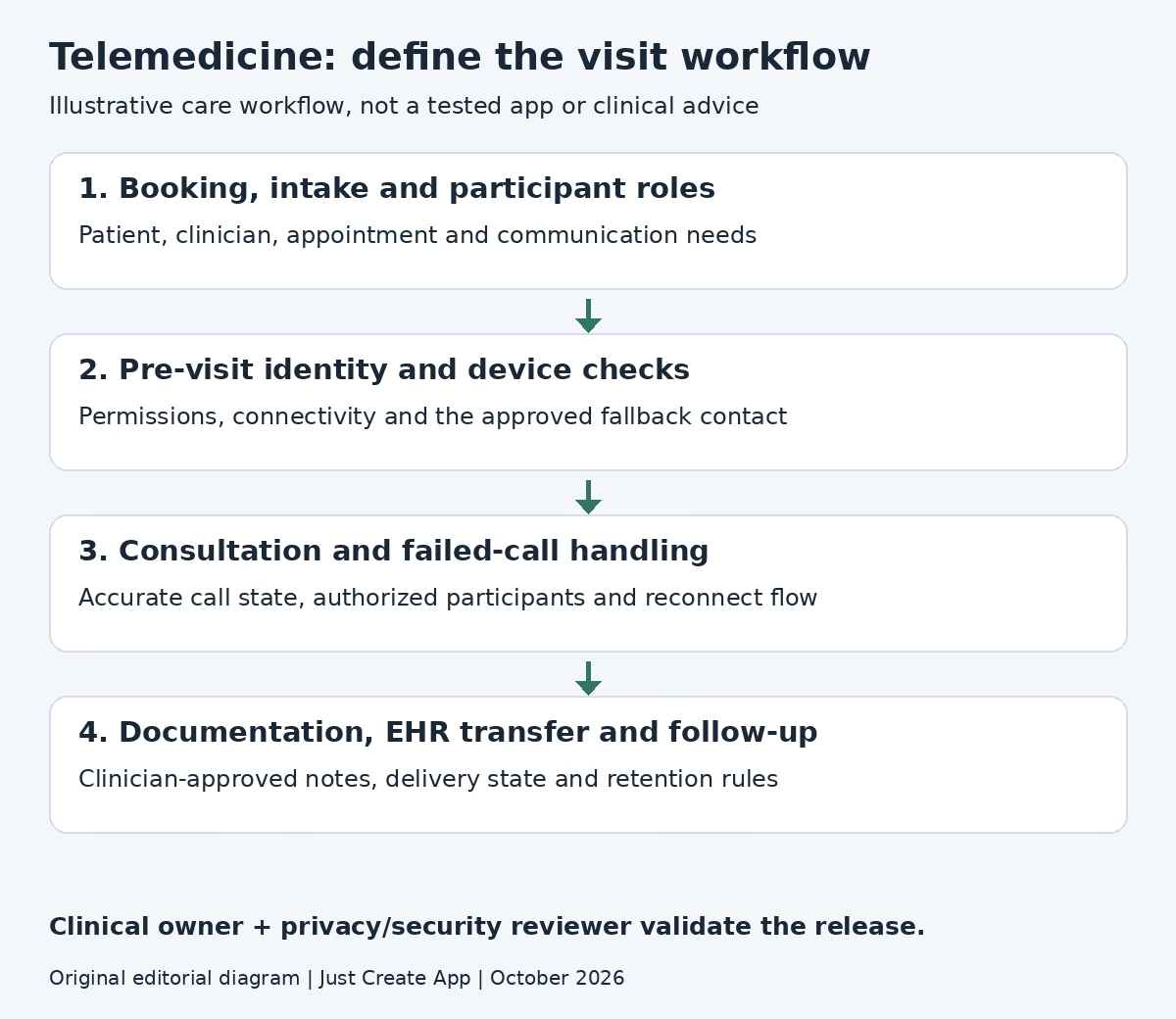
- Booking/intake: identify the appointment, patient, clinician and allowed participant roles; explain the session and accessibility needs.
- Pre-visit: test device permissions and connectivity, confirm authorized participants and establish the approved fallback contact method.
- Consultation: apply role permissions, show call status and manage reconnect/failure without silently losing visit context.
- After the visit: complete clinician-approved documentation and follow-up, track EHR delivery and apply the approved retention/access policy.
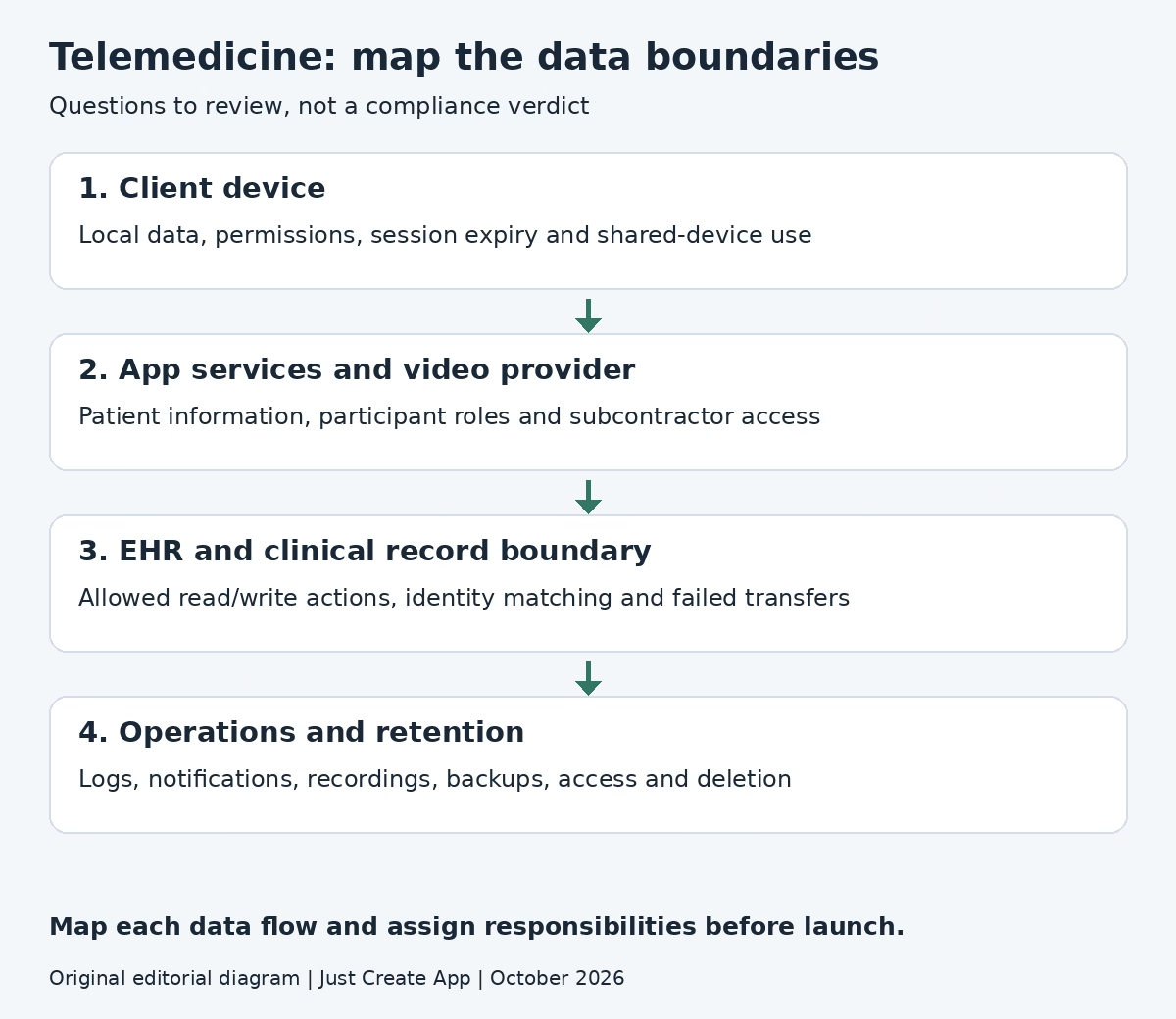
- Client device: identify local data, camera/microphone permissions, session expiry and shared-device behavior.
- App/video services: map which party creates, receives, maintains or transmits patient information, including subcontractors.
- EHR boundary: define allowed read/write operations, identity matching, retry and reconciliation when a transfer fails.
- Operations: define what enters logs, notifications, recordings and backups, who can access it and how deletion/retention is applied.
US HIPAA obligations are not a universal app label
HHS telehealth guidance says covered providers and plans must use appropriate technology vendors and enter HIPAA business associate agreements for relevant telehealth technologies. HHS business-associate guidance explains the roles of app developers, cloud services and maintenance providers handling PHI, as well as downstream subcontractor agreements. Have qualified counsel/privacy specialists determine the applicable roles, contracts and duties for your arrangement.
HIPAA is a US framework, not proof of compliance with another jurisdiction’s health/privacy rules. Identify where the care organization, patients, staff and data processing are located before choosing requirements. A vendor’s compliance marketing, an encrypted video call or a signed BAA alone does not prove the whole product and its operation comply.
Failed-call handling belongs in the clinical workflow
For a synthetic test visit, interrupt connectivity and deny a device permission. Check that patient and clinician see an accurate status, can follow the care organization’s approved fallback process, and do not create duplicate appointments or conflicting notes. Let the clinical owner define escalation and urgency handling; do not let the development team invent a clinical triage policy. Reconnection should not grant access to an unauthorized participant.
An accessibility and device test protocol to run before release
This is a test protocol, not a completed test report. Use synthetic patients and approved devices. Keep exact browser/OS/app versions, steps, expected results, observed results, screenshots with no identifiers, defects and retest status.
On a narrow screen, swipe the table horizontally to read all columns.
| Test | Evidence to keep |
|---|---|
| Booking and joining by keyboard/screen reader | Focus order, control names, errors, timeout behavior and an actual recorded pass/failure on the agreed assistive technology. |
| Camera/microphone denied; low-bandwidth call; device rotation | Visible state, error guidance, reconnect/fallback behavior and clinician-approved visit continuation. |
| Interpreter or caregiver access | Role authorization, participant visibility, removal and rejoin behavior. No accidental access to unrelated records. |
| EHR unavailable or duplicate request | Retry/reconciliation record and assurance that the approved note/patient identity is not silently duplicated or mismatched. |
| Retention and operational logs | Reviewer-approved inventory of recordings, notifications, logs and backups, with permitted access and retention/deletion evidence. |
WCAG 2.2 supplies accessibility criteria to assess. Its live-caption guidance distinguishes broadcasts from two-way calls; do not claim that this one criterion universally requires every video call to be captioned. Determine communication accommodations with the care organization and applicable obligations, and test the chosen implementation with users.
Does “HIPAA certified” settle the hiring decision?
No. Request the actual scope and evidence behind any claim, then have qualified reviewers assess your data flows, contracts and operation. Do not replace that work with a badge or a promise.
What should the maintenance agreement cover?
Assigned support, security/dependency updates, device/browser changes, EHR/API changes, incident communication, access review and evidence retention. Agree responsibilities and exclusions before the care organization relies on the service.








Leave a Reply