


Last updated: October 2026.
Welcome to JCA’s guide to the top supply chain companies in 2026. Whether you are searching for the best supply chain companies to learn from, the biggest global supply chain operators, the leading supply chain management software platforms, or a logistics partner for your own business, this list covers all three worlds in one place. We profile 28 companies in depth – 16 global companies with the best supply chains, 8 top supply chain management software companies, and 4 leading logistics and 3PL providers – followed by more supply chain leaders worth watching from our extended research.
Every company profile includes its official website, what its supply chain is known for, and a current look at the company itself. If you are benchmarking your own operation, our guides to inventory metrics and KPIs every manager should monitor and the top USA logistics trends pair well with this list.
Top supply chain companies at a glance
The table below compares all 28 profiled supply chain companies by category, what each supply chain is known for, and who it is best suited for.
| Company | Category | Supply chain known for | Best for |
|---|---|---|---|
| Cisco Systems | Operator | Networking and IT infrastructure with a famously resilient multi-tier supplier network | Electronics and networking supply chain design |
| Colgate-Palmolive | Operator | Consumer goods supply chain running since 1806 | High-volume consumer goods distribution |
| Schneider Electric | Operator | Energy technology with a repeatedly top-ranked supply chain | Sustainable industrial supply chains |
| Johnson & Johnson | Operator | Healthcare supply chain at global scale | Regulated healthcare logistics |
| Nestle | Operator | World’s largest food company supply chain | Food and beverage sourcing at scale |
| PepsiCo | Operator | Integrated snack and beverage supply chain | Direct-store-delivery networks |
| Intel | Operator | Semiconductor manufacturing supply chain | Complex capital-intensive manufacturing |
| L’Oreal | Operator | Beauty industry supply chain agility | Fast-moving consumer beauty operations |
| Alibaba Group | Operator | E-commerce and cross-border logistics ecosystem | Cross-border e-commerce supply chains |
| Walmart | Operator | World’s largest retail supply chain | Retail distribution and replenishment |
| Apple | Operator | Most-admired electronics supply chain | Global electronics sourcing and assembly |
| Amazon | Operator | E-commerce fulfillment and last-mile network | Fast delivery fulfillment operations |
| Procter & Gamble | Operator | Consumer staples supply chain mastery | Daily-essentials category management |
| Unilever | Operator | 3.7 billion daily users served | Emerging-market distribution reach |
| McDonald’s | Operator | Restaurant supply chain consistency | Food service quality at scale |
| Nike | Operator | Outsourced manufacturing supply chain model | Contract-manufacturing orchestration |
| SAP | Software | Full-suite SCM inside the world’s largest ERP ecosystem | Enterprises standardizing on SAP |
| Oracle | Software | Cloud-native SCM suite with embedded AI | Companies wanting one cloud suite |
| Blue Yonder | Software | AI-driven end-to-end supply chain platform | Retail and manufacturing planning depth |
| Kinaxis | Software | Concurrent planning pioneer | Real-time scenario planning |
| o9 Solutions | Software | AI-powered integrated business planning | Digital planning transformations |
| Manhattan Associates | Software | Warehouse and omnichannel execution leader | Distribution center operations |
| Infor | Software | Industry-specific cloud SCM | Manufacturing and distribution verticals |
| E2open | Software | Connected multi-enterprise supply chain network | Partner-network orchestration |
| DHL | Logistics/3PL | World’s leading logistics company | International shipping and contract logistics |
| Ryder | Logistics/3PL | North American 3PL and fleet giant | Dedicated fleets and warehousing |
| Flexport | Logistics/3PL | Tech-first freight forwarder | Digital freight and customs |
| Landstar | Logistics/3PL | Agent-based freight network | Specialized and truckload freight |
Global companies with the best supply chains
These 16 global companies run the most-admired physical supply chains in the world – the operators that manufacture, source and move real products at massive scale. Several of them rely on IoT in industrial automation and connected factories to keep goods flowing through disruption.
1. Cisco Systems

Official website: cisco.com
Cisco builds the networking hardware and software that much of the internet runs on, and its own supply chain is studied for how it handled repeated global disruptions without stopping shipments. The company works with hundreds of suppliers and manufacturing partners across a multi-tier network and holds them to published responsibility standards. Cisco has committed to reaching net-zero greenhouse gas emissions across its entire value chain by 2040, with a near-term goal of cutting absolute Scope 3 emissions from purchased goods, upstream transportation and sold-product use by 30% by fiscal 2030 against a fiscal 2019 baseline. Its supply chain operations team pairs digital risk monitoring with diversified sourcing, so when one region or component line is hit, production routes around it. For businesses studying how a hardware company keeps product flowing through shocks, Cisco is a reference case.
2. Colgate-Palmolive

Official website: colgatepalmolive.com
Colgate-Palmolive has been making and moving consumer products since 1806, and today sells oral care, personal care, home care and pet nutrition products in more than 200 countries and territories. Running a supply chain at that scale means coordinating raw material sourcing, manufacturing plants and distribution networks across nearly every market on earth. The company ties supplier relationships to its sustainability agenda, with programs covering responsible sourcing of palm oil and other forest-risk commodities, traceability, and supplier climate commitments. Its supply chain teams manage the flow of everyday essentials – toothpaste, soap, pet food – that retailers depend on for consistent shelf availability. Colgate-Palmolive is a strong example of how a legacy consumer goods company keeps a two-century-old supply operation modern, ethical and reliable.
3. Schneider Electric

Official website: se.com
Schneider Electric is a global energy technology company employing around 160,000 people and working with roughly one million partners in more than 100 countries, generating about EUR 40 billion in 2025 revenue. Its supply chain is regularly cited among the strongest in the world for combining resilience with decarbonization. Schneider runs a multi-year supply chain transformation program built on four pillars: people, digitization, sustainability and a regionalized network of smart factories and distribution centers. The company digitized its planning and logistics so it can see and rebalance flows in near real time, and it requires suppliers to commit to its own decarbonization targets. For manufacturers that want a supply chain which is both greener and harder to break, Schneider Electric is the operator to study.
4. Johnson & Johnson

Official website: jnj.com
Johnson & Johnson is the world’s largest and most broadly based healthcare company, with roughly 140,000 employees developing medicines, medical technology and consumer health products since 1886. Its supply chain has to meet a bar most industries never face: pharmaceutical-grade quality control, cold-chain handling, strict regulatory documentation and zero-tolerance delivery reliability for hospitals and patients. J&J coordinates a global manufacturing network and supplier base under those rules while also pushing digitization – using track-and-trace, advanced planning systems and automation across its plants and distribution centers. The company publishes supplier sustainability and human-rights standards and audits against them. For anyone looking at how to run a supply chain where a late or compromised shipment is a health risk, J&J is a leading example.
5. Nestle

Official website: nestle.com
Nestle is the biggest food and beverage company in the world, with around 271,000 employees, more than 30 billionaire brands and a presence in 185 countries. Its supply chain starts far upstream – with hundreds of thousands of farmers – which is why Nestle invests heavily in traceability and responsible sourcing programs for cocoa, coffee, dairy and palm oil. The company maps its supply chains back to origin, works directly with farming communities on sustainable practices, and publishes progress against deforestation-free and regenerative agriculture commitments. Downstream, it runs a global manufacturing and distribution network built for daily shelf availability of perishable and packaged goods. Nestle shows what responsible sourcing looks like when your ingredient supply chain spans nearly every agricultural region on the planet.
6. PepsiCo

Official website: pepsico.com
PepsiCo generated nearly $94 billion in net revenue in 2025, and its products are enjoyed by consumers more than one billion times a day in more than 200 countries and territories. Behind that is one of the most sophisticated route-to-market systems anywhere: a mix of direct-store-delivery, warehouse distribution and bottler networks tuned by product and region. PepsiCo runs its own agriculture supply chain too, sourcing potatoes, oats, corn and citrus from farmers worldwide, and applies precision-agriculture and water-stewardship programs upstream. Its pep+ (PepsiCo Positive) agenda ties supply chain transformation to regenerative farming, net-zero and packaging goals. PepsiCo is a textbook case of a company that treats its supply chain – from farm to store shelf – as its core competitive advantage rather than a cost center.
7. Intel

Official website: intel.com
Intel designs and manufactures semiconductors – some of the most complex products humans make – and its Intel Foundry business is the only U.S.-headquartered leading-edge chip foundry, combining chip design, manufacturing and advanced packaging at global scale. A single chip can cross international borders dozens of times before it ships, so Intel’s supply chain orchestrates wafer fabrication, assembly, test and logistics across a tightly controlled global network. The company also runs one of the industry’s longest-standing responsible-minerals programs, surveying suppliers and requiring smelters to conform to responsible-sourcing assurance processes. Its multi-billion-dollar investments in new U.S. and European fabs are reshaping semiconductor supply resilience. For understanding how the chip supply chain actually works, Intel is the essential case.
8. L’Oreal

Official website: loreal.com
L’Oreal has been the world’s leading beauty company since its founding in 1909, selling products in more than 150 countries across skincare, makeup, haircare and fragrance. Beauty is a trend-driven business where a viral product can see demand spike overnight, so L’Oreal built a supply chain around agility: regional manufacturing, demand sensing, and fulfillment operations designed to handle everything from mass retail to e-commerce single-unit orders. The company pairs that operational speed with strong sustainability commitments through its L’Oreal for the Future program, which sets science-based targets for climate, water, biodiversity and packaging across its whole value chain. It also invests in Beauty Tech – AI shade matching, personalized products – which pushes even more demand variability onto its supply chain, and it absorbs it.
9. Alibaba Group

Official website: alibabagroup.com
Alibaba Group runs some of the world’s largest e-commerce marketplaces, and its logistics arm Cainiao – established in 2013 – operates a smart logistics network spanning more than 200 countries and regions. Cainiao is a top e-commerce supply chain solution provider and the largest cross-border e-commerce logistics provider, handling everything from international line-haul and customs to last-mile delivery and the largest reverse-logistics operation of its kind. Alibaba’s supply chain capability is what lets a small manufacturer in one country sell directly to consumers across the globe with tracked, reliable delivery. The group is led by chairman Joseph Tsai and CEO Eddie Wu, and continues to invest in automated warehouses, smart routing and AI-driven logistics. For cross-border commerce, Alibaba’s ecosystem is unmatched in reach.
10. Walmart

Official website: corporate.walmart.com
Walmart serves approximately 280 million customers and members each week across more than 10,900 stores and numerous eCommerce websites in 19 countries – and its global supply chain moves more than 100 billion items per year. Walmart essentially invented modern retail logistics: hub-and-spoke distribution centers, cross-docking, its own private fleet, and inventory systems that keep shelves stocked at unmatched cost efficiency. Today it layers automation onto that foundation – automated fulfillment centers, supply chain software it now sells to other businesses, and drone delivery pilots. Around 75% of its U.S. salaried store, club and supply chain managers started as hourly associates, which keeps operational knowledge deep. Walmart’s supply chain remains the benchmark every other retailer measures itself against.
11. Apple
Official website: apple.com
Apple designs its products in California and coordinates one of the most sophisticated supply chains ever built: thousands of supplier facilities in more than 60 countries feeding components into assembly operations that ship hundreds of millions of devices. Its supplier responsibility program is one of the most rigorous in any industry – suppliers must meet strict labor, safety and environmental standards, and Apple has trained millions of supplier employees on their workplace rights since 2008. On materials, 30% of the materials by weight used in its products came from recycled or renewable sources in 2025, part of its Apple 2030 carbon-neutrality plan. Apple’s ability to launch complex products at enormous scale, on a fixed date, year after year, is a supply chain achievement few companies on earth could repeat.
12. Amazon
Official website: aboutamazon.com
Amazon turned logistics from a support function into the core of its business. Its operations span a global network of fulfillment centers, sortation hubs and delivery stations, plus its own air fleet and one of the largest last-mile delivery networks in retail – the infrastructure behind Prime one-day and same-day shipping. Amazon deploys hundreds of thousands of robots across its fulfillment centers and keeps investing heavily in its fulfillment and transportation workforce and technology. The same network also powers Fulfillment by Amazon, which lets millions of third-party sellers plug into Amazon’s warehousing and delivery machine. For pure speed and scale of getting a package from a click to a doorstep, Amazon’s supply chain is the one every e-commerce company studies.
13. Procter & Gamble
Official website: us.pg.com
Procter & Gamble has been making daily-use products since 1837, with net sales of $84.3 billion in fiscal 2025 and products sold in more than 180 countries. P&G’s supply chain is built for a special kind of pressure: products like detergent, diapers and shampoo that consumers expect to find in stock every single day, everywhere. The company runs synchronized supply networks with real-time demand data flowing from retail partners, highly automated plants, and distribution systems tuned for both big-box replenishment and e-commerce. P&G pairs this with ambitious environmental targets across its operations and supply chain. Decades of top-tier supply chain performance are a big part of why P&G’s brands hold their shelf positions – reliability is the brand promise as much as the product.
14. Unilever

Official website: unilever.com
Unilever’s products are used by 3.7 billion people every day, its brands are available in 190 countries, and it turned over EUR 50.5 billion in 2025 with 59% of that in emerging markets. Reaching consumers in places where infrastructure is thin is a supply chain discipline of its own, and Unilever has spent decades building distribution that reaches small shops and rural markets competitors struggle to serve. The company has also embedded sustainability deep into its supply base, with long-running programs for sustainable sourcing of palm oil, tea and other agricultural inputs, plus commitments on deforestation-free supply chains and supplier climate action. Unilever demonstrates how a supply chain built for reach can also be a supply chain built for responsibility.
15. McDonald’s

Official website: mcdonalds.com
McDonald’s serves tens of millions of customers daily across more than 36,000 restaurants in over 100 countries – and a burger in Tokyo tastes like a burger in Texas because of its supply chain. The company runs one of the world’s most consistent food supply systems: approved suppliers held to uniform global quality and safety specifications, dedicated distribution partners, and cold-chain logistics that deliver identical ingredients to every restaurant. Its famous three-legged stool model – company, franchisees and suppliers – aligns incentives across the whole chain. McDonald’s also pushes its Scale for Good agenda into sourcing, with commitments on sustainable beef, cage-free eggs and packaging. When people talk about supply chain consistency as a brand moat, McDonald’s is the classic example.
16. Nike

Official website: about.nike.com
Nike pioneered the model of designing and marketing products while contracting manufacturing to a global network of partner factories – a structure now standard across apparel and footwear. Co-founded by Phil Knight and Bill Bowerman more than 50 years ago, the company manages hundreds of contract factories and material suppliers worldwide, coordinating product creation from design to shelf through its own supply chain technology and planning teams. Nike publishes its factory list and holds contract manufacturers to a detailed code of conduct covering labor, health, safety and environment, with regular audits. Its Move to Zero initiative pushes carbon and waste targets through the supply base. Nike’s chain shows both the power and the responsibility that come with running a fully outsourced global manufacturing model.
Top supply chain management software companies
Not every supply chain leader moves boxes – some move data. These 8 companies build the supply chain management software that plans, orchestrates and automates the networks above. If you are weighing a platform against a custom build, see our takes on the benefits of an ERP system, ERP and business intelligence, the benefits of implementing ERP systems in the logistics industry, and the top enterprise software development companies and ERP software development companies that build them. AI is reshaping this category fast – our piece on how AI is revolutionizing different industries gives the wider picture.
17. SAP

Official website: sap.com
SAP is a global leader in enterprise applications and business AI with more than 50 years of history, EUR 36.8 billion in total revenue (non-IFRS) in FY2025, and employees from more than 157 countries. Its supply chain portfolio – SAP Integrated Business Planning, SAP S/4HANA supply chain modules, and the SAP Business Network – covers planning, procurement, manufacturing, logistics and asset management in one connected stack. Because hundreds of thousands of enterprises already run finance and operations on SAP, its SCM tools plug into data companies already have, which shortens implementation and improves planning accuracy. Recent releases push toward autonomous supply chains, where AI agents recommend and execute planning decisions. For enterprises already living in the SAP ecosystem, its SCM suite is the natural choice.
18. Oracle

Official website: oracle.com
Oracle delivered $57 billion in revenue in FY2025 with 141,000 employees, and its Fusion Cloud Supply Chain and Manufacturing suite is one of the two dominant enterprise SCM platforms. Oracle Cloud SCM covers planning, procurement, manufacturing, inventory, order management and logistics as a single cloud suite, with AI features for demand forecasting, supply planning and anomaly detection built in rather than bolted on. Oracle updates the suite quarterly, so customers get new capabilities continuously instead of through painful upgrades. Its SCM suite also connects natively with Oracle’s ERP and CX clouds, giving companies one data model from order to delivery. For organizations that want an integrated cloud supply chain platform with rapid innovation cadence, Oracle is a top contender.
19. Blue Yonder

Official website: blueyonder.com
Blue Yonder is the world leader in digital supply chain transformation, and retailers, manufacturers and logistics service providers worldwide rely on it to optimize their supply chain from planning through fulfillment, delivery and returns. Its AI-driven platform and multi-enterprise, multi-tier network enable more accurate forecasting and dynamic management of capacity, inventory and transport. Blue Yonder has close to 40 years of successful customer engagements behind it, and it has pushed hard into cognitive, real-time supply chains – a single trusted view of supply and demand that lets companies sense disruption and respond fast. It is especially strong in retail, where its merchandise and supply planning tools run some of the world’s largest store networks. For planning depth, Blue Yonder is a category benchmark.
20. Kinaxis
Official website: kinaxis.com
Kinaxis has been revolutionizing supply chain management for more than three decades from its Ottawa, Canada headquarters, and its Maestro platform (long known as RapidResponse) is built around one idea: concurrent planning. Instead of running separate, sequential plans for demand, supply and inventory, Kinaxis lets every part of the plan update instantly when anything changes, so planners see the full impact of a decision in seconds. That architecture makes it a favorite for complex manufacturers in high-tech, automotive, aerospace, life sciences and consumer goods, where volatility is constant. The company has layered AI and machine learning onto the platform for demand sensing and automation, while keeping its signature what-if scenario speed. For companies that live in spreadsheets because their planning tools are too slow, Kinaxis is the answer.
21. o9 Solutions

Official website: o9solutions.com
o9 Solutions was founded by tech entrepreneurs Sanjiv Sidhu and Chakri Gottemukkala, who built their track record delivering innovative supply chain planning software to global companies. Its Digital Brain platform gives enterprises a single AI-powered platform for demand, supply, revenue and integrated business planning, replacing fragmented legacy tools and spreadsheets. o9 has grown into one of the most-valued independent planning software companies, winning large transformation deals against long-established rivals, and its clients span retail, consumer goods, manufacturing and high-tech, including multiple $1B+ revenue value cases. The platform’s knowledge-graph approach models the entire supply chain so companies can simulate decisions before making them. For organizations planning a full digital supply chain transformation, o9 is one of the strongest modern platforms.
22. Manhattan Associates

Official website: manh.com
Manhattan Associates has been supply chain commerce software since 1990 – publicly traded, debt-free, with more than 1,200 customers and 4,500 associates worldwide. Where planning vendors optimize decisions, Manhattan optimizes execution: its warehouse management, transportation management and omnichannel order systems run the physical movement of goods through distribution centers and stores for global brands. Its Manhattan Active platform is fully cloud-native and microservices-based, so every customer is always on the latest version with no upgrades. The company invests heavily in AI, machine learning and robotics integration for warehouse automation, and its order orchestration connects over 2 billion people to over 20 billion consumer choices. For companies whose bottleneck is warehouse and fulfillment performance, Manhattan Associates is the specialist.
23. Infor

Official website: infor.com
Infor is a global leader in business cloud software for industry-specific markets, with more than 60,000 organizations – including 15,000+ cloud customers – relying on it worldwide. Rather than selling one generic suite, Infor builds complete industry CloudSuites: supply chain capabilities come pre-configured for manufacturing, distribution, food and beverage, healthcare and other verticals, which cuts customization time and cost. Its supply chain portfolio covers planning, procurement, warehouse management, transportation and supply chain visibility, all running on its cloud platform with embedded data science and process intelligence. Infor’s October 2025-era releases added governed AI agents that turn insight into automated action across operations. For mid-market and enterprise companies in asset-intensive industries, Infor’s vertical depth is its edge.
24. E2open

Official website: e2open.com
E2open runs a connected supply chain platform that helps the world’s largest companies transform how they make, move and sell goods and services. Its distinguishing strength is the network: E2open connects hundreds of thousands of trading partners – suppliers, contract manufacturers, logistics providers and customers – onto one platform, so companies can see and manage their extended supply chain end-to-end, not just their own four walls. Its applications span demand and supply planning, global trade and customs compliance, transportation, and channel management. As supply chains rely on ever more external partners, that multi-tier visibility matters: E2open lets a brand respond to a supplier’s supplier having a problem before it becomes their own shortage. For partner-network complexity, E2open is built for it.
Top logistics and supply chain services companies
These 4 logistics and 3PL companies run supply chains as a service – freight, warehousing, fulfillment and delivery on behalf of other businesses. For more in this space, see our list of the top logistics automation companies.
25. DHL

Official website: dhl.com
DHL is the world’s leading logistics company: 584,000 people in more than 220 countries and territories, generating EUR 82.9 billion in revenue in 2025. Founded in 1969, it grew from international document delivery into a full-spectrum logistics group covering express parcels, air and ocean freight, road transport, e-commerce logistics and contract supply chain management through DHL Supply Chain, one of the largest contract logistics providers on earth. Its Strategy 2030 program doubles down on quality, e-commerce and digitalization, including heavy investment in warehouse automation and data-driven logistics. DHL also runs serious green logistics programs with a 2050 net-zero target. Whether a business needs a single parcel delivered overseas or a fully outsourced supply chain, DHL has a division built for it.
26. Ryder

Official website: ryder.com
Ryder is a third-party logistics provider working behind the scenes for companies from emerging retailers to some of the world’s best-known brands, covering the entire supply chain from port to door: warehouse management, distribution, e-commerce fulfillment, managed transportation, last-mile delivery, freight brokerage, truck leasing and rental, and maintenance. Its numbers are massive – approximately 240,000 vehicles under management, around 320 warehouses, and more than 100 million square feet of warehouse space across the United States, Mexico and Canada. Ryder pairs that physical scale with proprietary technology platforms for visibility and orchestration, plus a growing e-commerce fulfillment network. For companies that want one partner to run trucks, warehouses and delivery in North America, Ryder is the established choice.
27. Flexport
Official website: flexport.com
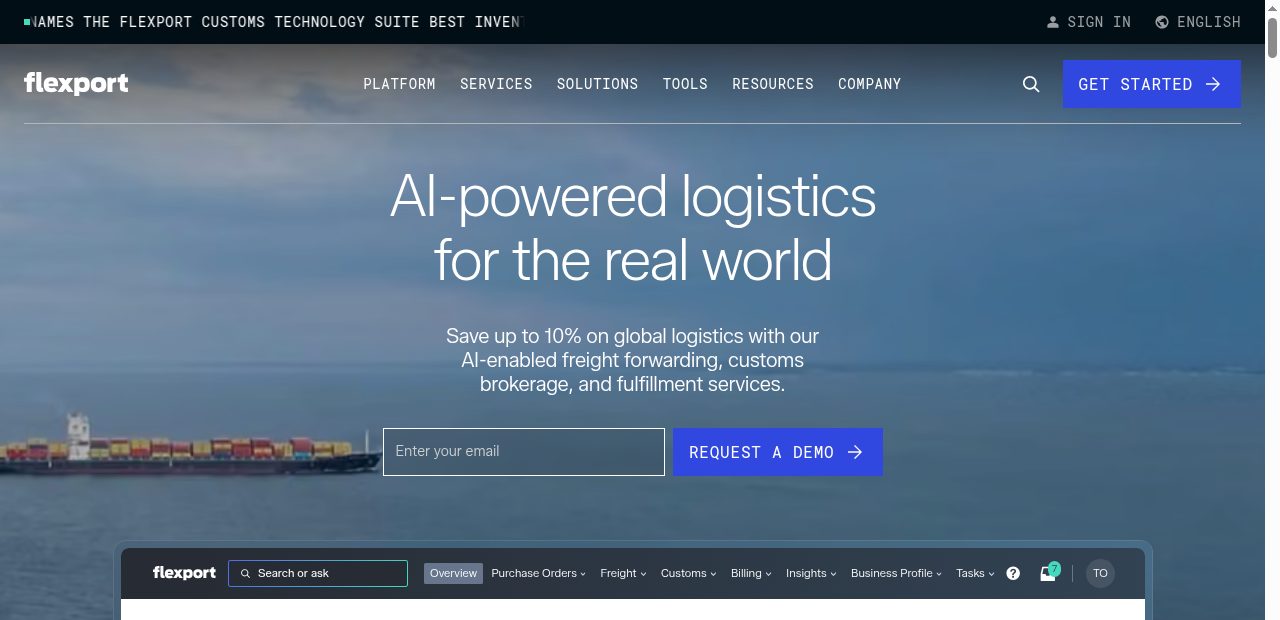
Flexport is a leading freight forwarder, customs broker and fulfillment provider moving goods across 135 countries, combining freight, fulfillment, customs and financing on one platform. It built its name by making global trade – notoriously paper-driven and opaque – digital: real-time shipment visibility from origin to final delivery, online quoting and booking, and integrations with ERPs and e-commerce marketplaces. Its AI operating system runs on deep historical trade data, and the company reports customers hitting 99% final-mile and 95% global-mile on-time delivery, recovering over $1 billion in duty drawback and tariff savings, and saving an average of 10% on freight costs. For importers and e-commerce brands that want a modern, data-rich freight partner, Flexport is the disruptor that became an establishment player.
28. Landstar

Official website: landstar.com
Landstar runs a different logistics model: instead of owning giant fleets, it operates a network of independent agents and capacity providers – thousands of owner-operators and broker carriers – coordinated through Landstar’s systems, technology and safety programs. That structure gives it unusual flexibility: it can flex capacity up and down with customer demand and handle specialized, heavy or unusual freight that rigid carriers struggle with, across truckload, LTL, expedited, heavy-haul and intermodal services in North America plus global air and ocean. Landstar is a safety-first company with strict operator qualification requirements, and its proprietary technology and mobile apps make it a leader in digital freight management rather than mere load matching. For shippers with variable or specialized freight, Landstar’s network model is the fit.
More supply chain leaders worth watching
Our extended research covers more businesses with noteworthy supply chain operations beyond the 28 in-depth profiles above. These companies remain relevant names in global supply chain discussions, grouped by what they do:
- Consumer, food and retail: Coca-Cola, Diageo, General Mills, Starbucks, Inditex (Zara), Toyota, BMW, British American Tobacco
- Technology and industrial: Microsoft, Lenovo, HP, Dell, Samsung Electronics, TSMC, Siemens, Northrop Grumman, Lockheed Martin
- Pharmaceutical: Pfizer, AbbVie, AstraZeneca, Bristol Myers Squibb
- Logistics and delivery: Stord, DoorDash, Echo Global Logistics, Coyote Logistics (now part of RXO following its 2024 acquisition)
- Supply chain advisory: Deloitte, whose supply chain and network operations practice advises enterprises on designing and transforming their supply chains
How to choose the right supply chain company for your business
The right pick depends on which of the three categories your need falls into. If you are benchmarking your own operations, study the operators – Walmart for retail distribution, Schneider Electric for sustainable industrial networks, Apple for orchestrated global sourcing. If you need technology, shortlist two or three software vendors above and run a structured evaluation; companies with unique workflows often compare platforms against building custom logistics management software. If you need someone to physically run freight or warehousing, the logistics and 3PL providers are your category.
Whichever route you take, evaluate candidates on network visibility (can you see every tier and shipment?), integration with your existing systems, resilience track record, sustainability commitments, and total cost of ownership – not just license or freight rates. Tools like warehouse optimization software and real-time fleet technology can also close gaps without a full platform switch, and connected-sensor programs – see the benefits of using IoT for business – increasingly sit underneath all of it.
Frequently asked questions
Which company has the best supply chain in the world?
There is no single official ranking, but Schneider Electric, Cisco, Colgate-Palmolive, Johnson & Johnson and Nestle are the operators most frequently recognized for supply chain excellence, with Walmart, Apple and Amazon also considered benchmarks in retail and e-commerce. Our list above profiles all of them in depth.
What are the biggest supply chain companies?
By physical scale, Walmart (more than 10,900 stores moving 100+ billion items per year), Amazon, Nestle, PepsiCo and DHL (584,000 people in 220+ countries) operate the largest supply chains. Among software vendors, SAP and Oracle are the biggest by enterprise footprint and revenue.
What is a supply chain management company?
A supply chain management company either operates supply chains for others (3PLs and logistics providers like DHL, Ryder and Flexport), builds software to plan and run them (SAP, Oracle, Blue Yonder, Kinaxis), or advises on designing them (firms like Deloitte). Some lists also include the global operators – like Walmart or Apple – whose own supply chains are the benchmark.
What is the difference between supply chain software and supply chain services?
Supply chain software (like SAP IBP, Oracle Cloud SCM or Blue Yonder) gives your own team the tools to plan, track and optimize your network. Supply chain services (3PLs like DHL Supply Chain or Ryder) physically run part of your supply chain for you – warehousing, transport, fulfillment. Many companies use both together.
What are examples of supply chain companies?
Operator examples: Cisco, Nestle, PepsiCo, Unilever, Nike. Software examples: SAP, Oracle, Kinaxis, o9 Solutions, Manhattan Associates, Infor, E2open. Logistics examples: DHL, Ryder, Flexport, Landstar. All 28 are profiled in this guide.
What are the top 10 supply chain companies?
Our ten most-studied picks across categories: Schneider Electric, Cisco, Walmart, Amazon, Apple, Nestle and PepsiCo among operators; SAP and Oracle among software platforms; and DHL among logistics providers. The full 28-company list with profiles is above.
Which supply chain companies are best to work for?
The largest employers in this guide – Walmart, Amazon, DHL (584,000 people), Nestle (~271,000 employees), Schneider Electric (~160,000) and J&J (~140,000) – offer the deepest supply chain career paths, from planning and procurement to logistics technology. Software vendors like Blue Yonder, Kinaxis and Manhattan Associates are strong picks for supply chain technology careers.
How do I choose a supply chain partner?
Match the category first (operator to learn from, software to buy, 3PL to outsource to), then evaluate network visibility, integration fit, resilience, sustainability and total cost. Our how-to-choose section above walks through the criteria in detail.
Final words
The top supply chain companies in 2026 share one trait: they treat their supply chain as a strategic asset, not a cost center – investing in visibility, resilience, sustainability and technology before disruption forces them to. Use this list to benchmark, shortlist and plan. And if your next step is building custom supply chain or logistics software for your own business, our app development cost calculator is a practical place to start scoping it.







Leave a Reply