





A DeFi wallet development company should be chosen for its custody design, supported networks, protocol integrations and security-review process, not an unsupported rating. This shortlist keeps the 15 companies from our earlier guide, updates their current positioning and explains what to verify before hiring. Some publish dedicated wallet services; others need a wallet-specific capability check.
Reviewed October 4, 2026. Official websites confirm current service descriptions, not independent guarantees of delivery quality or security. We do not assign numerical ratings, promise returns or treat marketing claims as audited results.
Wallet evidence: separate custody, chain scope and delivery proof
Checked October 4, 2026. This adds specific evidence to the existing shortlist rather than another security rating. Provider pages are self-reported. A chain logo, audit badge or wallet-service page does not establish that the exact version you will ship was independently reviewed.
On a narrow screen, swipe the table horizontally to read all columns.
| Provider | Current wallet evidence | Boundary to resolve |
|---|---|---|
| Rapid Innovation | Dedicated wallet page describes self-custody, MPC, multisignature and smart-contract wallets, custom/white-label delivery, and Ethereum/EVM networks with other chains where relevant. | These are different signing models. Name the signers, recovery parties, exact chains and shipped client before treating them as one product. Audit/partner logos are not a scoped audit report. |
| Antier | Dedicated DeFi wallet page describes multi-chain support, MPC wallets and protocol connectivity. | Ask which custody model, recovery process and chain implementation applies to your proposal. Marketing security language is not acceptance evidence. |
| Unicsoft | Wallet service page names custodial, non-custodial and MPC options. Its AlphaWallet case describes contributions since 2020, Ethereum-network support, dApp integration and white-label customization. | The case supports a specific self-custodial Ethereum-wallet experience, not every chain or architecture offered on the service page. Request the current release, repository contribution and responsibilities. Do not repeat claims that offline keys eliminate all hacking risk. |
| INC4 | Blockchain Hub describes EVM/NEAR work, protocols and wallet integration, with named on-chain projects. | Wallet integration is not proof of building and operating a full wallet client. Request custody/key-management design and a comparable wallet reference before choosing it for a wallet-only brief. |
Make the signing boundary visible before implementation
This original diagram is a procurement discussion aid, not a tested design or security approval. A qualified reviewer must evaluate the implemented wallet, its dependencies, signing model and threat assumptions.
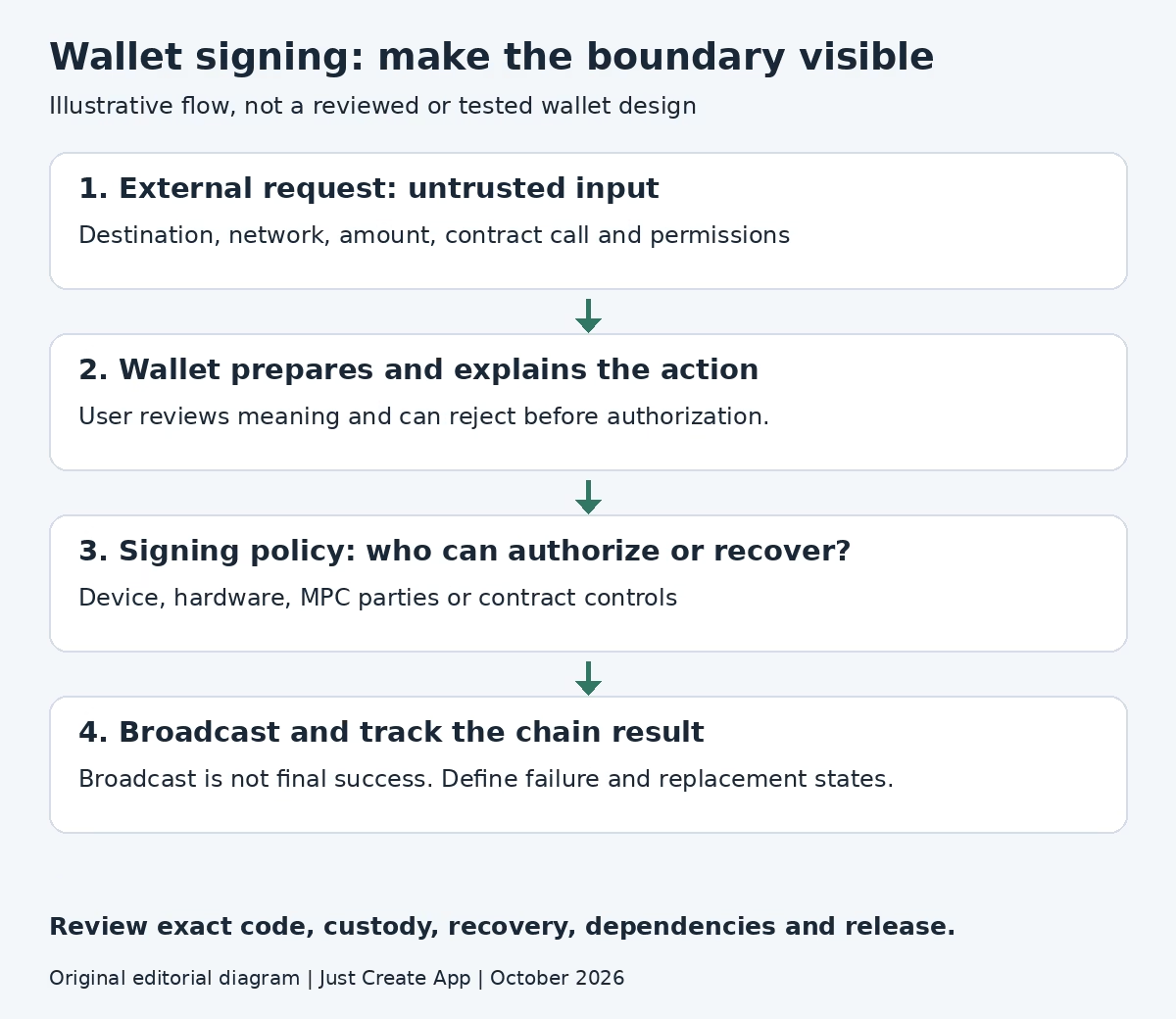
- A dApp or external service requests an action. Treat its requested destination, network, amount and permissions as inputs to review.
- The wallet prepares the transaction and presents its meaning to the user. A simulation result is a separate check, not proof of future execution.
- The selected signing policy authorizes the action. Identify the device, hardware, MPC parties or contract controls that can sign or recover.
- The signed transaction is broadcast. Record network status and failure/replacement handling; do not assume a broadcast means final success.
Sample threat model: malicious approval request
In this synthetic scenario, a dApp asks for token-spending permission that exceeds the user’s intended action. Assets at risk are signing authority and token allowances. The trust boundary is between the external request and the wallet’s approval display/signing policy. Ask the reviewer to test how the client presents the network, spender, token and permission extent, how the user can reject the request, and whether a misleading label can hide the actual action. This is not a claim that a listed company passes that test.
OWASP MASVS storage guidance distinguishes protected storage from unintended leakage through logs and backups. Its cryptography control calls for current strong cryptography used according to best practices. Use these as review inputs, not a wallet certification or a substitute for chain-specific assessment.
Key recovery is a control decision, not a convenience checkbox
For a seed-based design, specify who can access backups and what happens after loss. For MPC, identify the parties, threshold, availability dependencies and recovery authority. For a smart-contract wallet, identify authorized recovery actors, delays, revocation and upgrade powers. Ask a qualified reviewer to examine both theft and permanent-loss scenarios. Do not assume that “non-custodial” or “keyless” means no third party has meaningful control.
On a narrow screen, swipe the table horizontally to read all columns.
| Release check | Evidence required |
|---|---|
| Signing and rejection | Synthetic/testnet cases for supported transaction types and misleading external requests, with actual observed display and rejection results. |
| Recovery and loss | Documented test for lost device, unavailable recovery party and revoked access, with reviewer-approved expected results. |
| Storage and telemetry | Reviewer findings for logs, crash reports, backups and device storage; no production secrets in evidence. |
| Chain support | Exact network IDs, assets, signing formats and protocol integrations tested for this release, not just a chain-logo list. |
| Audit scope | Named assessor, date, repository/commit, components in scope, findings, remediation and retest. Record what remains outside scope. |
| Operational handover | Monitoring ownership, incident contact, dependency update plan and controlled release/upgrade authority. |
Does an audit badge establish this release is safe?
No. Request the report and match its date, code version and scope to the delivered wallet. An audit may cover only contracts, not the client, recovery service or deployment. Even a matching review cannot guarantee future safety.
What does a company need to demonstrate before a wallet contract?
A comparable wallet reference, custody and recovery design, exact chain scope, release acceptance evidence and ownership of ongoing security work. No production funds, real recovery phrases or private keys should be used in procurement demonstrations.
How to compare DeFi wallet development companies
Start with a written product brief: who controls the keys, which networks and assets the wallet must support, and which actions users need. A mobile wallet, browser extension, embedded wallet SDK and treasury wallet have different requirements. Multi-chain support also differs from cross-chain bridging. Ask vendors to describe both separately.
- Custody and recovery: identify who can sign, how a lost device is recovered and what happens if a recovery provider fails.
- DeFi integration: name the swap, lending or staking protocols, external APIs and contracts. Decide which interactions are available at launch.
- Security assurance: require a threat model, test coverage, code review and an independent review of the relevant signing and contract components.
- Ownership and maintenance: define repository access, licensing, app-store accounts, release responsibilities and incident response.
- Commercial scope: compare the same deliverables across quotes. Separate build fees from audits, RPC services, infrastructure, API charges and support.
For background, Ethereum’s wallet guide explains wallets and why account access matters. For a broader supplier search, compare our DeFi development companies guide and cryptocurrency wallet development companies shortlist.
DeFi wallet company comparison: scope and delivery fit
This compares provider-published scope, not delivery quality or security. It is not a quality ranking. A published service is a starting point for due diligence. Where the commercial model is not clear from the reviewed page, request it rather than assuming fixed-price delivery.
| Company | Scope to investigate | Engagement evidence |
|---|---|---|
| 1. Rapid Innovation | Dedicated wallet architecture and launch | Discovery and custom or white-label |
| 2. Antier Solutions | Wallet inside a wider financial platform | Request a scoped proposal |
| 3. Unicsoft | Wallet plus tokenization or DeFi application | Request a scoped proposal |
| 4. Clarisco | Wallet and custom application integration | Request a scoped proposal |
| 5. INC4 | Protocol and infrastructure-heavy products | Request current team/engagement terms |
| 6. WeAlwin | Wallet alongside a broader crypto product | Request a scoped proposal |
| 7. Tanθ Software Studio | Wallet-focused services with developer hiring | Request current team/engagement terms |
| 8. SDLC Corp | Application delivery with specialist proof required | Request a scoped proposal |
| 9. Maticz | Wallet and custody scope to compare | Request a scoped proposal |
| 10. SapientPro | Product engineering, not yet a verified wallet specialist | Request a scoped proposal |
| 11. Calibraint | Product delivery or extra blockchain capacity | Dedicated / project / augmentation published |
| 12. Blockchain App Factory | Web3 launch services; wallet client scope unverified | Request a scoped proposal |
| 13. LeewayHertz | General product delivery with current wallet scope unresolved | Dedicated and project models; wallet scope unconfirmed |
| 14. Prolitus | Blockchain applications with a wallet reference to verify | Request a scoped proposal |
| 15. ARTJOKER | Application engineering with a published wallet case | Request a scoped proposal |
15 companies to investigate for a DeFi wallet project
1. Rapid Innovation
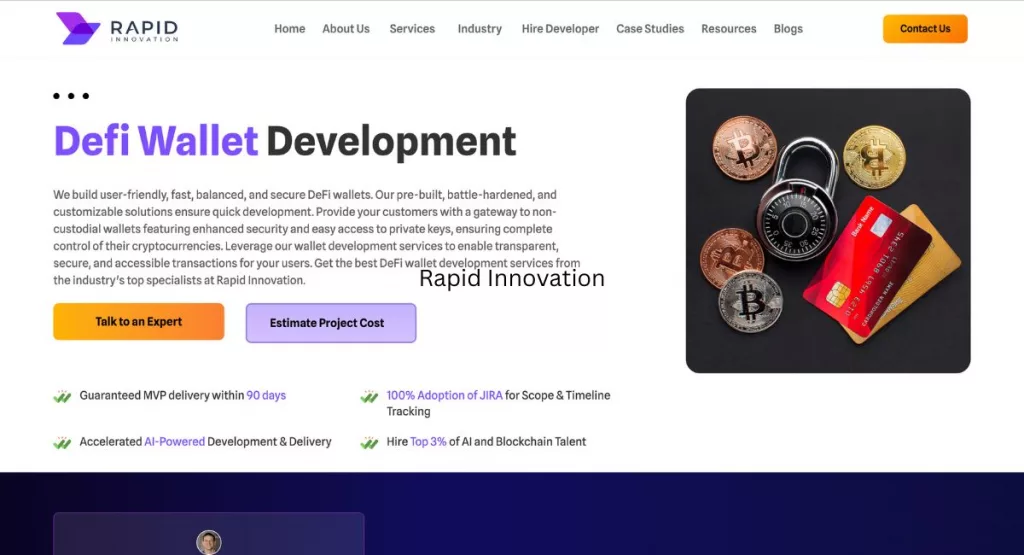
Current evidence and fit: Its service page explicitly covers browser extensions, iOS and Android clients, embedded SDKs, account abstraction and treasury multi-signature wallets. It describes discovery and architecture, a UX prototype, wallet-core implementation, integration work, security testing and post-launch monitoring. This is a useful starting point for a buyer who wants one proposal spanning client and signing infrastructure.
Engagement and scope: Ask it to turn the advertised process into deliverables: a custody diagram, chain-by-chain test matrix, recovery demonstration and an independent review scope. Its security and launch claims are provider statements, not guarantees.
Visit Rapid Innovation’s official website
2. Antier Solutions

Current evidence and fit: Antier’s dedicated DeFi wallet page advertises multi-chain support, MPC wallets and DeFi connectivity. These are provider statements. The proposed signing and recovery model, exact networks and protocol permissions need separate assessment.
Engagement and scope: Use a scoped discovery proposal to separate account access, trading, custody and fiat-provider responsibilities. Have the team identify the entity that can authorize a transfer and the external services needed for production. The engagement model and wallet-specific maintenance terms need a written quote.
Visit Antier Solutions’s official website
3. Unicsoft

Current evidence and fit: Unicsoft’s wallet service page advertises custodial, non-custodial and MPC options. Its AlphaWallet case describes Ethereum-network work, dApp integration and white-label customization. A case documents the vendor’s stated contribution, not independent review of a current release.
Engagement and scope: Ask for evidence on the exact chain and transaction type your product needs. Define whether consulting produces an architecture only or includes implementation, and separate protocol contracts from the wallet client in acceptance testing. Do not infer a custody model from general crypto-development coverage.
Visit Unicsoft’s official website
4. Clarisco

Current evidence and fit: Clarisco names crypto wallet development on its homepage and describes digital wallets alongside exchanges, DeFi platforms, smart contracts and Web3 applications. It also names Ethereum, Solana and Polygon in its blockchain introduction. This is more specific wallet evidence than a generic software-development claim, but it does not establish which of those networks is included in your proposed wallet.
Engagement and scope: Ask for a chain-specific demo and a clear split between reusable components and custom work. If the product connects to an exchange, require separate signing and access-control diagrams for each. Confirm the actual delivery model, assigned engineers, security review and ongoing support in the proposal.
Visit Clarisco’s official website
5. INC4

Current evidence and fit: INC4 describes dedicated engineering teams and a Blockchain Hub covering L1/L2 systems, DeFi and smart contracts. Its published projects include a Layer 1 blockchain and a blockchain system for forest-project measurement and reporting. These examples support an infrastructure discussion, not a claim that a ready-made consumer wallet is included.
Engagement and scope: It may suit a buyer whose wallet is part of a larger protocol or infrastructure roadmap. Request separate workstreams for the client application, signing and chain services. For a dedicated team, specify who owns product decisions, architecture approval, release reviews and incident coverage; team access is not the same as a fixed deliverable.
6. WeAlwin
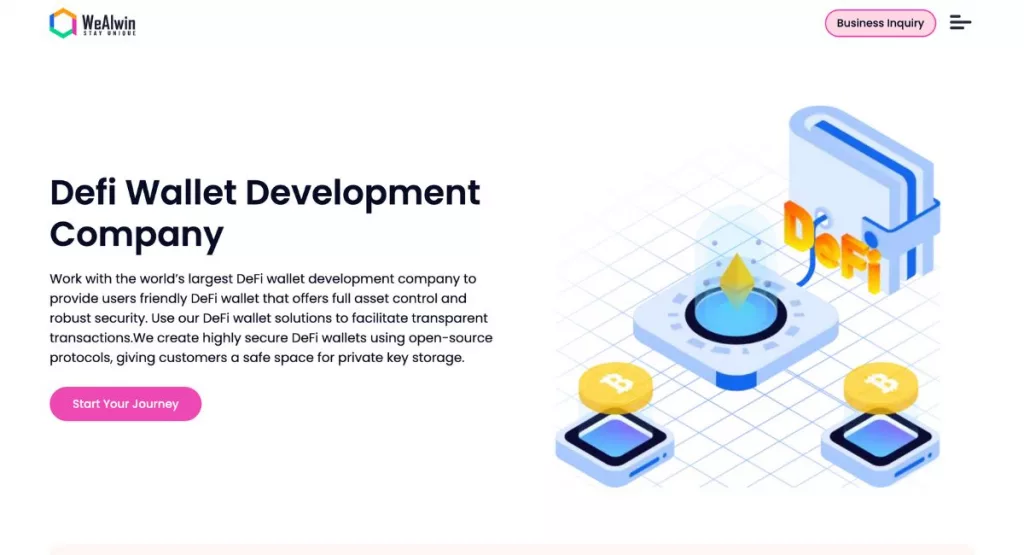
Current evidence and fit: WeAlwin lists DeFi and Web3 development and displays crypto-wallet work in its portfolio. Its wider services include blockchain games, token development and crypto trading bots. A buyer can use that portfolio to begin a relevant discussion, while still requiring proof of the proposed wallet functions rather than assuming exchange or trading experience transfers to self-custody.
Engagement and scope: Ask to see the actual wallet reference and which parts the current team built. State whether you are buying custom engineering, configuration of an existing product or ongoing team capacity. Confirm the release route for each platform and whether third-party integrations can be changed without the vendor.
Visit WeAlwin’s official website
7. Tanθ Software Studio

Current evidence and fit: Tanθ explicitly lists wallet and DeFi-wallet development on its current site. This supports a wallet-service inquiry, not a promise that any advertised network, recovery method or DeFi action is included in one package.
Engagement and scope: It is worth investigating for a wallet-centered Web3 product or additional specialist capacity. Ask which senior engineer reviews transaction construction and recovery. If hiring a dedicated developer, put code review, testing and security escalation into the engagement rather than buying only development hours.
Visit Tanθ Software Studio’s official website
8. SDLC Corp

Current evidence and fit: SDLC Corp currently emphasizes AI-first product engineering, web and mobile applications, workflow systems and enterprise modernization. It describes production case studies, but that homepage positioning alone does not verify a current specialist DeFi-wallet team. Keeping it in this historical shortlist should not place it on the same evidence footing as a provider with an explicit wallet offering.
Engagement and scope: Consider it only after receiving recent, comparable wallet references and a named signing/security lead. A general application team could handle interface or backend work alongside another specialist, but that arrangement must be explicit. Reject proposals that leave ownership of custody design or integration failures unclear.
Visit SDLC Corp’s official website
9. Maticz
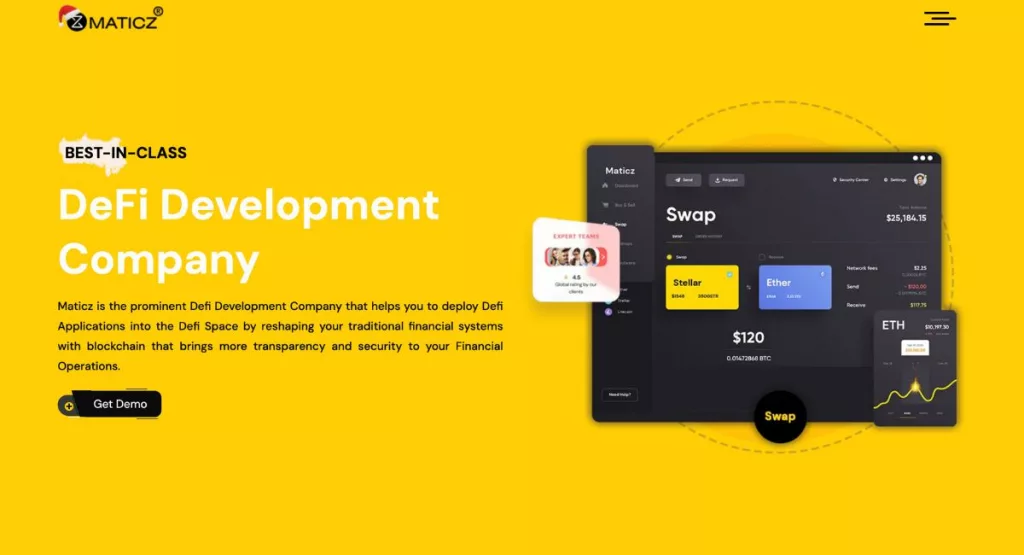
Current evidence and fit: Maticz explicitly advertises Web3 and DeFi wallet solutions, multi-currency and enterprise wallets, and asset storage and access layers. Its homepage also presents Krinos Wallet as a Web3 payments project. This creates a more direct wallet-development lead than its general AI and blockchain positioning alone.
Engagement and scope: It may suit a buyer comparing consumer-wallet and enterprise-custody requirements, provided the proposed architecture matches the use case. Request a walkthrough of the relevant reference, not only a marketing image. Clarify licensing, source availability, change rights, privileged access and the ongoing cost of any proprietary core before choosing a reusable platform.
Visit Maticz’s official website
10. SapientPro

Current evidence and fit: SapientPro describes custom software, SaaS and AI product engineering. Its current homepage says engagements begin with goals and constraints and continue through launch and growth. That helps explain a general delivery approach, but does not by itself confirm a dedicated DeFi-wallet service or signing-security capability.
Engagement and scope: A buyer with a strong internal blockchain team could investigate application work, subject to relevant references. Ask who supplies chain integrations, transaction review and recovery design. If those responsibilities sit outside the company, define the partner, review process and joint defect ownership before treating the proposal as a complete wallet build.
Visit SapientPro’s official website
11. Calibraint

Current evidence and fit: Calibraint explicitly lists cryptocurrency-wallet development and white-label crypto wallets. Its Web3 description discusses account abstraction, passkey authentication and sponsored gas. It also publishes three engagement models: a dedicated development team, project-based delivery and team augmentation. Those models are useful to compare against the amount of product and technical direction your own team can provide.
Engagement and scope: For a project, ask for acceptance criteria and launch responsibilities. For augmentation, identify the internal reviewer and architecture owner. Its stated testing and security approach should be supported by project-specific evidence, including review scope, remediation and maintenance, rather than treated as certification of your wallet.
Visit Calibraint’s official website
12. Blockchain App Factory

Current evidence and fit: Blockchain App Factory presents development and marketing together and covers decentralized applications, tokens and staking or claim systems. It also describes smart-contract audit services. That wider launch scope can be relevant when a wallet connects to a new token ecosystem, but marketing support does not answer custody, key-management or recovery questions.
Engagement and scope: Buy engineering and promotion as separate deliverables. Request the proposed reviewer identity and independence, the exact artifacts reviewed and evidence that findings were fixed. Establish whether wallet clients and backend services are included: a token-contract audit should not be presented as review of the whole product.
Visit Blockchain App Factory’s official website
13. LeewayHertz

Current evidence: The official homepage returned an “under construction” page during this review. Current wallet services, assigned team and commercial models remain unverified. This historical entry is not a cleared wallet recommendation.
Procurement checks: Confirm the current company/contact, comparable wallet release, signing/recovery responsibilities and contracting entity before shortlisting. Do not infer wallet-security capability from earlier AI or general-software claims.
Visit LeewayHertz’s official website
14. Prolitus

Current evidence and fit: Prolitus describes custom blockchain services, dApps, appchains and rollups, tokenization and Telegram ecosystem applications. Its site includes a customer statement referring to DeFi-wallet, NFT-marketplace and decentralized-exchange work. That is a provider-published testimonial, not an independent technical review; it is a lead for a reference discussion.
Engagement and scope: It may be relevant where the wallet belongs to a broader blockchain application. Ask the team to show the actual wallet and explain its contribution. Confirm the contractual engagement model, supported chains and maintenance coverage, then test signing, recovery and integration failure paths on the proposed implementation.
Visit Prolitus’s official website
15. ARTJOKER

Current evidence and fit: ARTJOKER publishes GoodDollar as a mobile crypto-wallet example and describes Ethereum, Solidity smart contracts and the G$ ERC20 token in that project. Its broader site describes custom software and UX/UI delivery. This gives a buyer a concrete reference to discuss rather than relying on a generic blockchain label.
Engagement and scope: Ask what ARTJOKER built in the reference and whether the same skills are available for your project. It may be worth investigating for a wallet interface and surrounding application, subject to proof of signing and security responsibilities. Compare a project engagement with augmentation according to who will own architecture and release decisions.
Visit ARTJOKER’s official website
Custom build or white-label DeFi wallet?
A white-label starting point can reduce repeated engineering work, but buyers must inspect licensing, customization limits and dependencies. A custom build offers more control over product behavior, with more design and testing work to own. Ask both types of provider for a demonstration of the exact deliverable, not only screenshots or an unrelated exchange product.
Questions to settle before signing
What does DeFi wallet development cost?
There is no universal price for the companies on this list. Ask for an itemized quote covering the custody architecture, supported networks, client applications, protocol integrations, independent security review and maintenance. A provider’s advertised starting price is not a quote for your product. Compare equal scopes before deciding.
How long will the project take?
The schedule depends on what is already built and what must be designed, integrated, reviewed and tested. Require milestones for architecture, a working prototype, security review, remediation and release. Keep external audit availability and app-store review outside any unsupported delivery promise.
Can a wallet support several blockchains?
It can be designed to, but each network adds integration and testing work. Obtain a named network list and confirm how balances, fees, token discovery, signing and recovery work on each. Do not assume support for one EVM network proves support for every chain.
Does an audit guarantee wallet safety?
No. Review the audit’s scope, date, findings and remediation evidence. The wallet client, signing layer, backend and external protocols may have separate risks. Include ongoing dependency updates, monitoring and an incident-response plan alongside pre-release review.
Which company is best for a startup?
The best fit is the team that can demonstrate the required product, explain the security tradeoffs and offer a contract you can maintain. Shortlist two or three candidates with relevant evidence, run the same technical questions past each and compare scope and ownership before committing.
Hiring DeFi developers for more than a wallet
A DeFi application development company may build a protocol, smart contracts, a web interface and a wallet connection, while a wallet development company may focus on account access and transaction signing. These are related services, not interchangeable deliverables. If you are looking to hire a DeFi development team, split the proposal into wallet engineering, protocol work and application work so that responsibility for each is clear.
When hiring decentralized finance developers or DeFi specialists, ask who will review the signing and recovery design, who tests the protocol integrations and who owns incident response. A broad claim of DeFi expertise is less useful than a technical walkthrough of comparable work. For a wallet app, specify whether you need iOS, Android, web, a browser extension or an embedded component. Each client needs its own release and testing plan.
What should a DeFi wallet development service deliver?
A useful proposal separates the wallet into signing and recovery, blockchain connectivity, client applications, and DeFi adapters. A polished portfolio screen does not tell you who controls keys or whether the product can safely recover from a failed transaction. Use the same acceptance checklist with every shortlisted team.
- Architecture package: custody and recovery diagrams, a threat model, supported networks, third-party dependencies and a list of privileged actions. Identify who can change signing rules or upgrade smart accounts.
- Working prototype: onboarding, backup or recovery, send and receive, fee display and a clear signing prompt. Test with the intended users before adding a long list of earning features.
- Integration evidence: named protocols and versions, transaction simulation where applicable, rejected-signature handling, slippage settings and behavior during RPC or provider failures.
- Review and remediation: mobile and web testing, contract review where contracts are used, findings, fixes and a second check. Define the independent reviewer before launch rather than relying on an unspecified audit promise.
- Handover and operations: source repositories, build instructions, dependency licenses, monitoring, release ownership, support limits and a tested rollback or feature-disable plan. Your organization should control its own production accounts.
The OWASP Mobile Application Security project provides a useful basis for discussing mobile testing. WalletConnect’s documentation is a primary reference when that connectivity is in scope. Neither reference certifies a particular vendor or replaces a review of your implementation.
How do you hire a DeFi development team without an internal blockchain lead?
Start with a paid or clearly scoped discovery phase, not an open-ended full build. Require an architecture you can take to another reviewer. Name the product owner, wallet-security lead and independent reviewer. Compare two or three proposals against the same acceptance tests, and ask each team to explain which work it will not do. A provider that identifies its limits gives you more usable information than a promise to handle everything.
What is the difference between DeFi wallet solutions and DeFi application development?
A wallet solution focuses on account access, signing and recovery, while a DeFi application also needs protocol logic, contracts or integrations, and an interface for actions such as swaps or lending. Some suppliers do both; others provide only a client or a reusable wallet core. Write each component into the contract, including who fixes defects at the boundary between them.
What should a startup leave out of its first wallet release?
Define one custody and recovery approach, a limited network set and the essential transaction flow first. Treat extra chains, bridges, fiat ramps and earning features as separately approved scope, with their own dependencies and tests. This is a planning recommendation, not a promise of lower costs or faster delivery. A narrower release still needs security review and production support.







Leave a Reply