



Short answer: the leading mobile app development trends for 2026 and planning into 2027 are agentic apps, on-device and hybrid AI, agent-assisted coding, accessibility and AI compliance, and agentic commerce. Foldables and connected devices still matter, but they should not crowd AI out of the list.
I compare app-development approaches for a living. This revised list separates standards, announcements, previews and forecasts rather than treating them as equally available. Checked on 20 October 2026, it includes WWDC26, Google I/O 2026 and the announced iPhone Duo. The 2027 recommendations are planning judgments, not claims about events that have already happened.
If you are costing a project, use our app development cost calculator alongside the platform requirements below. Choose changes that improve a real user task rather than collecting every fashionable technology.
The 14 biggest mobile app development trends at a glance
| # | Trend | Priority |
|---|---|---|
| 1 | Agentic AI turns apps into actions, not just screens | Evaluate now |
| 2 | On-device AI grows into a hybrid inference strategy | Evaluate now |
| 3 | Agentic coding changes the development workflow | Evaluate now |
| 4 | Accessibility and AI compliance enter launch planning | Evaluate now |
| 5 | Agentic commerce reaches the checkout | Evaluate now |
| 6 | Foldable-ready layouts now include iPhone | Use-case dependent |
| 7 | AR and spatial computing share a focused product lane | Use-case dependent |
| 8 | Post-quantum security becomes an inventory problem | Use-case dependent |
| 9 | Wearable apps need distinct jobs and smaller interactions | Use-case dependent |
| 10 | Edge computing supports selective low-latency work | Use-case dependent |
| 11 | 5G changes the opportunity, not the minimum connection | Use-case dependent |
| 12 | Blockchain and decentralized apps belong in one narrow lane | Use-case dependent |
| 13 | Sustainable development means measuring wasted work | Use-case dependent |
| 14 | Matter 1.5 expands smart-home apps beyond basic controls | Use-case dependent |
Trend 1: Agentic AI turns apps into actions, not just screens
The biggest shift is from answering a question to carrying out a task. An app can expose an action, such as creating a reminder or finding a document, that an authorized assistant can discover and call. At Google I/O 2026, Google described Android as an “intelligence system.” Its AppFunctions documentation connects this direction to Model Context Protocol (MCP): apps contribute tools, data and services rather than waiting for a person to tap through every screen.
Keep the release status straight. AppFunctions is an experimental preview on Android 16 or higher. The documentation describes Gemini integration as a private preview with trusted testers. This is a reason to prepare an integration, not a claim that every Android user can use it today. MCP compatibility does not grant unlimited access. Permissions and the app’s own authorization still matter.
Apple’s WWDC26 App Intents guide describes schemas that make content discoverable and actions available through Siri AI. Its June announcement and September iPhone Duo page describe a new Siri experience, rolling out in beta with iOS 27. Treat an announcement, beta availability and your own supported-device list as separate things.
Gartner predicted in August 2025 that 40% of enterprise applications would integrate task-specific agents by 2026, up from less than 5% in 2025. That is a forecast about enterprise software, not measured mobile adoption. My recommendation is narrower: expose one useful action, require confirmation for sensitive changes, and make retries safe so the same request cannot create duplicate work.
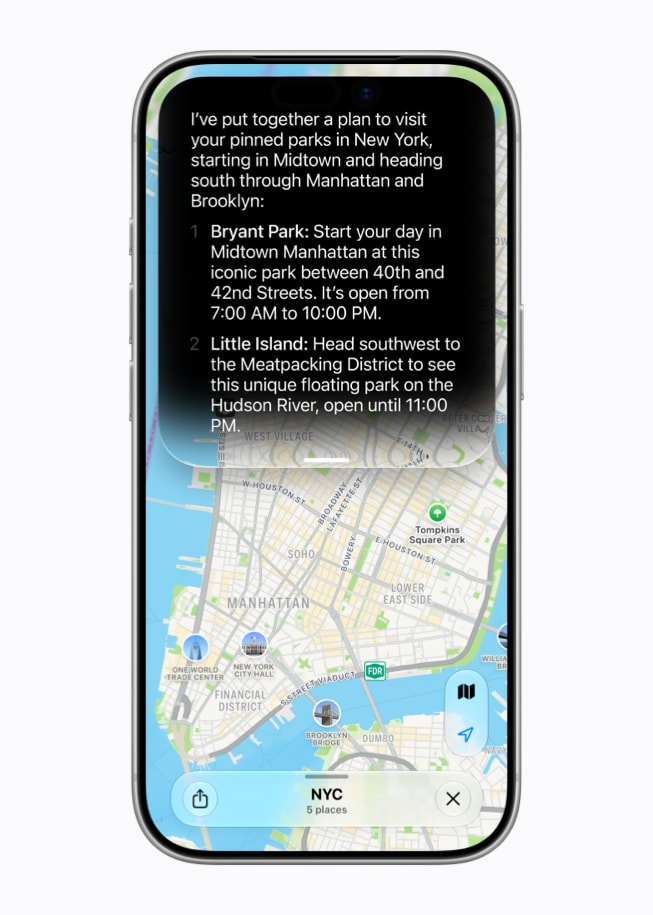
Apple illustration of Siri AI using personal context, from its WWDC26 announcement.
Trend 2: On-device AI grows into a hybrid inference strategy
On-device AI changes privacy, latency and operating costs. Apple’s 2026 Foundation Models guidance covers access to its on-device model, image input, tool calling and a common interface for other model providers. Apple’s June 2026 developer announcement also says the next Apple Foundation Models were custom-built in collaboration with Google and its Gemini models. Google’s I/O 2026 recap introduced the Gemini Nano 4 preview, ML Kit GenAI improvements and Firebase AI Logic hybrid inference. Where a request runs matters more than whether the app carries an AI label.
Local inference can keep a short summary or classification on a phone without a network round trip. It is not automatically free in every sense: model downloads, memory, thermal load, battery use and older-device support remain product costs. Cloud models can handle work that exceeds local limits. A hybrid design needs a clear routing rule and honest disclosure when content leaves the device.
Google lists routing modes including PREFER_ON_DEVICE and ONLY_ON_DEVICE. Apple’s framework also supports server models. Neither means every provider, language or device has identical capabilities. Check availability at runtime and preserve a non-AI fallback. Our AI development trade-off guide helps frame the decision. Evaluate task quality, latency and energy on your supported devices before choosing the route.
Apple WWDC26 Foundation Models session artwork.
Trend 3: Agentic coding changes the development workflow
AI affects how the app is built as well as what it does. Apple’s Xcode 27 guide describes coding agents powered by a chosen model, working on prototypes, implementation details and polish. It also covers agent-assisted localization alongside testing and performance tools. This is more concrete than the promise that a prompt replaces an engineering team.
Use an agent for a bounded change with a testable result: add a screen state, draft a unit test, update a string catalog, or explain a failing build. Review permissions, dependencies, data handling and migrations. A prototype compiling does not establish that login, billing or offline recovery is safe. Keep code review and device testing in the release path.
There is a counterpoint to the hype. TechCrunch reported in September 2025 limited downloads and revenue for dedicated mobile vibe-coding apps, citing Appfigures. That is a dated observation about coding on a phone, not proof that desktop AI coding tools or all AI-built apps fail. For 2027 planning, budget for faster iteration and stronger review, not for engineering disappearing. Compare options with our development tools guide and MVP development shortlist.
Apple WWDC26 Xcode session artwork.
Trend 4: Accessibility and AI compliance enter launch planning
The European Accessibility Act began applying on 28 June 2025 to covered products and services. It is not a blanket rule that every app has identical duties. Scope, exemptions and national implementation need checking, especially for banking, transport and consumer commerce. Test screen-reader labels, readable contrast, scalable text, focus order and alternatives to gestures.
AI introduces another compliance track. The Commission’s current AI Act timeline lists general-purpose model obligations from 2 August 2025 and transparency rules from August 2026. Its updated timeline puts certain Annex III high-risk use cases at 2 December 2027 and AI embedded in regulated products at 2 August 2028. Do not collapse those dates into one deadline or assume the app developer is necessarily the model provider.
Identify your role and actual use case before choosing compliance work. Customer support, employment screening and a regulated medical product do not have the same risk profile. Keep model and data documentation, distinguish AI output from human decisions, and seek qualified legal advice where rights or regulated activities are involved. Generated content and conversational controls still need accessible labels and a usable escape route.

Accessibility illustration retained from the earlier article, not a compliance certification.
Trend 5: Agentic commerce reaches the checkout
Commerce is moving beyond recommendations into transactions carried out through an assistant. OpenAI announced Instant Checkout and the Agentic Commerce Protocol on 29 September 2025, co-developed with Stripe. That launch began with U.S. Etsy sellers and single-item purchases, with wider merchant and regional support described as future work. Those are launch conditions, not a claim about every merchant’s availability in October 2026.
The lesson is that a catalog and a mobile checkout are no longer the only entry points. An agent needs accurate product data, an explicit order total, an inventory check and a reliable way to pass an order to the merchant. In the protocol OpenAI describes, the merchant still owns fulfillment, returns and support. A conversation should not hide those responsibilities.
Build approval and recovery before automation. Show the item, destination, full price and cancellation terms before a commitment; make order creation safe to retry; distinguish a payment authorization from a completed order. This is a distribution path to evaluate, not a reason to remove normal checkout. Start with one category and measure completed orders, refunds and support cases rather than counting chats.

OpenAI diagram of the Agentic Commerce Protocol.
Trend 6: Foldable-ready layouts now include iPhone
Foldables are no longer an Android-only planning discussion. Apple announced iPhone Duo on 9 September 2026, with pre-orders from 16 October and availability scheduled for 23 October. As of this article’s 20 October check, that means announced and in pre-order, not already in every customer’s hands. Apple describes a 7.6-inch inner display, a 5.4-inch outer display and an iOS 27 experience adapted to folding and multitasking.
The engineering task is continuity: preserve work when a window changes size, the device folds, or another app shares the display. Android adaptive-layout guidance addresses the same class of problem. Test keyboards, video, cameras and dialogs as well as the main screen. Our React Native vs Swift comparison and Flutter developer shortlist can help with implementation choices, but a framework does not replace testing on target layouts.
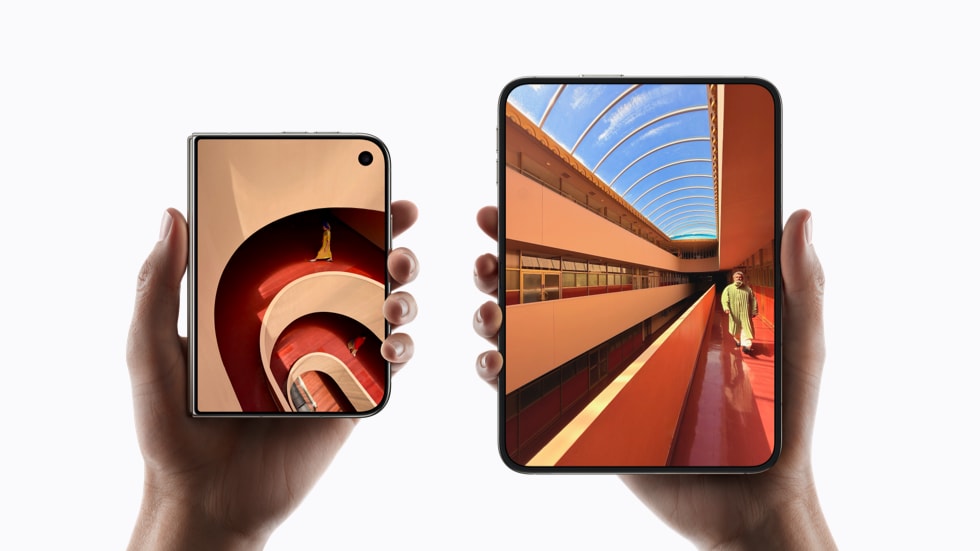
Apple press image of the announced iPhone Duo folded and unfolded.
Trend 7: AR and spatial computing share a focused product lane
I would combine augmented reality and spatial computing rather than use two slots for overlapping experiences. The question is whether spatial context helps complete a task: place an object, inspect a design, follow a training step or understand a space. Phone AR and headset experiences have different input and comfort constraints even when they share 3D assets.
Start with the cheapest experience that proves the job. A narrow try-on flow may teach a retailer more than a large virtual showroom. Keep a non-camera route; test lighting, tracking loss, asset loading and accessible alternatives. Our AR development shortlist, VR shortlist and spatial development guide cover different delivery paths. The metaverse explainer and Web3 comparison provide background, not evidence that every app needs a virtual world.

AR app-development illustration from the earlier article.
Trend 8: Post-quantum security becomes an inventory problem
NIST finalized its first three post-quantum encryption standards in August 2024. That is a standards milestone, not a claim that quantum computers can break every app today. Identify cryptography in network libraries, authentication, certificates, stored records and third-party SDKs. Sensitive data with a long useful life deserves particular attention.
Do not invent a cryptographic scheme in application code. Ask infrastructure and SDK providers about migration plans, measure compatibility and payload overhead, and keep protocols updatable. A mobile release cannot fix an unprepared server dependency by itself. A sensible 2027 plan is a dependency inventory and a tested migration path, not a marketing badge saying the app is quantum-proof.
Trend 9: Wearable apps need distinct jobs and smaller interactions
A watch should solve a short task without becoming a miniature phone. Ask what can be understood at a glance, what needs a phone handoff, and what happens without connectivity. Health and fitness products need clear consent and careful treatment of sensitive data. Background collection should serve a real benefit rather than become the default.
Treat battery use, synchronization conflicts and interrupted sessions as core tests. Our fitness app guide provides product context, while the business IoT guide covers connected-device use cases. Evaluate the watch feature on completion time and usefulness, not how many phone screens it reproduces. A short interaction that works reliably is worth more than a large feature list that depends on constant connectivity.

Wearable integration illustration from the earlier article.
Trend 10: Edge computing supports selective low-latency work
Edge computing and on-device inference are not identical. On-device work runs on the phone; edge work runs on infrastructure closer to the user than a distant central region. Decide which operations need proximity and which need a central source of truth. Caching public content is different from reconciling a payment or updating a private record.
Measure the complete path: radio conditions, network round trips, backend work and rendering. Add infrastructure only when it fixes a measured bottleneck and its consistency model fits the task. Keep authentication and data residency in the design. The IoT app planning guide is useful for systems where devices, phones and servers must agree despite intermittent connections. Define what may be stale and for how long before selecting a cache strategy.
Trend 11: 5G changes the opportunity, not the minimum connection
Faster mobile networks can support richer video and responsive interactions, but a network label is not a service guarantee. Coverage, congestion, indoor reception and data plans still affect the experience. I would not design a basic task to fail when someone drops to an older connection or enters a lift.
Build adaptive media, resumable transfers and honest offline states before increasing payload size. Profile startup on a constrained connection, then decide whether richer assets justify their cost. Cross-platform teams can compare integration needs with our React Native developer shortlist. The useful 2027 metric is successful task completion across real conditions, not theoretical peak speed. Show the difference between queued, sent and confirmed operations so a weak connection does not cause duplicate requests.

5G illustration; actual performance depends on network conditions.
Trend 12: Blockchain and decentralized apps belong in one narrow lane
Blockchain and decentralized apps overlap enough to count as one trend. Begin with a requirement: do multiple parties need a shared record without one trusted operator, or would a conventional database be simpler? Wallet integration, key recovery, transaction costs and privacy can outweigh the benefit for ordinary consumer tasks.
For a justified use case, design recovery and support before the wallet interface. Losing a device should not be an afterthought. Our blockchain development shortlist and blockchain trends guide are starting points for specialist research. Neither is a reason to add a chain without a clear trust or coordination problem. I rank this below agentic interfaces and on-device AI for a general mobile roadmap.

Blockchain app-development illustration from the earlier article.
Trend 13: Sustainable development means measuring wasted work
Efficiency is a quality goal even without a sustainability claim. Repeated network requests, unnecessary location checks, oversized images and a model running without a useful task all consume resources. Compare a smaller local model, a cached result and a server request against the same quality target. The greener-sounding architecture is not automatically more efficient.
Track battery drain, transferred bytes, cold-start time and avoidable background work. State measurement conditions before claiming an improvement; do not turn a smaller payload into an unsupported carbon estimate. A practical release gate is that a feature meets its quality target without making older supported devices unusable. This is useful work for 2027 whether or not the product markets itself as sustainable.
Trend 14: Matter 1.5 expands smart-home apps beyond basic controls
The old 1.4.1 reference is no longer current. The Connectivity Standards Alliance released Matter 1.5 on 20 November 2025, adding cameras, closures, soil sensors and energy-management capabilities. Camera support uses WebRTC for live audio and video, with local and remote access mechanisms. Matter 1.5.1 followed on 31 March 2026 with camera and device-flexibility improvements.
A specification is not proof that every device or ecosystem implements every feature. Keep a compatibility matrix for supported devices and controllers. Test onboarding, permission changes, lost connectivity and access revocation. For cameras and doors, a failed action or privacy mistake has more weight than a cosmetic update. Our industrial IoT guide provides another connected-device context, but smart-home products still need device-level tests.
How we verified this list
Updated 20 October 2026. This is a documentation-based editorial review, not a hands-on test of every device or preview. I checked Apple developer and newsroom pages, Android documentation and the I/O recap, European Commission guidance, NIST, the Connectivity Standards Alliance and the original commerce announcement. Links sit beside the claims they support. Gartner is labeled as a forecast; the TechCrunch counterpoint is labeled as a September 2025 report. Announcement images are illustrations, not our own device tests.
One further change affects agent discovery: the Commission’s 16 July 2026 DMA guidance aims to give competing AI services equal access to Android features used by Google’s own services. That is a regulatory direction and implementation issue, not a guarantee that all rival assistants already have identical access. Re-check API availability, regions and legal dates before release.
Frequently asked questions about mobile app development trends
What is the biggest mobile app development trend in 2026?
Agentic AI is the strongest change in this list: apps expose actions and data to authorized assistants. AppFunctions and App Intents make the direction concrete, but availability varies. Start with one permissioned action rather than replacing the entire interface.
Are AppFunctions and Gemini integration generally available?
The Android documentation checked on 20 October 2026 calls AppFunctions experimental and describes Gemini integration as a private preview with trusted testers. It supports preparation and testing, not a promise of availability for every user.
Should every AI feature run on the phone?
No. Match the task to device capability, privacy, latency and quality. Local inference can avoid a network round trip; a cloud model may handle harder work. Hybrid routing needs disclosure, availability checks and a fallback.
Will agentic coding replace mobile developers in 2027?
That is not established by these sources. Xcode 27 includes coding agents, but architecture, permissions, review, testing and release decisions still need accountable owners. Plan for a changed workflow rather than assuming engineering disappears.
Which EU dates matter for a roadmap?
The EAA began applying to covered products and services on 28 June 2025. The Commission lists AI Act transparency rules from August 2026, certain Annex III high-risk rules from 2 December 2027 and regulated-product AI rules from 2 August 2028. Duties depend on the service, use case and role.
Is iPhone Duo available at this article date?
Apple announced it on 9 September 2026, with pre-orders from 16 October and availability scheduled for 23 October. This review is dated 20 October, so it describes the announcement and pre-order stage, not a hands-on test.
What should a small team prioritize for 2027?
Start with accessible core tasks, reliable performance and privacy. Then evaluate one agent action or AI feature against a measurable user benefit. Add foldable, spatial, blockchain or smart-home support only when your audience justifies the work.


Leave a Reply