



MVP development companies: choose for the learning goal, not the longest feature list
A minimum viable product is a working first version built to test an important assumption with real users. It is not simply an inexpensive copy of the final roadmap. The useful question is whether the first release lets a specific customer complete a valuable task, and whether the results tell you what to build, change or stop next.
This guide revisits nine current businesses from the earlier list. Their official sites support the company descriptions below. The list is not a scored ranking, an endorsement of delivery quality or evidence that a vendor has capacity for your launch date. Prices, team availability and contract terms require a proposal for your own scope.
Nine companies to evaluate for an MVP engagement
1. Cleveroad

Cleveroad describes an MVP service that joins product discovery, UI/UX design, development, testing, launch and continued development. Its discovery work includes requirements, wireframes, a user journey and a specification, with business analysis and solution architecture among the roles involved. The service page names healthcare, supply chain and finance among its industry areas, alongside marketplaces, education and other digital products. This is an end-to-end delivery offer rather than a developer-only placement.
For a founder without a technical team, that breadth is useful to investigate because the decisions before coding can be as important as the build. Ask for the discovery deliverables separately from the implementation estimate. Confirm who signs off the user journey and which assumptions will be tested after release. A product can reach the market without proving demand; launch support and learning from usage should be separate acceptance criteria.
Ask the proposed team to show how a comparable workflow went from discovery to release. Check who owns cloud accounts, repositories, app-store access and analytics, and whether support after launch is included or separately contracted.
Explore Cleveroad’s current offer
2. Net Solutions

Net Solutions presents MVP development as part of a wider product and platform engineering business. Its current service page emphasizes AI-assisted development, automated testing, product validation and analysis of user behavior. Its homepage also describes experience design, data and AI engineering, digital commerce and application modernization. For a startup, the relevant distinction is whether the proposed engagement is a small learning-focused release or a larger platform build with an MVP label.
The service page advertises a four-to-six-week development window. Treat that as the vendor's stated offer, not a deadline that applies to every product. A regulated workflow, integration-heavy product or mobile app-store launch may have dependencies outside the engineering team's control. Ask what the window includes, which inputs must already be ready and what happens if validation changes the requirements. AI can help analyze evidence, but it does not replace actual customers using the product.
Get an example of the first release's scope, its measurement plan and the human review of AI-generated work. Clarify data handling, external model providers, code ownership and the cost of ongoing services before choosing an AI-heavy delivery plan.
Explore Net Solutions’s current offer
3. Classic Informatics

Classic Informatics separates its MVP offer into discovery and scoping, product strategy, build and delivery, and post-launch iteration. The current page describes architecture and feature choices before implementation, followed by design, development, QA and launch. It also names insurance workflows such as quote-and-bind, claims intake and broker portals. These are specific examples of product paths, not evidence that one company is the right choice for every regulated industry.
This structure is worth examining when the main risk is a large backlog rather than a lack of coding capacity. Ask the team to explain what will be left out of the first release and how those exclusions preserve the learning goal. A useful scope document defines both the happy path and the limited exceptions that must work. An architecture plan should explain likely next steps without charging the first release for every possible future feature.
Check the outputs and decision points of discovery, the testing approach for your integrations, and the arrangement for iterations after launch. If the proposal relies on insurance or other sector expertise, request a comparable case and clarify the client's role in legal and compliance sign-off.
Explore Classic Informatics’s current offer
4. Bacancy Technology

Bacancy maintains a dedicated MVP development page alongside a broader engineering business that currently emphasizes AI, data, healthcare and finance. The MVP page describes discovery, requirements gathering, business analysts and technical assistance, with a focus on testing core assumptions and adjusting from early feedback. It also acknowledges that an MVP is not necessary for every business, particularly where a known process and approved budget already define the final product.
That distinction is helpful. A startup searching for product-market fit and a company replacing a well-understood internal system need different success measures. Ask Bacancy to identify the uncertainty the first version will address, rather than treating every smaller software project as an MVP. Confirm whether your proposal is a managed outcome, an embedded team or a staffing arrangement, since the responsibilities for scope and acceptance differ.
Request named roles, time-zone overlap and a feature-by-feature acceptance plan. Determine who prioritizes the backlog, who can approve changes and how actual user feedback affects the next sprint. Do not treat claims of faster delivery or successful validation as a guarantee for an untested idea.
Explore Bacancy Technology’s current offer
5. Attract Group

Attract Group's MVP page gives a useful sequence: business analysis, wireframes and prototypes, an interactive prototype or proof of concept, an MVP, and later evolution into a commercial product. It specifically names a Lean Model Canvas and Product Vision & Scope as business-analysis outputs. The company's wider site describes custom software delivery, dedicated teams and a business-first approach. Its MVP offer therefore includes planning and design work rather than assuming the founder arrives with a complete specification.
Consider this route when the idea needs to be narrowed before the build. Ask which deliverables are contractual and which are illustrative process descriptions. A proof of concept can test technical feasibility, while a live MVP tests whether users complete the valuable action. Separating those goals prevents a polished demonstration from being mistaken for market validation. It also makes it easier to stop after discovery if the evidence argues against building.
Ask for a sample scope document with confidential details removed. Confirm how customer interviews, prototype feedback, development and product analytics connect, and which handover artifacts you retain if you change vendors after the planning phase.
Explore Attract Group’s current offer
6. Code&Care

Code&Care's current homepage offers custom software projects, dedicated engineers and a white-label delivery platform. It explicitly refers to taking products from MVP to enterprise solutions. The listed services include UX/UI design and discovery, QA and test automation, DevOps and infrastructure, and ongoing support. It also presents time-and-materials and fixed-price projects. These choices make the engagement model a central part of evaluating the company.
A founder with a technical lead may want engineers who join an existing workflow; a nontechnical founder may instead need a team accountable for discovery, scope, release and support. Those are different purchases, even when both produce the same application. Ask which party owns product decisions and which deliverables the price covers. If the white-label delivery platform is involved, clarify whether it is optional infrastructure for managing the engagement or a dependency the product itself needs.
Compare a fixed-price proposal with a time-and-materials proposal using the same scope and assumptions. Check change control, QA ownership, repository access, deployment documentation and the terms for maintaining the product after the first release.
Explore Code&Care’s current offer
7. OTAKOYI
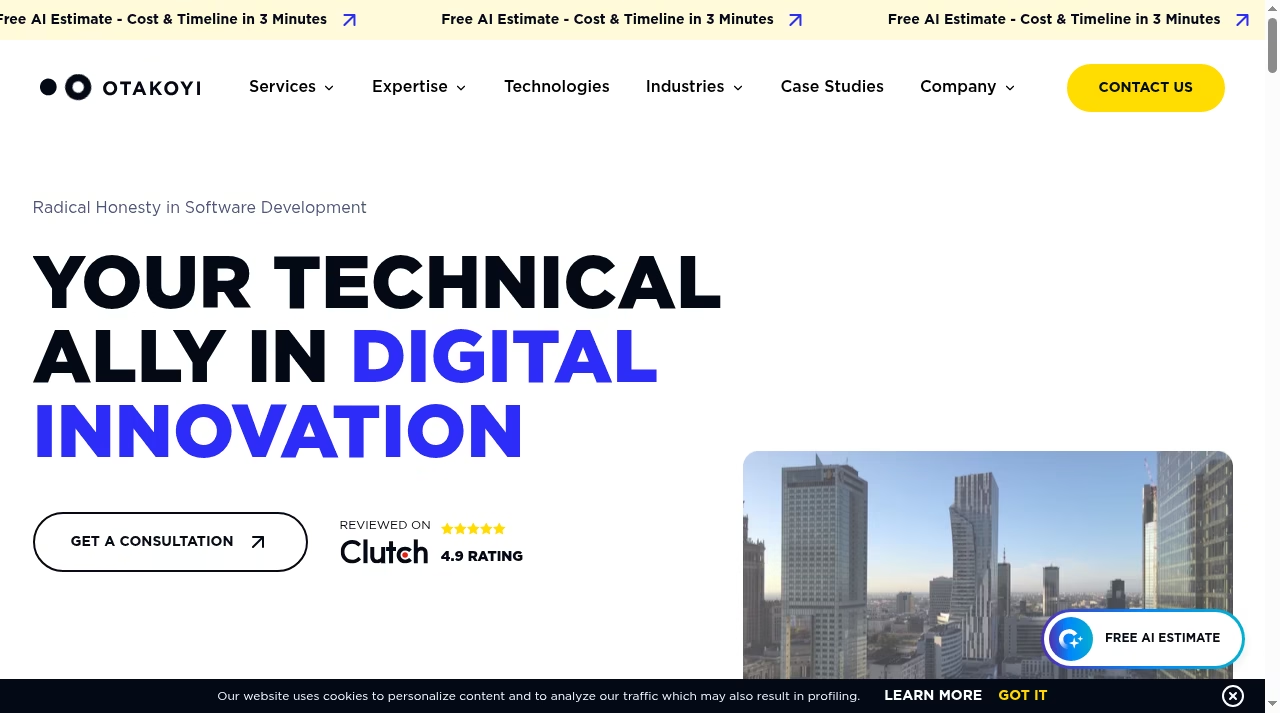
OTAKOYI's current startup offer brings together business analysis, design, software architecture, web and mobile development, AI/ML and cloud services. Its homepage now gives prominent space to AI business automation, AI assistants, medical-scribe solutions and managed agentic engineering. This is a broader and more AI-led positioning than a simple MVP-only agency profile. The startup page still emphasizes core features and planning around business goals and user needs.
For an AI-enabled product, ask which part of the customer problem actually requires a model and which part is ordinary software. The first release must still support the main workflow when an AI answer is missing, slow or wrong. For a product that does not need AI, clarify whether the proposed team can keep the build simpler. The vendor's technology interests should not become extra scope that obscures the hypothesis you are trying to test.
Check evaluation datasets, human review, access control and recurring model costs for any AI component. For mobile work, confirm the supported platforms and release responsibilities. Request the first-release architecture and the smallest set of features that can produce meaningful customer feedback.
Explore OTAKOYI’s current offer
8. LeanyLabs

LeanyLabs currently presents custom software, team support, process automation and improvements to existing systems. Its homepage displays technologies including JavaScript, TypeScript, React, Node.js, databases and cloud tooling. Its own MVP explanation distinguishes a working product with core features from an internal prototype and argues for learning from traction and usage. The MVP article is useful context, but it is not itself a current quotation or a promise that every technology or project type is available.
This is a reasonable company to investigate for a focused web-product build where the proposed stack matches your team's skills. Ask for an MVP-specific scope and recent comparable work rather than assuming the general custom-software offer covers your exact project. A small feature set should still include the reliability and access controls needed for the users you plan to invite. Cutting speculative scale is different from ignoring basic operational safety.
Clarify the team composition, whether design and discovery are included, and who sets up analytics and user-feedback collection. If you expect your own engineers to take over later, review code conventions, tests, infrastructure definitions and onboarding documentation before contracting.
Explore LeanyLabs’s current offer
9. Dinarys
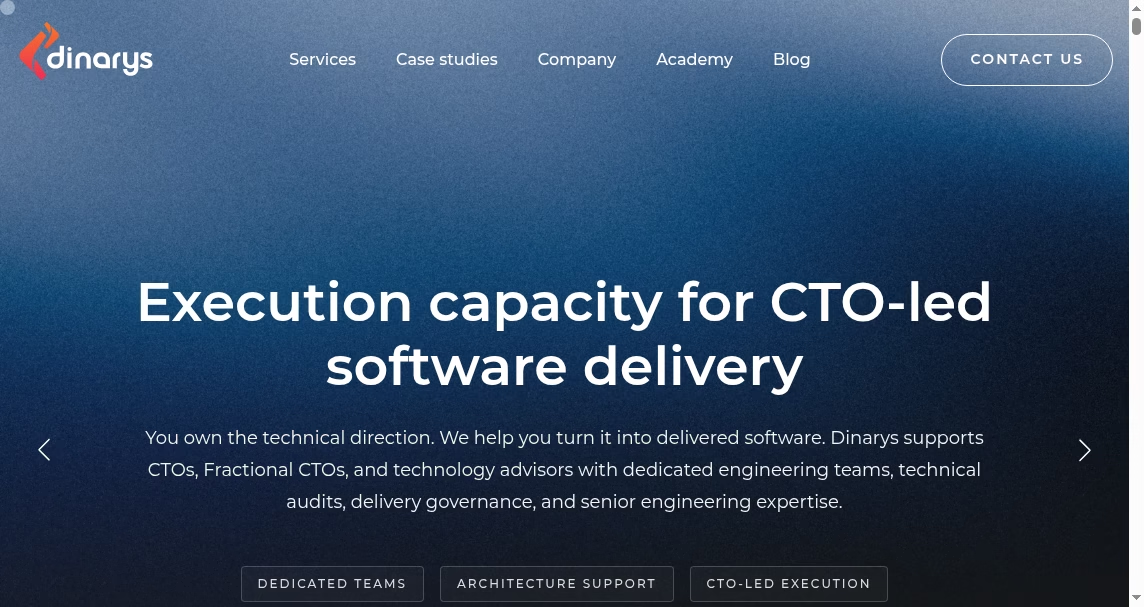
Dinarys has a dedicated MVP page covering analysis, collaboration, product planning and development, while its current homepage emphasizes CTO-led execution, dedicated engineering teams, architecture support, delivery governance and technical rescue. The MVP page discusses the target audience, competitors and business environment as inputs to feature selection. The current positioning is therefore broader than the older description of a startup-only launch partner.
This may be useful when a founder already has technical direction or when an early product needs a stronger delivery team. Ask whether the company is taking ownership of a defined release or adding capacity under your CTO. If a build has stalled, request an assessment that separates product-scope problems from code quality and project-management problems. Rebuilding everything should not be the default response to a delayed MVP.
Confirm what is included in the initial analysis, who owns architecture decisions and how progress is demonstrated. For rescue work, get a prioritized stabilization plan with measurable checkpoints, access requirements and rollback arrangements before committing to a larger implementation.
Explore Dinarys’s current offer
Historical entry not included in the current shortlist
The earlier version also listed UIG Studio. Its old domain now displays an unrelated transport and logistics business, and continuity with the former software company was not established. It is not counted or recommended here as a current MVP provider.
How to turn a product idea into a useful MVP brief
Write the assumption before the feature list
Start with one user, one problem and one action. For example, a small-business owner might upload invoices and return each week to review overdue payments. The test is not whether a dashboard exists; it is whether the owner uses that workflow enough to change an existing habit. Give the vendor the current workaround, the user's reason to switch and the evidence that would make you continue. A vague goal such as "validate the idea" is difficult to price or test.
Pick a learning measure before implementation. Completion of the main action, repeat use, conversion to a paid plan or time saved can be relevant, depending on the business. A count of registrations alone may hide poor use. Agree the observation window and who will interpret the evidence. These are product decisions for the owner, not facts a development agency can establish from a specification.
Separate a prototype, a feasibility test and the live release
Use a prototype when the uncertain part is navigation, terminology or the offer itself. Use a technical proof of concept when an integration, model or data source may not work. Build a live MVP when you need to observe real behavior in a usable workflow. Combining all three into one undefined phase makes it harder to understand what the money is buying. Ask each vendor to name the output and the decision that output enables.
The live release still needs appropriate testing, data handling, recovery and access controls. A payment or medical workflow cannot omit necessary controls because the product is small. Reduce secondary features first. Keep the operational requirements that allow invited users to complete the main task safely, and document any manual work used behind the scenes.
Put exclusions and dependencies in writing
Describe what the first release will not do: additional user types, languages, devices, reporting, integrations or automation. Identify external dependencies such as payment approval, app-store review, sample data and access to third-party APIs. Ask the vendor to show a critical path and the owner inputs required at each point. A short advertised timeline is useful only when both sides understand the assumptions behind it.
Make the handover part of the brief. Name the repositories, accounts, design files, tests, deployment instructions and support arrangements that you expect to receive. If a founder cannot access those assets, changing a vendor can become expensive even when the original contract was inexpensive. Avoid shared accounts where an owner-controlled account with limited collaborator access will do.
How to compare proposals without buying the wrong delivery model
Compare responsibility, not just hourly rates
A managed project, a dedicated team and individual staff augmentation distribute responsibility differently. In a managed project, ask who owns scope, acceptance, release and defects. In a dedicated team, ask who supplies product management and technical direction. With staff augmentation, the buyer usually needs a workflow capable of directing and reviewing the engineers. Do not compare prices until these responsibilities are made explicit.
Send the same brief to the finalists. Request the named roles, planned involvement, major assumptions, exclusions and change process. A lower price may exclude discovery, QA, deployment or support. A higher price may fund unnecessary architecture. Compare the work needed to answer the first product question, and ask each team to explain any material difference in scope.
Test the team's reasoning with a small paid discovery phase
Before a large build, a bounded discovery phase can show how a vendor challenges assumptions, communicates risks and makes technical choices. Define its outputs and ownership first. Useful outputs include a prioritized user journey, a feature boundary, a tested prototype where appropriate, an implementation estimate and a risk list. The phase should leave you with usable material even if you do not hire that vendor for development.
During evaluation, ask what evidence would make the team remove a feature, delay a platform launch or recommend not building. A team that agrees with every request may be easy to work with initially and costly later. Check who will actually attend planning and delivery meetings; the sales conversation is not a substitute for meeting the people responsible for the release.
Budget for launch and the next decision
The build is only part of the cost. Ask about hosting, model or API charges, monitoring, analytics, support, defect fixes and the first iteration after user feedback. Distinguish optional subscriptions from services the application needs to function. For third-party tools, record account ownership and how costs change with use. Ask for assumptions, not an unsupported universal MVP price.
Set the post-launch decision in advance: continue, revise the core workflow, run another test or stop. Allocate enough owner time to recruit users and read the evidence. A vendor can deliver software, but a founder still needs a route to the intended customers. An MVP without users and a measurement plan may become a demonstration rather than a learning tool.
MVP development questions
What should an MVP development company deliver?
The answer depends on the engagement, but a managed MVP project should define the user journey, first-release scope, implementation, testing, deployment and handover. Discovery artifacts, analytics and support should be named rather than assumed. Ask which outputs are included in the quoted price and who owns each decision. A staffing contract may provide engineers while leaving product management and acceptance with you.
How is an MVP different from a prototype?
A prototype usually tests a concept or user experience without running the full live service. An MVP lets a real user complete the core task and produces evidence about behavior. A proof of concept answers a technical feasibility question. Choose the smallest artifact that addresses the uncertainty you have, rather than paying for a full build when a prototype or limited technical test would be enough.
How long does MVP development take?
There is no single timeline supported for every product. Scope, integrations, data access, security requirements, team availability and release approvals all matter. Some vendors advertise short delivery windows, but those claims depend on assumptions and exclusions. Ask for a plan tied to your specific user path, with owner inputs and external dependencies shown separately from engineering work.
How much does an MVP cost?
These company pages do not establish a comparable current price for your project. Request written proposals using the same scope and compare discovery, design, QA, deployment, handover and support. Include ongoing hosting and third-party charges. A fixed fee is meaningful only with clear acceptance criteria and change rules; time-and-materials needs visibility into effort, progress and the remaining work.
Should I choose fixed price or time and materials?
Fixed price can suit a well-defined release with stable requirements, provided exclusions and changes are explicit. Time and materials can suit a product whose scope will change from testing, but it needs active prioritization and budget controls. Neither model removes product uncertainty. Ask how both models handle new findings, defects, delayed owner inputs and work that no longer needs to be built.
Do I need AI in my MVP?
Only when it serves the customer problem or the assumption you are testing. An AI-led vendor may offer useful capabilities, but model integration adds evaluation, privacy, failure handling and recurring costs. Ask whether a simpler rule-based or manual workflow can answer the first question. If AI is essential, define acceptable output quality, human review and the behavior when the model cannot provide a useful answer.
Who should own the source code and cloud accounts?
Put ownership and access in the contract. The buyer should understand the rights to code, designs, data and documentation, including any vendor or third-party components that cannot be transferred. Owner-controlled repositories and service accounts make later handover easier. Have a qualified adviser review terms where ownership, licenses or personal data are material; a verbal assurance is not a replacement for the agreement.
Are these companies ranked or independently quality-verified?
No. This is a current-offer comparison based on the companies' own official pages, not an independent delivery audit. Homepage screenshots establish what the sites currently show, not the quality of future work. Check relevant references, meet the proposed team, review a comparable project and verify availability and terms before choosing a partner.
Make the shortlist smaller before making the product larger
Start with the companies whose current offer matches your delivery model and technical needs. Then use one brief to compare responsibilities, assumptions and the first-release boundary. The best next step is a proposal that makes the learning goal measurable, not the longest roadmap or the strongest marketing claim.







Leave a Reply