
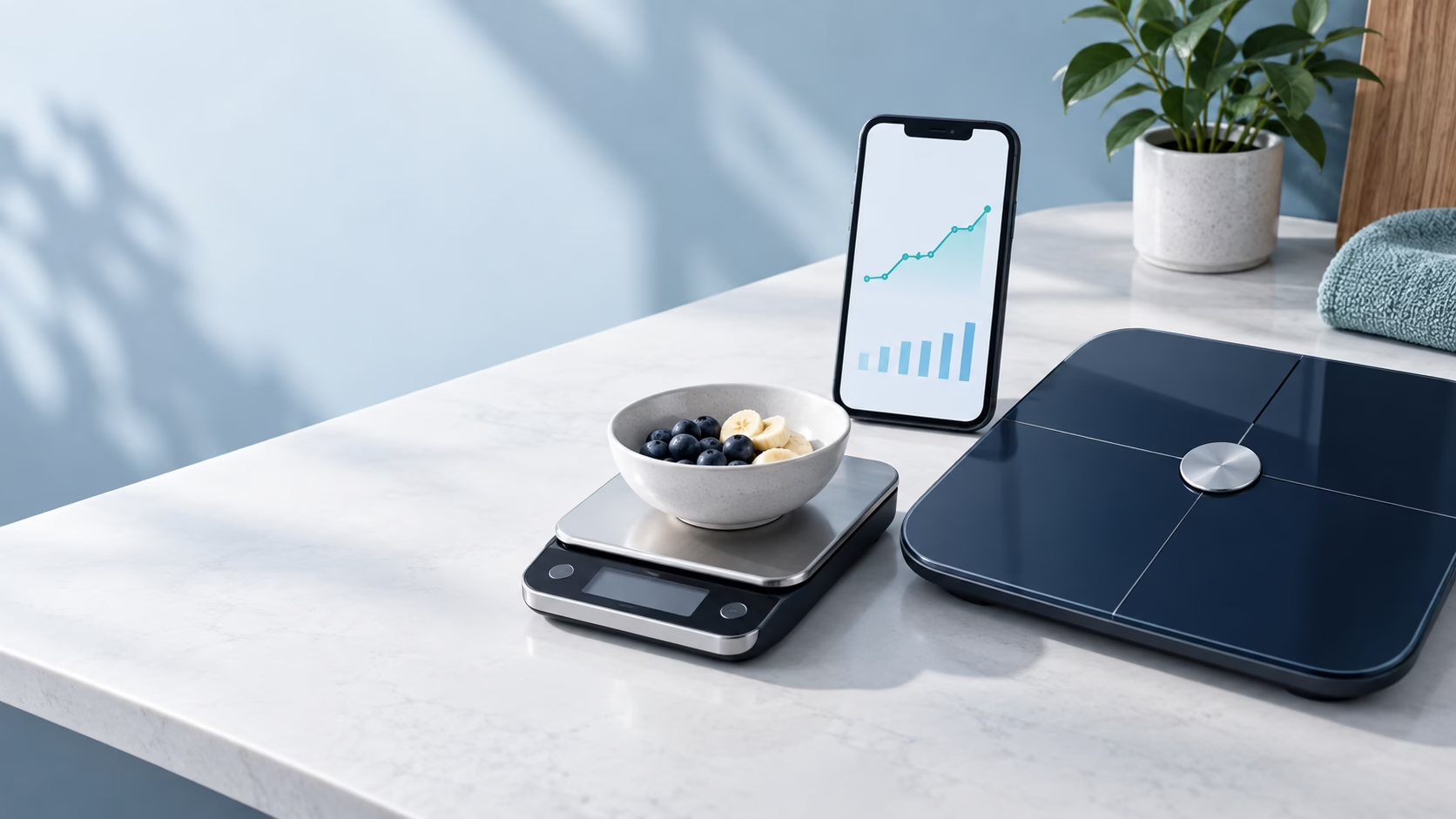

Can a phone weigh an object by itself? Not reliably. A weighing app either receives a reading from a real scale, logs a weight you enter, or simulates a scale for entertainment. Do not put coffee beans, jewelry or food on your phone screen expecting a gram reading. If grams matter for cooking, postage or valuables, use a calibrated physical scale. Apple’s built-in Measure app measures dimensions, not mass. Even experimental pressure-screen approaches were restricted and are no substitute for scale hardware, as The Verge reported.
This guide compares 16 current apps by what they actually do. We reviewed manufacturer documentation and available official app listings for this October 2026 update. We did not install the apps or independently test measurement accuracy. Compatibility varies by phone OS and scale model; check both before buying hardware.
The scale and the app disagree: check the reading before changing the software
A wrong-looking number can come from measurement, units, the selected person or a sync delay. Those are different problems. Compare the number shown on the physical scale with the new reading in the app, then check the timestamp, active profile and unit. Do not delete the old history or repeatedly reset hardware before you know which step failed.
If the physical measurement looks wrong
Start with the exact model’s manual. For example, RENPHO’s body-composition scale manual says a moved or turned-over scale needs recalibration: on a firm, flat surface, wake it with one foot, remove the foot and let it return to zero. That sequence is model guidance, not a universal reset for every Bluetooth scale. Do not apply it to a coffee or kitchen scale with a different calibration method.
Garmin’s Index S2 instructions recommend a hard, flat floor and standing still with feet flat. Its measurement guide explains that body composition is estimated using bioelectrical impedance and can vary with hydration and recent activity. A changing estimate is not the same as an app failing to sync. Follow the manufacturer’s precautions and do not use a consumer body-composition estimate to diagnose a medical condition.
If the scale is right but the app shows an old or different result
- Compare the same measurement. Check date and time, unit and active person before comparing two numbers. A previous reading or another household member’s profile can look like an accuracy failure.
- Separate a manual entry from a connected reading. Weight loggers such as WeightFit and Happy Scale organize numbers you enter; they do not add a weighing sensor to the phone. Confirm where the number came from.
- Verify the exact app-model pairing. A Bluetooth logo does not establish compatibility. Acaia’s app compatibility guide, for example, distinguishes its apps by supported scale. Use the manufacturer’s documented route for the hardware you own.
- Keep useful evidence for support. Record model, app version, phone OS, the displayed number and the app timestamp. Describe whether the scale failed to measure, connect or save. That is more useful than saying only that the digital-scale app is inaccurate.
For a kitchen or coffee scale, also check grams versus ounces, tare and whether you are reading total weight or a timed brewing display. Use that scale’s calibration and support instructions. The phone app can display, log or help interpret a reading, but the physical hardware and its setup still determine whether you measured the right thing.
Quick comparison: which app fits your scale?
- Withings (iPhone, Android): Withings smart-scale ecosystem; a compatible scale does the weighing.
- RENPHO Health (iPhone, Android): RENPHO scale and household profiles; a compatible scale does the weighing.
- VeSync (iPhone, Android): Etekcity food or body scale, depending on model; a compatible scale does the weighing.
- Garmin Connect (iPhone, Android): Garmin Index S2 and fitness data; a compatible scale does the weighing.
- Wyze (iPhone, Android): Scale Ultra with Wi-Fi or Bluetooth sync; a compatible scale does the weighing.
- eufy Life (iPhone, Android): supported eufy smart scales; a compatible scale does the weighing.
- WeightFit (Android): manual weight log; use any real scale and enter its result.
- Happy Scale (iPhone): smoothed weight trends; use a real scale and record the result.
- Weight Gurus (iPhone, Android): body-scale sync for supported hardware.
- Smart Chef (iPhone/iPad): food logging with a Smart Chef scale.
- Acaia Brewmaster (iPhone, Android): coffee-brew graphs with Acaia scales.
- Acaia Brewguide (iPhone, Android): recipes for the Pearl S family.
- Arboleaf (iPhone): Arboleaf body composition scales; a compatible scale does the weighing.
- FITINDEX (iPhone): FITINDEX smart body scales; a compatible scale does the weighing.
- TIMEMORE Coffee (iPhone): brew curves with Black Mirror scales and Dot.
- HIROIA JIMMY (iPhone): pouring modes with the JIMMY scale.
Bottom line: For grams in a kitchen, choose a compatible food scale with an app such as Etekcity’s VeSync. For body-weight history, pick the app that matches your existing scale, or use a manual tracker if you do not need automatic syncing.
1. Withings: best if you already use a Withings smart scale

The Withings app gathers measurements from Withings devices and shows weight and body-composition trends alongside other health data. It is available on iPhone and Android. A Withings scale does the weighing; the phone does not. Check the current app listing and your exact scale model before upgrading.
Withings says its app tracks data from its smart health devices, including smart scales, smartwatches, blood pressure monitors, sleep analyzers and thermometers, so you get one view of your health. In the body health area you can set goals and track weight and body composition and view your trends, and you can join programs for motivation.
Trade-off: Convenient if you are in the Withings ecosystem; buying its scale is a separate hardware decision. Some features are offered under Withings+; do not assume everything in the app is free.
2. RENPHO Health: best for a RENPHO scale and family profiles

RENPHO’s setup guide says to pair a supported scale over Bluetooth, stand on the physical scale, then view measurements in RENPHO Health. The app is listed for iPhone and Android. It supports multiple profiles; its documentation also describes manual entry of body-weight data.
RENPHO’s own safety notes add useful limits: its page says the scale should not be used to diagnose or treat any medical condition, is not intended for pregnant women or for children under 10, and should be avoided if you have a pacemaker or similar implanted device. Read these notes for your model before you rely on body-composition numbers.
Trade-off: Its body-composition values are estimates and not a diagnosis. RENPHO says pregnancy, implanted medical devices and other circumstances require special care; read the manual for your model before using the body-composition feature.
3. VeSync: best for a compatible Etekcity food scale

For a recipe or food log, the physical Etekcity ESN00 Smart Nutrition Scale weighs ingredients and pairs with VeSync for nutrition information. VeSync is listed on the App Store and Google Play. Select a compatible food scale if you need grams; a body scale is not interchangeable with one.
Etekcity’s product page for the ESN00 says it connects to the free VeSync app, Apple Health and Fitbit to track up to 19 nutrients and build daily, weekly and monthly reports, using food data from Nutritionix. It weighs from 3 g to 5000 g in 1 g steps and switches between oz, lb:oz, g and ml. Its barcode scanner is listed as US-only.
Trade-off: You need the supported Etekcity hardware. Food-database nutrition numbers are estimates and are different from the scale’s mass reading.
4. Garmin Connect: best if you own an Index S2

The Garmin Index S2 setup manual explains how to set the scale up with Garmin Connect and Wi-Fi; the physical scale supplies the reading. Garmin Connect has iOS and Android listings. It makes the most sense if your weight trend belongs beside activity and training data you already keep in Garmin.
Garmin’s Index S2 manual says you can use the Garmin Connect app to turn widgets and weight metrics on or off on the scale display, and that changes take effect after you record a measurement and sync. That fits people who already manage a Garmin watch or other device in the same app.
Trade-off: It is not a stand-alone kitchen scale app. Check phone compatibility and network requirements against Garmin’s current manual before buying the scale.
5. Wyze: best for Scale Ultra and smart-home users

Wyze Scale Ultra records weight on the scale and syncs to the Wyze app over Wi-Fi or Bluetooth. Check the current store listing and product manual for phone compatibility. The app itself is listed on iOS and Android.
Wyze’s support page says the Scale Ultra connects over Bluetooth, Wi-Fi, both or neither, and still measures when you step on without your phone. It has a 4.3-inch screen for metrics and trends and lists 13 body composition measurements, including weight, body fat, BMI, muscle mass, visceral fat and heart rate.
Trade-off: The product page calls body-composition figures BIA estimates for reference, not a clinical result. iPhone app OS requirements can be stricter than the scale hardware page, so check the current listing for your phone.
6. eufy Life: best for eufy smart-scale owners

eufy’s P2/P3 setup instructions pair the physical smart scale to the app over Bluetooth, with a Wi-Fi setup option on supported models. The app has iOS and Android listings. Verify your exact scale model against eufy’s setup page; eufy sells several device families with different connections.
eufy’s support article says the first time you use the app you fill in basic information such as gender, age and height, and that Bluetooth permission for the app must be turned on before setup. The app can be downloaded from Google Play or the App Store.
Trade-off: It is a companion to supported eufy hardware, not a way to weigh an item directly on your phone.
7. WeightFit: best simple Android manual log

WeightFit’s Google Play listing describes weight entries, charts and trend lines, goal tracking and CSV export; the current listing notes optional Health Connect sync. This is a practical choice if you already have an ordinary bathroom scale and just want a history on Android.
The Google Play page also lists a BMI calculator that works out your BMI and ideal weight, a personal target weight, statistics such as average weight and difference from your starting weight, optional reminders to log your weight, metric or imperial units, and syncing with Google Fit.
Trade-off: It tracks a number you enter or sync, not the mass of an object placed on your phone. The listing shows ads and in-app purchases; check what the free version covers.
8. Happy Scale: best iPhone trend view

Happy Scale’s developer describes a smoothed trend line, goals and predictions based on recorded body weights. It is listed on the iPhone App Store. It is a tracker for people who want to see a longer-term trend despite daily fluctuations.
Happy Scale’s site says it smooths out daily scale weights and predicts when you will hit your goals, and that you do not need weeks of data before the math starts giving insights. The trend line can keep moving even when the scale does not, which the developer pitches as a way to change your relationship with the scale.
Trade-off: The app does not turn the iPhone into a physical scale. It needs a real measurement as input, and predictions are projections, not guarantees.
9. Weight Gurus: for compatible Greater Goods body scales

Weight Gurus connects the phone to supported body scales. Its current iPhone listing describes Bluetooth, Wi-Fi, App Sync and hybrid models, account backup, goals, charts and CSV export. It also has an Android listing. The correct connection depends on the hardware you own: two scales sold under the same brand need not use the same setup.
Use it for: Recording body weight automatically from a supported scale, or reviewing a longer history instead of remembering each reading. Choose the profile that belongs to the person weighing in and check that the latest record has the right date and units.
Limit: This is not an app for weighing a parcel, ring or spoonful of flour. Body-composition numbers are estimates, and available metrics depend on the scale. The developer’s older website and newer store listing differ on phone compatibility; use the current store listing for your device rather than an old minimum-OS claim.
10. Smart Chef: for a supported food scale and kitchen logging

Smart Chef Smart Food Scale is an iPhone/iPad app whose listing explicitly requires a Smart Chef Pocket Smart Food Scale. It describes recipe building, unit conversion, food logging, coffee or tea brewing and a talking-scale workflow. That hardware requirement is the important difference between a real kitchen-scale companion and a phone-only simulator.
Use it for: Following ingredient weights on a compatible scale and keeping food information alongside the reading. A simple baking workflow is to put an empty bowl on the scale, tare it, add the first ingredient, and record its mass before moving to the next ingredient. Confirm the hardware’s capacity and resolution before choosing it for your recipe.
Limit: Nutrition information is not the same as measured mass. App-store reviews include both helpful experiences and connection/interface complaints, so do not assume a listed feature will work perfectly on every phone. Check the current listing and manufacturer instructions before buying. This guide has not independently tested its accessibility features or integration accuracy.
11. Acaia Brewmaster: for logging coffee brews from Acaia scales

Acaia Brewmaster is a coffee-specific scale companion, not a general body-weight app. Acaia describes saving a visual graph of brewing data after a brew and recommends it for espresso logging. Its app compatibility guide says Brewmaster connects with Acaia scales; the apps page provides iOS and Android routes.
Use it for: Reviewing what happened during a coffee brew when a supported scale supplies the weight readings. Keep the dose, output and timing comparable between attempts. A graph can help you compare a recipe with the next attempt, but it does not decide whether the coffee tastes good.
Limit: Acaia hardware is required for the connected weighing workflow. This is a specialized choice for people who already brew with that equipment, not a reason to buy a coffee scale merely to obtain a free app. Check the current scale model and app pairing before installing.
12. Acaia Brewguide: for Pearl S brewing recipes

Acaia Brewguide lets users create or find coffee recipes and upload guides to the Pearl S. The manufacturer presents it as a recipe-sharing app for that scale family and lists iOS and Android availability. Its compatibility page distinguishes Brewguide’s Pearl S support from Brewmaster’s wider scale support.
Use it for: Repeating a pour-over recipe with instructions on supported Pearl S hardware. Pick it when a step-by-step brewing guide matters more than reviewing a graph afterward. Brewguide and Brewmaster are separate apps with different jobs, not two interchangeable names for the same tool.
Limit: Do not expect Brewguide to pair with every Bluetooth kitchen scale. A generic Bluetooth label does not establish app support. Confirm your Pearl S model against Acaia’s current documentation; app features and supported hardware can change.
13. Arboleaf: for Arboleaf body composition scales
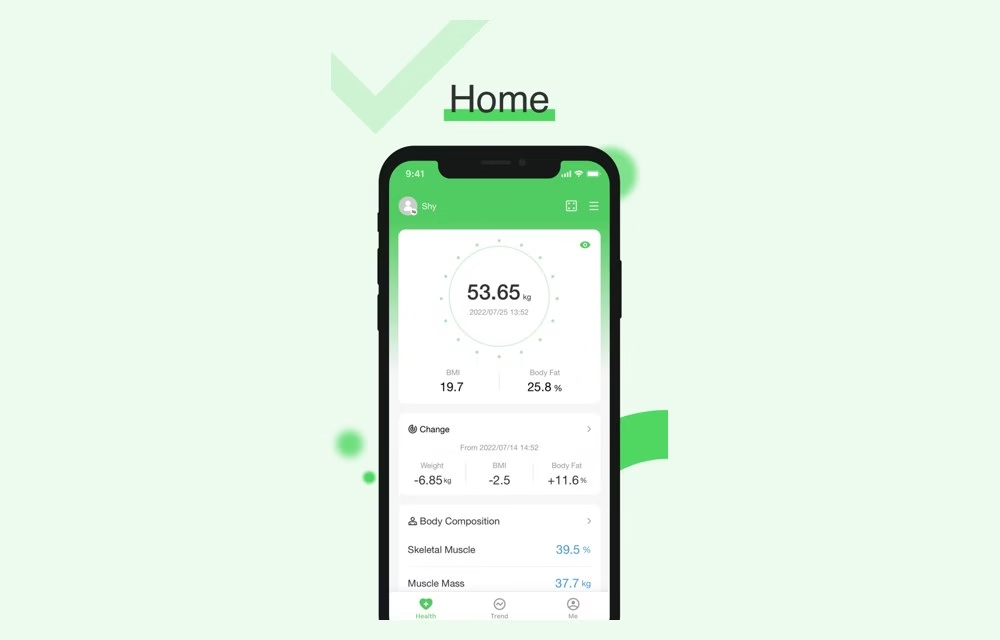
The Arboleaf app is the companion for Arboleaf body composition smart scales. Its App Store listing says it tracks body weight, body fat, BMI and other body composition data, and that it works with Arboleaf scale models. The app connects with fitness apps such as Apple Health and Fitbit, according to the same listing. View the official App Store listing.
Use it for: Reviewing body-composition trends when you already own an Arboleaf scale.
Limit: The app only makes sense with that hardware, and the listing notes some scale models do not support every measurement. Body-fat and similar numbers from a home scale are estimates, so watch the trend and do not treat a single reading as exact.
14. FITINDEX: for FITINDEX smart body scales
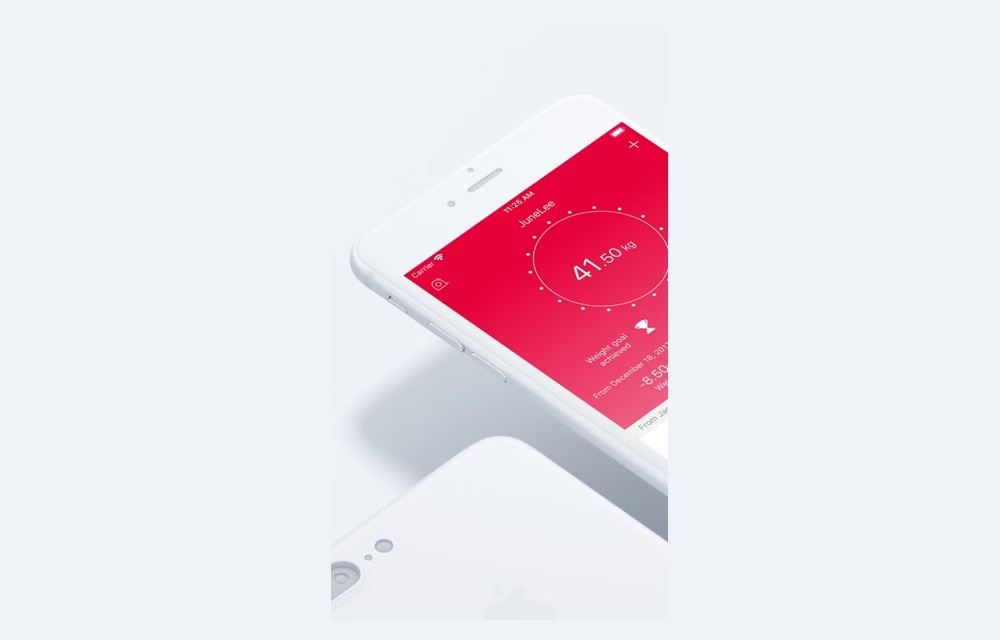
FITINDEX is the app for FITINDEX smart body scales. Its App Store listing says it tracks body composition measures such as BMI, body fat percentage, body water, bone mass and visceral fat level, with cloud-based charts and reports. It also describes family use, so several people can track from one scale, and syncing of weight data to Apple Health. View the official App Store listing.
Use it for: Households that share one FITINDEX scale and want separate charts per person.
Limit: You need a compatible FITINDEX scale for the weighing, and the app does not replace one. Check the scale model against the listing before you buy hardware.
15. TIMEMORE Coffee: for Black Mirror scales and Dot
Compatibility and data check: The current App Store listing requires iOS 13 or later and identifies contact information as data that may be linked to you. Check your phone compatibility and the developer’s privacy information before creating a community profile. The listing describes brewing curves and recipe sharing; it does not turn an unsupported scale or the phone itself into a measuring instrument. Test one brew with your specific Black Mirror or Dot model before relying on the recorded curve.
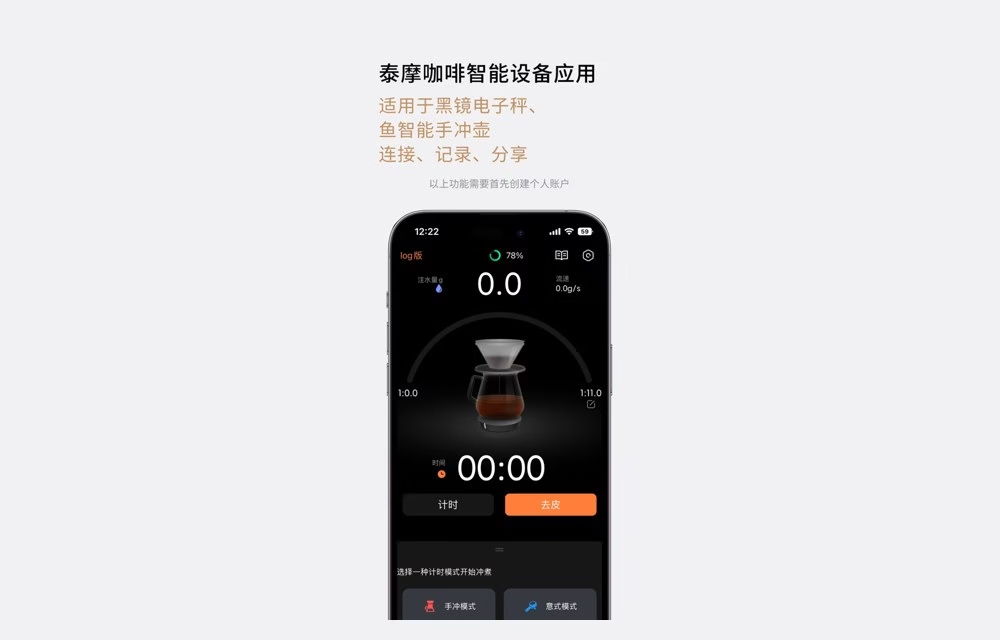
TIMEMORE Coffee is the companion app for Timemore Black Mirror scales and the Dot. Its App Store listing says it syncs brewing data in real time and generates brewing curves, and it also hosts a community for sharing recipes. View the official App Store listing.
Use it for: Reviewing a pour-over brew curve when you own a supported Timemore scale.
Limit: It is a coffee tool tied to Timemore hardware, not a general weight tracker. Confirm your scale model against the listing, since support can change.
16. HIROIA JIMMY: for the JIMMY brewing scale
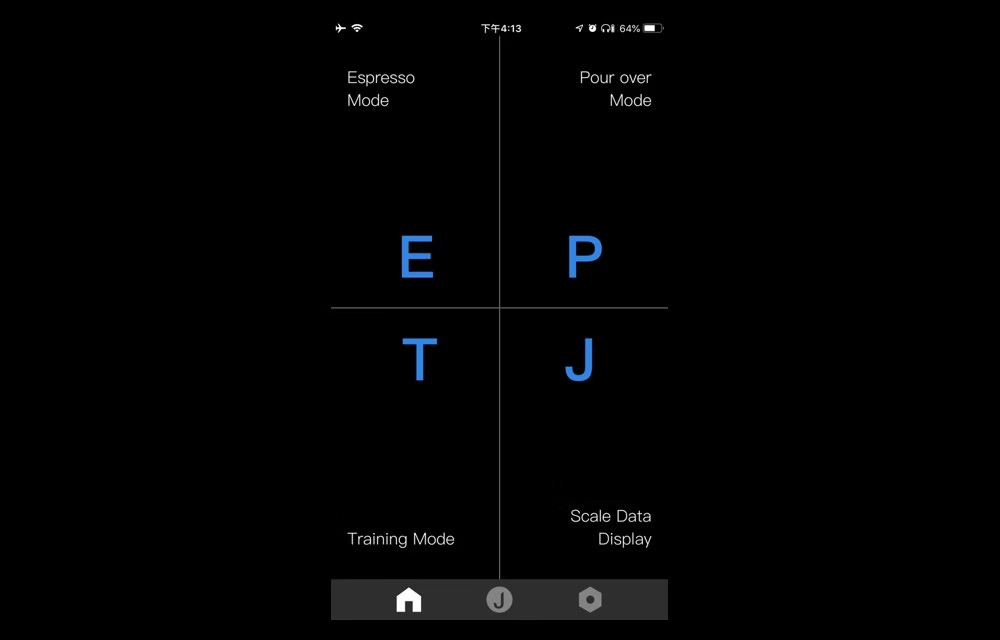
The HIROIA JIMMY app works with the JIMMY coffee scale. Its App Store listing describes an espresso mode that helps manage brewing quality, a pouring-practice mode that scores your stability, a pouring-plan mode with set flow rates, and remote control of the JIMMY. A companion watch app is listed for pouring practice with sound and vibration. View the official App Store listing.
Use it for: Practicing steady pour-over technique with the JIMMY scale.
Limit: It needs the JIMMY hardware to be useful. The listing describes training and brewing modes rather than general weight logging, so skip it if you only want a body-weight tracker.
How to measure grams with a digital kitchen scale app
For a trustworthy gram reading, the physical scale measures the object and the app displays or stores the result. A camera estimate is not the same measurement. Use a kitchen, pocket or coffee scale suited to the object and the precision you need.
- Check the pairing first. Read the model number on the scale and match it to the manufacturer’s app. For example, an Etekcity nutrition scale may use VeSync; RENPHO’s R-T001 food-scale manual specifies Gennec rather than RENPHO Health. Brand name alone is not enough.
- Set up on a stable surface. Follow the scale manual and select grams. Check the scale’s stated capacity and resolution. A body scale is not a substitute for a small-item scale.
- Tare the container. Put an empty bowl or tray on the scale and use its zero/tare control. This removes the container from the displayed ingredient weight.
- Add the item. Keep within the scale’s capacity and wait for a stable reading. Keep food and liquids away from the phone and follow the hardware’s cleaning instructions.
- Confirm the app record. Check the unit, timestamp and selected item before saving. If the app reads differently from the scale, pause and check the connection instead of choosing the number you prefer.
RENPHO’s R-T001 manual documents its flat-surface, tare and Gennec setup steps. These are model-specific instructions, not proof that every RENPHO scale uses the same app.
Free digital scale apps for Android: what is actually free?
A free download does not provide a free weighing sensor. Weight Gurus and Acaia describe their apps as free, but their connected workflows still require compatible hardware. WeightFit is a manual Android weight tracker with ads and in-app purchases listed on Google Play. For an ordinary bathroom scale you already own, entering the reading into a tracker can be enough.
If you search for a free digital scale app for an Android phone to weigh grams without equipment, look carefully at its description. The Grams Weight Scale Approximate listing, for example, describes a tilt-and-balance estimate, says accuracy cannot be guaranteed, recommends a real scale for accuracy, and explicitly warns not to place weight on the screen. It is not included among our recommended connected weighing apps.
Other camera-based listings promise an approximate range from a photo. Treat that as an estimate, not a scale measurement. A photograph does not establish a material’s hidden density, moisture or contents. Do not rely on an estimate for medication, valuables, postage or a recipe where the amount matters.
Best scale app for iPhone: pick by the job, not the name
For body weight, start with the app made for your existing scale: Withings, RENPHO Health, Weight Gurus, Garmin Connect, Wyze or eufy Life. If you need only a manual record and trend view, consider Happy Scale. For food, use a supported food-scale app such as VeSync or Smart Chef. For an Acaia coffee setup, compare Brewmaster’s logs with Brewguide’s Pearl S recipe workflow.
Do not confuse Apple’s Measure app with a digital gram scale. Measure works with dimensions, not mass. Historic 3D Touch weighing demonstrations depended on particular old pressure-sensitive hardware; they do not establish that a current iPhone can weigh objects safely or accurately. Never put a heavy, sharp, hot or wet item on a phone screen to try a scale app.
Bluetooth scale app not connecting? Work through this checklist
- Wrong app or model: Check the manual for the exact scale. RENPHO Health and Gennec serve different product workflows, and Acaia’s apps have different supported devices.
- Scale asleep: Wake the scale as its manual instructs. Check its battery or charge before blaming the app.
- Permissions: Enable the Bluetooth and device permissions the app requests for its documented connection method. Review why it needs each permission; do not grant unrelated access just to troubleshoot.
- Wrong connection route: Follow the manufacturer’s in-app pairing process. A device visible in system Bluetooth settings is not proof the app supports it.
- Wi-Fi model: Check the network requirements in the model’s setup guide. Bluetooth and Wi-Fi modes are not interchangeable on every scale.
- Wrong user: Check the active profile before weighing. A successful connection can still save a reading to the wrong household member.
- Still failing: Record the model, phone OS, app version and error message for manufacturer support. Avoid repeated resets that erase useful data without addressing the cause.
Body-weight apps, bathroom scales and health data
A body weight scale app is mainly useful for keeping readings consistent and seeing trends. Weighing under similar conditions can make comparisons easier; RENPHO’s documentation recommends a hard, flat floor and a consistent time of day. A single reading can vary for ordinary reasons. Use trends as context, not as a diagnosis.
Body-fat, muscle and water percentages from consumer smart scales are estimates. Follow the model’s safety guidance, especially if you have an implanted medical device or are pregnant. Speak with a clinician about medical decisions. A fitness scale app, body-measurement app and camera-based body scan are different tools and should not be presented as interchangeable measurements.
Before turning on cloud backup or connecting another health app, check which information will be shared. Use separate household profiles, review export and deletion options, and avoid sending weight histories unintentionally. Download from the developer’s official store route rather than a third-party APK page.
Jewelry, liquids, parcels and pocket scales: when an app is not enough
Jewelry: Use a suitable calibrated physical scale with the resolution and capacity required for the task. A “precision digital scale app” name does not prove measurement precision. Do not value or trade an item using a camera estimate or a phone-screen experiment.
Liquids: Mass and volume are different quantities. Grams measure mass; milliliters measure volume. A conversion depends on the substance’s density, so a liquid-scale app should not treat every liquid as water. Check the scale’s manual for any built-in volume mode.
Parcels: Use a scale that can support the parcel and check the carrier’s own rounding and service rules. A kitchen or pocket scale may have the wrong capacity. The app can record the number, but it cannot make an overloaded scale accurate.
More questions about weighing scale apps
Is there a scale app that really works?
Yes, as a companion to a supported physical scale or as a log of real measurements. The key question is where the measurement comes from. If there is no scale hardware and the app only takes a photo, tilts a phone or imitates a display, it should not be treated as a reliable weighing instrument.
Can an app weigh me without a bathroom scale?
No app in this comparison measures your body weight from the phone alone. Smart-body-scale apps receive readings from their hardware; manual trackers need you to enter a reading from a real scale.
Does a touch scale app work on Android?
Do not assume so. A touchscreen response is not proof of a calibrated mass measurement. Android apps that describe tilt or camera estimates have different limitations, and their developer claims do not make them substitutes for a physical scale.
Can I use a digital scale app online in a browser?
A website can display or record information, but browser access does not add a weighing sensor to a phone. Historical pressure-screen experiments were device-specific. For dependable weighing, use the correct scale hardware and its supported app.
What should I check before choosing a smart scale app?
Check the exact hardware model, phone compatibility, connection method, units, capacity, measurement resolution, cost of optional app features and data-sharing settings. Install the app first if possible to confirm that its current store listing supports your phone.
Is Scale Up, Magic Scale or Rawtech the same as one of these apps?
No. Similar search names are not enough to identify a developer or establish compatibility. Match the developer name, official store link and model manual before downloading. This guide does not recommend an unverified app just because its name contains “scale”.
How to choose without a misleading scale claim
- Need grams for cooking? Use a real kitchen scale; if you want the phone log too, check the precise model-to-app pairing first. VeSync with a compatible Etekcity food scale is one example.
- Need body-weight sync? Choose the app supported by your physical scale. Model requirements, OS minimums and Bluetooth/Wi-Fi setup matter more than a generic top-15 ranking.
- Only want a log? A manual app such as WeightFit (Android) or Happy Scale (iPhone) avoids buying new hardware if you already own a working scale.
- See an app promising exact grams from a bare phone? Treat it as a simulation unless it names and supports external scale hardware; do not rely on it for food, medication, shipping or trade.
Frequently asked questions
Can I use my phone as a digital scale without hardware?
Not as a trustworthy gram or body-weight scale. A phone can display a reading from a connected scale or record a value you type. Its camera-based or pressure-screen experiments are not a substitute for a calibrated weighing sensor.
Will any Bluetooth scale work with any app?
No. Pairing protocols and supported models differ. Check your scale’s official manual and the app listing, not just “Bluetooth” in the product name.
Is a smart body scale’s body-fat number exact?
No. Consumer scales commonly estimate body composition. Manufacturers warn about limits and special-use cases. Discuss medical decisions with a clinician.
Explore our apps guides and no-code app builders comparison for other software decisions. Those guides are not weighing recommendations.


Leave a Reply