


Last updated: October 2026.
Welcome to JCA’s guide to the top AI app development companies in 2026. AI has moved from experiment to line item: the companies below are the development partners businesses are actually hiring to build AI-powered applications, from mobile apps with intelligent features to enterprise systems where AI agents run whole workflows. If your immediate need is task-level automation rather than a custom build, start with our tested list of the best automation tools; if you are planning an AI application and want a budget first, our app development cost calculator will give you a realistic range before you talk to anyone.
This guide profiles 20 AI app development companies worth shortlisting in 2026. Every entry was re-verified this month: we visited each company’s official website, confirmed its current positioning and services, and captured a fresh screenshot of its homepage, which you will see under each heading. Rankings here are editorial, based on the strength of each company’s published AI work, delivery record and specialization – not paid placement. We do not accept payment for inclusion, and we say so plainly when a company’s focus has shifted since our last review.
Two quick filters before the list. If you know your category already, our more specific guides may get you there faster: we maintain dedicated rankings of telemedicine app development companies, taxi booking app developers, retail and e-commerce development companies and blockchain development companies. And if you are weighing whether to build at all, our comparison of the best no-code app builders shows what is possible without a development partner.
What separates an AI app development company from a regular app agency in 2026? Three things. First, data engineering depth: AI features live or die on the pipeline feeding them. Second, production experience with LLMs and agents: a demo is easy, a feature that stays accurate under real usage is not. Third, an honest scoping process: the best partners will tell you when a rules-based workflow or an off-the-shelf automation tool solves the problem cheaper. Every company below cleared those bars in its own way. For the broader context on where mobile development is heading, see our rundown of the biggest mobile app development trends.
Top 20 AI App Development Companies in 2026
Here is the full list, in alphabetical and editorial-balance order rather than claimed merit – each profile notes who the company fits best. Every screenshot below was taken from the company’s live homepage in October 2026.
1. Fingent

Official website: fingent.com
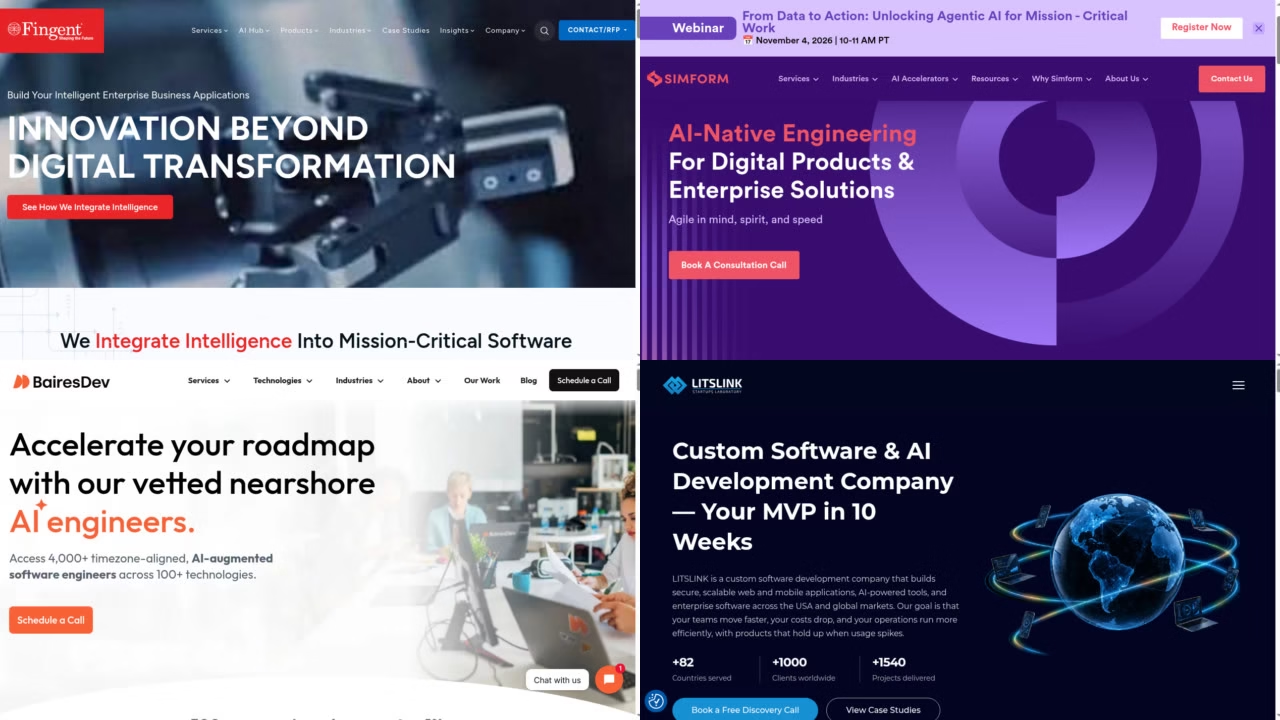
Fingent is an ISO 27001-certified custom software development company whose current pitch is simple: it integrates intelligence directly into the mission-critical software a business already runs on. Rather than treating AI as a bolt-on, Fingent builds what it calls the intelligent enterprise – business applications where AI is embedded across the whole software development lifecycle, from cost estimation and requirements validation through design, coding, testing and security.
The company positions its delivery around measurable outcomes, citing faster time to market, lower delivery cost and reduced planning time on its AI-engineered process. Its services span custom software, web and mobile applications, data and AI solutions, and modernization work for mid-size and enterprise clients, with dedicated industry practices and a products arm. For a buyer, the practical draw is a single partner that can take a legacy system and layer in AI capability without a rip-and-replace program.
2. Simform

Official website: simform.com
Simform describes itself as an AI-native digital engineering company, and its 2026 positioning backs that up with partner credentials: it has achieved Claude Select Services Partner status for enterprise AI systems and holds Microsoft Solutions Partner designations, including one for AI business solutions, plus an Azure Virtual Desktop specialization. That partner stack matters because it signals the company builds on the same foundation models and cloud platforms its clients are standardizing on.
Simform’s core work is product and platform engineering – digital products, data engineering, cloud and DevOps, and application modernization – delivered with agile teams that slot into a client’s existing organization. The company also markets AI accelerators that shorten common builds. For enterprises that want an engineering partner already fluent in agentic AI patterns rather than one learning on their budget, Simform is one of the more credentialed options on this list.
3. LITSLINK

Official website: litslink.com
LITSLINK is a US-based custom software and AI development company that leads with speed: its headline offer is an MVP in 10 weeks. The numbers it publishes are substantial for a firm its size – more than 82 countries served, over 1,000 clients and 1,540 projects delivered. Its services run from an initial MVP through scalable enterprise software, covering web and mobile applications, AI-powered tools and dedicated AI agents.
The company organizes its offer around outcomes a buyer can hold it to: teams ship more with fewer people stuck in details, products hold up when usage spikes, and operations get cheaper to run. LITSLINK also maintains industry-specific practices and a hire-developers model for companies that want staff augmentation rather than a full project handoff. For startups and mid-market companies that need a working AI product on a fixed, short timeline, its MVP-first model is the clearest fit on this list.
4. Net Solutions
Official website: netsolutions.com
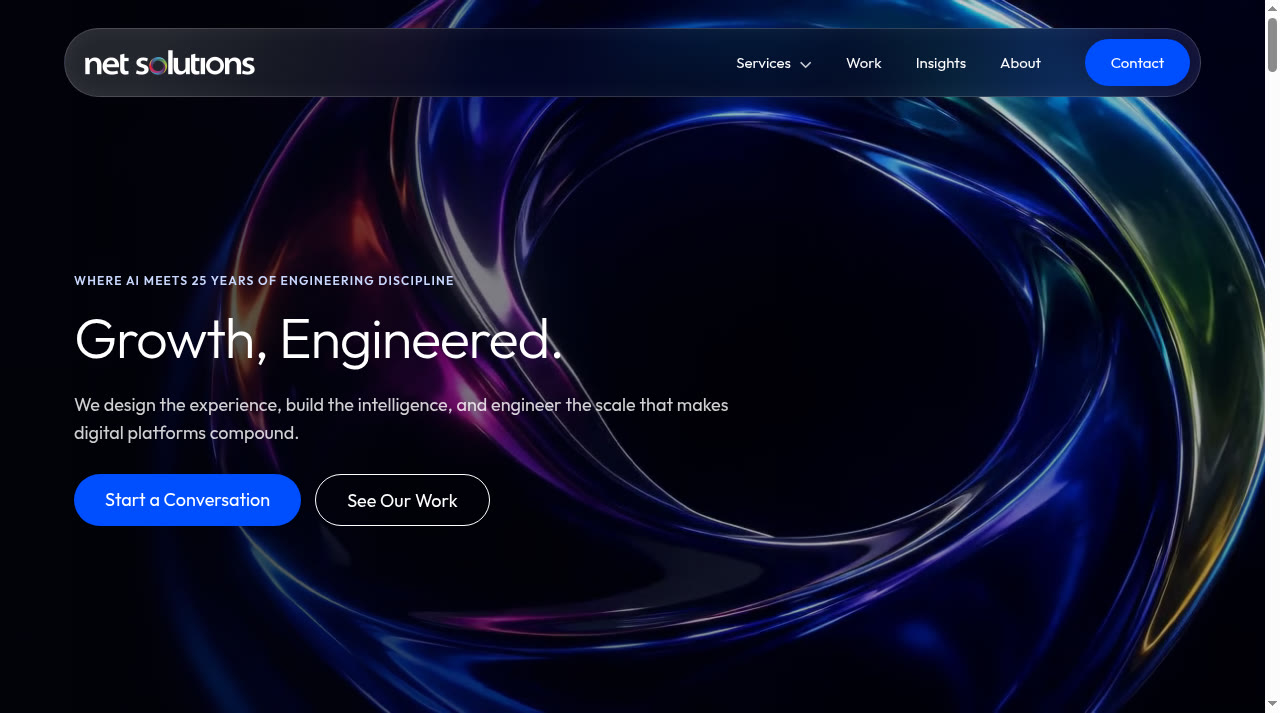
Net Solutions frames its 2026 offer as where AI meets 25 years of engineering discipline. That long history is the point: this is a product engineering firm that has shipped through several technology cycles and now applies the same discipline to AI-native builds. Its service lines cover data and AI engineering, commerce engineering, application modernization, product and platform engineering, and experience design.
A current focus is the Digital Product Passport wave in Europe, where Net Solutions helps commerce brands turn mandated product data into a growth asset rather than a compliance chore – a good example of how it approaches AI work generally, starting from the data foundation. The company designs the experience, builds the intelligence and engineers the scale, in its own words. Retail and commerce organizations that need an AI partner fluent in both storefront engineering and data platforms will find its profile unusually well matched.
5. BairesDev

Official website: bairesdev.com
BairesDev is the nearshore scale play on this list. It fields more than 4,000 timezone-aligned software engineers across over 100 technologies, draws them from what it calls the top 1% of talent, and says more than 500 companies rely on its teams. In 2026 its pitch is explicitly AI-augmented: every discipline from front-end and back-end development through QA, data and DevOps is delivered by engineers working with AI tooling, and its AI and machine learning practice ships LLM applications and ML pipelines built to survive production.
The delivery model is staff augmentation, dedicated teams and full project outsourcing, all on Latin American timezones that overlap the US working day – the practical reason buyers pick nearshore over offshore. For North American companies that need to add AI-capable engineering capacity fast without a long hiring cycle, BairesDev’s combination of scale, vetting and timezone alignment is difficult to match.
6. SoftKraft

Official website: softkraft.co
SoftKraft is a Poland-based custom software development company whose 2026 focus is process automation with AI. Its four service lines tell the story: AI and data engineering to turn a company’s data into a competitive edge, software audits that produce an actionable roadmap, full-cycle software development from first concept to complete product, and IT staff augmentation for teams that need extra senior engineers.
The company’s promise is custom AI solutions that integrate with existing systems rather than demanding a platform replacement, automating for efficiency and unlocking new growth. That audit-first approach is worth noting for buyers unsure where AI fits their stack: SoftKraft will assess the current software, identify where automation pays back fastest, and then build it. For European and US companies that want senior engineering talent at Central European rates with a genuine data engineering practice behind the AI label, SoftKraft is a strong candidate.
7. GrowExx

Official website: growexx.com
GrowExx builds what it calls AI systems that change how enterprises operate. Its differentiator is the combination of an Oracle partnership with AI and data product engineering: the company helps enterprises add an intelligence layer on top of an existing ERP-heavy stack through AI consulting, AI automation, Oracle consulting and custom software development. Its diagnosis is familiar to any operations leader – workflows that should run themselves still need people, and decisions that should be instant still wait on reports.
The delivery model combines ERP systems, AI-powered workflows and product engineering into solutions it says deliver measurable business outcomes. For mid-size and large enterprises already invested in Oracle or similar enterprise platforms, GrowExx offers a path to AI automation that works with the systems of record rather than around them – a narrower but more realistic promise than a ground-up rebuild.
8. Markovate

Official website: markovate.com
Markovate is a generative AI company through and through – not a generalist agency with an AI page, but a firm whose whole 2026 identity is engineering intelligence for impact. Its published case work is concrete: in manufacturing, an intelligent drawing-classification system with GD&T compliance verification made bill-of-materials extraction 70% faster; in construction, automated takeoff generation from large drawing sets reached 90% accuracy and cut bid-submission time.
The pattern across its manufacturing, construction and healthcare work is the same: take a document-heavy, expert-time-heavy process and turn it into an AI workflow with measurable accuracy and speed gains. Markovate emphasizes fast, secure, enterprise-ready delivery, and its services span generative AI development, AI agents and ML engineering. For industrial and field-services companies whose AI opportunities live in drawings, documents and bids rather than chatbots, Markovate’s portfolio is directly relevant.
9. Unicsoft

Official website: unicsoft.com
Unicsoft has sharpened its positioning since our last review: it now leads as a Web3 development company, with deep service lines in blockchain development, dApp development, smart contract development and audits, tokenization, DeFi and NFT platforms. It builds on networks including Hedera, Solana, Ethereum, Hyperledger and Cardano, and offers a DeFi platform accelerator for faster launches.
AI remains part of the offer – machine learning and AI development sit alongside the Web3 practice – but buyers should read Unicsoft correctly in 2026: this is the partner for products where AI meets blockchain, such as tokenized asset platforms with intelligent analytics or decentralized applications with ML-driven features. If your project is a conventional enterprise AI app with no Web3 component, other entries on this list are a closer fit; if it touches digital assets, Unicsoft’s certified network expertise is exactly what you want.
10. Apptunix

Official website: apptunix.com
Apptunix is an AI product engineering and software development company with 13+ years in the market, trusted by more than 500 global brands and claiming over $2 billion in client value delivered. Its enterprise work shows a distinctive range: a conversational AI platform for a UAE national CSR authority reaching 92% response accuracy across English and Arabic, a centralized sales reporting platform for dealers across Africa that cut processing time by 35%, and a drone-integrated delivery platform that made last-mile delivery 70% faster.
That mix – multilingual conversational AI, dealer-network data platforms and logistics hardware integration – signals a team comfortable beyond standard web and mobile builds. Apptunix offers enterprise strategy calls and publishes case studies for buyers who want evidence before a conversation. For organizations in the Middle East, Africa or North America looking for an AI product partner with government and enterprise delivery experience, it is one of the more proven options here.
11. Talentica Software

Official website: talentica.com
Talentica Software has spent two decades as the product engineering firm behind technology companies, and its numbers reflect that focus: more than 200 products shipped, 50+ AI solutions in production, 600 AI-native engineers, two in three customers arriving by referral, and 30+ successful customer exits. Its 2026 tagline – we don’t just build AI, we ship products with it – captures the difference between an AI demo and an AI feature users pay for.
The company now offers DevX AI Pods, a delivery model promising faster shipping at lower cost, and structures its services around two distinct journeys: AI startups that need everything built to reach market while staying focused on core IP, and enterprises looking to productionize and reinvent existing products with AI. For venture-backed startups in particular, Talentica’s exit track record is the credential that matters – its teams have built products through acquisition, not just launch.
12. Maxiom Technology

Official website: maxiomtech.com
Maxiom Technology has been a custom software development company since 2002, and its current pitch is deliberately anti-hype: AI-powered software delivery without the hype. The model pairs AI acceleration with senior engineers who ship, targeting faster modernization, better code and lower cost for healthcare, fintech, SaaS and enterprise clients. It publishes credibility numbers earned over that long run – more than $100 million in software delivered, 98% client satisfaction and two decades in regulated delivery.
A distinctive proof point is console.maxiomtech.ai, its own AI-powered analysis tooling that demonstrates how the firm applies LLMs to real work such as customer feedback analysis at scale. Maxiom also offers an AI code audit as an entry point, a low-risk way for a buyer to see both the current state of their codebase and how the team works. For US companies in regulated industries that want AI speed with senior-engineer accountability, Maxiom is built for exactly that brief.
13. Biz4Group

Official website: biz4group.com
Biz4Group is an enterprise AI solutions and consulting company headquartered in Orlando, Florida, with a Bay Area office in California. Its focus is integration: building intelligent systems that plug into existing business workflows to reduce delays, prevent errors and boost productivity, with what it promises as zero disruption to the client’s team. The company serves enterprises across industries and publishes its contact points openly, including a direct US phone line – a small but telling sign of a services firm set up for domestic clients.
Services span AI development, AI consulting, chatbot and agent builds, and custom software, supported by a portfolio and testimonial library buyers can review before engaging. The practical positioning: Biz4Group wants to be the AI department for companies that do not have one, handling everything from the first estimation call through deployment. For US mid-market firms that want a domestic, consultative AI partner rather than an offshore build team, it fits that role well.
14. NMG Technologies

Official website: nmgtechnologies.com
NMG Technologies is a full-service IT outsourcing company with more than 17 years in the market, covering custom software development, SaaS development, web and mobile application development, e-commerce and IT consulting. Its technology menu is broad – artificial intelligence, agentic AI, fintech, augmented reality, blockchain and IoT – and it runs dedicated team setups for clients that want a standing offshore engineering organization rather than project-by-project work.
The company works across edtech, fintech, healthcare, market research, staffing and travel, and its published record includes helping startup clients raise funding and supporting millions of app downloads. For buyers, NMG’s appeal is breadth under one roof: a single vendor that can build the marketing site, the mobile app, the CRM customization and the AI feature, at Indian outsourcing rates. Companies that want one accountable partner for a mixed digital roadmap will find that consolidation genuinely useful.
15. Mobcoder
Official website: mobcoder.com
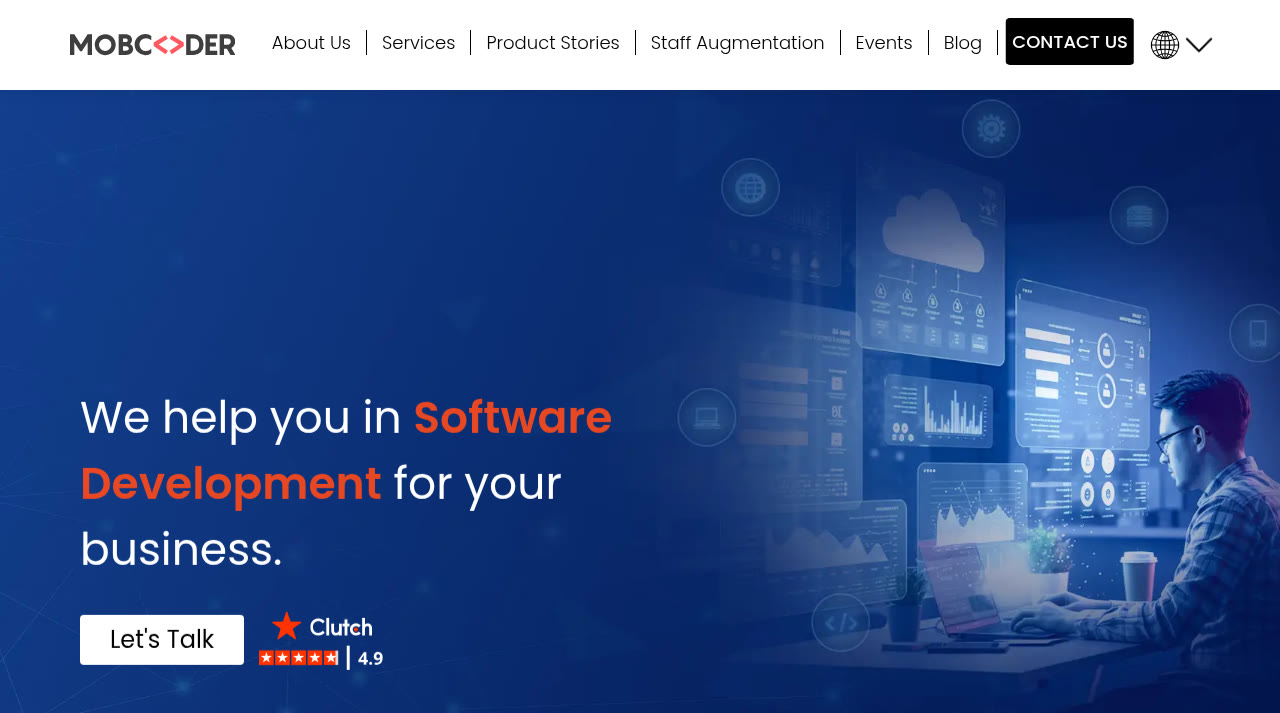
Mobcoder is a mobile, web and AI app development company with over a decade in the tech industry, positioning itself as a leading enterprise solution partner in North America. Its service spread covers the practical stack an enterprise app team needs: mobile and web development, AI and ML, data analytics, voice and AR experiences, IoT, DevOps, SAP migration and staff augmentation.
The company emphasizes dedicated teams, certified professionals and round-the-clock support – the operational basics that matter more than slogans once a project is live. Its published product stories show consumer and enterprise apps across industries, and the staff augmentation line gives buyers a flexible middle option between a full project handoff and direct hiring. For North American companies that want a single partner for an app plus its supporting cloud, data and AI plumbing, Mobcoder’s combined offer is worth a conversation.
16. TechMagic

Official website: techmagic.co
TechMagic is an AI-driven software product development company with a deliberately narrow industry focus: healthcare, cloud and cybersecurity. It takes responsibility for a software product from inception and design through engineering and support, starting from any step – so a client can hand over a backlog, a half-built product or a greenfield idea. The company reports more than 200 happy clients and publishes video testimonials from named CTOs.
The healthcare and security emphasis is the reason to shortlist TechMagic: these are the two domains where AI features carry the heaviest compliance and safety obligations, and a partner that ships in them routinely has already paid the learning costs. Its services cover product development, cloud engineering and security, with dedicated AI capability woven through. For a health-tech or security product company that needs an engineering team fluent in its regulatory reality, TechMagic’s specialization is the standout on this list.
17. Uptech

Official website: uptech.team
Uptech is an international software development company building intelligent software for finance, healthcare and beyond. Its track record: more than 200 projects delivered over 10 years, with clients spanning Fortune 500 and Inc. 5000 companies as well as startups, and 90% of clients arriving through referrals – the strongest retention signal a services firm can publish.
The company helps businesses harness AI, rethink finance and revolutionize healthcare, in its own framing, and its model covers product design, development and team extension through a hire-talents line. Uptech’s distributed team structure spans eight countries, giving it both cost flexibility and timezone coverage. For fintech and healthcare products where user experience quality is as important as the AI underneath, Uptech’s design-led product engineering is a natural fit – the referral rate suggests clients come back for exactly that combination.
18. Master Of Code

Official website: masterofcode.com
Master Of Code Global leads with a concrete offer: a working prototype for your AI use case in 30 days. The company validates the prototype technically and commercially, defines a scaling roadmap, then takes it through full development and implementation – a structure that de-risks the most dangerous phase of any AI project, the jump from demo to production. Its tagline, enterprise standards at startup speed, sums up the intended balance.
The firm specializes in custom generative AI – conversational experiences, AI agents and intelligent automation for enterprises – and publishes client testimonials from named executives at companies such as Infobip. For an enterprise that knows AI matters but has not yet found the use case that survives contact with real users, Master Of Code’s prototype-first engagement is the lowest-regret way to find out, and its conversational AI heritage runs deeper than most firms that adopted the label after 2023.
19. DataToBiz

Official website: datatobiz.com
DataToBiz is an India-based data analytics consulting company that now presents itself as enterprise AI agent developers – its homepage literally asks what you would like your AI agent to do, then offers to take it from there. The service package is a complete data intelligence stack: Microsoft Fabric implementation, AI agent development, end-to-end data engineering, and supported Power BI solutions, plus IT staff augmentation for teams that need extra hands.
That Microsoft-centric data platform expertise is the practical differentiator. Most enterprise AI projects fail on data plumbing, not models, and DataToBiz sells the plumbing first – Fabric, Power BI and data engineering – with agent development layered on top. For organizations standardized on the Microsoft data stack that want AI agents grounded in governed enterprise data rather than a standalone chatbot, DataToBiz’s combination is precisely the right shape, at Indian delivery rates.
20. LeewayHertz

Official website: leewayhertz.com
LeewayHertz is an AI development company with more than 15 years of experience building solutions for startups and Fortune 500 enterprises, and a notable recent development: it now operates as a Hackett Group company, giving its engineering practice the backing of an established global consultancy. Its work spans custom AI solution development, generative AI, and integration of AI into existing business workflows, with published experience across industries.
The company emphasizes both building cutting-edge solutions and ensuring their seamless integration into business workflows – the unglamorous second half where most AI value is actually won or lost. With its consulting-group ownership, LeewayHertz can now pair engineering delivery with broader transformation advisory, which matters for enterprise buyers who want one accountable throat to choke. For organizations that want a proven AI engineering firm with the governance and scale of a larger parent behind it, LeewayHertz’s 2026 profile is stronger than ever.
AI App Development Companies: Quick Comparison
Use this table to shortlist two or three companies before reading the full profiles above. None of these categories is a verdict – the best company is the one whose strengths match your project’s actual constraints.
| Company | Best for | Standout strength |
|---|---|---|
| Fingent | Enterprises adding AI to existing systems | ISO 27001-certified, AI-engineered delivery lifecycle |
| Simform | Enterprise AI and product engineering | Claude and Microsoft partner credentials |
| LITSLINK | Startups needing an MVP fast | Publishes a 10-week MVP timeline |
| Net Solutions | Commerce and retail platforms | 25 years of engineering plus data and AI |
| BairesDev | Scaling engineering teams quickly | 4,000+ timezone-aligned nearshore engineers |
| SoftKraft | Process automation on a budget | Audit-first AI and data engineering |
| GrowExx | Oracle-centric enterprises | ERP plus AI intelligence layer |
| Markovate | Manufacturing and construction | Document and drawing AI with published accuracy |
| Unicsoft | Web3 and blockchain products | Certified across Hedera, Solana, Ethereum and more |
| Apptunix | Government and enterprise platforms | Multilingual conversational AI at national scale |
| Talentica Software | Startups building toward exit | 200+ products shipped, 30+ customer exits |
| Maxiom Technology | Regulated US industries | Senior engineers plus AI acceleration since 2002 |
| Biz4Group | US mid-market AI adoption | Domestic consulting from Orlando and the Bay Area |
| NMG Technologies | One-vendor consolidation | Full-stack outsourcing across web, mobile and AI |
| Mobcoder | Apps plus supporting infrastructure | Mobile, web, AI, IoT and DevOps under one roof |
| TechMagic | Healthcare and security products | Narrow, deep focus on healthcare, cloud and cybersecurity |
| Uptech | Fintech and health-tech UX | 90% of clients arrive by referral |
| Master Of Code | Enterprises testing AI use cases | Working prototype in 30 days |
| DataToBiz | Microsoft data stack organizations | Fabric, Power BI and agents on governed data |
| LeewayHertz | Enterprises wanting consultancy backing | 15+ years, now a Hackett Group company |
How to Choose an AI App Development Company
Choosing among AI app development companies is mostly about eliminating mismatches early. A partner that is perfect for a venture-backed startup can be wrong for a hospital system, and vice versa. Work through these five checks in order and you will rarely waste a sales call.
1. Match the partner to your industry’s risk profile. Healthcare, fintech and government projects carry compliance obligations that change architecture decisions from day one. If that is you, weight specialists like TechMagic or Maxiom over generalists. Our guides to telemedicine developers and React Native companies show how category focus changes the shortlist.
2. Ask for production evidence, not demos. Any firm can show a chatbot that works in a screen recording. Ask what happened after launch: accuracy under real load, retraining cadence, and what broke. Companies publishing real metrics – Apptunix’s 92% response accuracy, Markovate’s 90% takeoff accuracy – are telling you they measure what matters. If you are earlier in your research, our overview of trending mobile app development tools will help you ask sharper technical questions.
3. Decide your engagement model before you shop. Staff augmentation (BairesDev, SoftKraft), a prototype-first engagement (Master Of Code), a fixed-scope MVP (LITSLINK) and a full product partnership (Talentica) are different purchases with different contract shapes. Knowing which one you want halves your shortlist immediately. For cross-platform consumer apps specifically, also review the top React Native app development companies.
4. Check the data foundation offer. AI features need pipelines, governance and evaluation harnesses. Partners like DataToBiz that lead with data engineering will often get you to a working AI feature faster than a flashier AI-first brand, because the plumbing is where projects actually stall. The same logic drives the market for adjacent specialist lists like the top blockchain companies – infrastructure first, features second.
5. Price the whole journey, not the first invoice. An MVP quote is not a product budget. Ask each finalist to price discovery, build, launch and a year of iteration separately, then compare totals. Our app development cost calculator gives you an independent baseline to sanity-check the numbers you receive, and if your project leans on third-party platforms, guides like our Rails outsourcing and outsourcing considerations pieces cover the contract side.
One more honest note: sometimes the right answer is not to hire a development company at all. If your need is a content workflow, a social pipeline or a simple internal tool, an AI app subscription – say one of the AI social media management apps, a presentation design tool, or the picks in our top AI tools roundup – will beat a custom build on cost and speed. Video and creative needs are similarly well served by the best text-to-video AI generators and fitness AI apps categories without custom development. Custom development earns its cost when the software itself is the product or the competitive advantage. And if your AI project is part of a wider operations modernization, our guide to the top supply chain companies shows how the same build-versus-buy logic plays out in logistics.
Frequently Asked Questions
Which company is best for AI app development?
There is no single best AI app development company for every project – the right choice depends on your industry, budget and engagement model. Simform and Fingent lead for enterprise work, LITSLINK and Talentica suit startups, BairesDev is strongest for scaling teams fast, and TechMagic is the pick for healthcare and security products. Read the profiles above and shortlist two or three whose strengths match your constraints.
How much does AI app development cost in 2026?
A focused AI MVP from a reputable development company typically starts in the $25,000 to $80,000 range, while a full enterprise AI application with data engineering, integrations and a year of iteration commonly runs $150,000 to $500,000 or more. Rates vary sharply by region and seniority, so always price discovery, build, launch and iteration separately. Our app development cost calculator gives a free baseline estimate before you request quotes.
How long does it take to build an AI-powered app?
A scoped prototype can arrive in about 30 days – Master Of Code structures its whole engagement around that promise. A production MVP typically takes 8 to 16 weeks, with LITSLINK publicly committing to a 10-week MVP timeline. A full enterprise AI application with data pipelines, integrations and compliance work usually runs 6 to 12 months from kickoff to stable production.
What is the difference between AI app development and traditional app development?
Traditional app development delivers deterministic features – the same input always produces the same output. AI app development adds probabilistic components such as language models, recommendation systems or computer vision, which need training data, evaluation harnesses, monitoring and periodic retraining. That is why the strongest AI development companies pair app engineering with data engineering, and why you should ask any candidate how they measure and maintain model quality after launch.
Should I hire an AI development company or use an off-the-shelf AI tool?
Use an off-the-shelf tool when your need matches an existing product category – automation workflows, social media scheduling, presentations or video generation are well served by subscriptions. Hire a development company when the software itself is your product, when your data cannot leave your systems, or when no existing tool fits your workflow. A good partner will tell you honestly when a $50-per-month tool beats a $50,000 build.
What should I ask an AI development company before signing?
Ask five questions: What production AI systems have you shipped, and what happened to their accuracy after launch? Who owns the code, models and data pipelines? How do you handle data privacy and security during development? What does the first 90 days look like, week by week? And what will iteration cost after launch? Companies that answer with specifics – timelines, metrics, named responsibilities – are safer than those answering with adjectives.
Are nearshore or offshore AI development companies reliable?
Yes, provided you verify the same things you would verify locally – production references, security certifications, and a clear delivery process. BairesDev fields 4,000+ timezone-aligned engineers for North American clients, SoftKraft delivers from Poland, and DataToBiz and NMG Technologies run mature Indian delivery operations. Timezone overlap and communication discipline matter more than geography; ask for a trial sprint before committing to a long engagement.
Final Thoughts
The AI app development market in 2026 rewards buyers who do the boring work: verify production evidence, match specialization to risk, and price the full journey. Every company on this list was re-verified this month against its live website, and each one earns its place for a different reason – BairesDev for scale, Master Of Code for speed to proof, TechMagic for regulated products, DataToBiz for data-first builds. Shortlist three, run the five checks above, and ask each for a scoped first milestone before any long contract. We will refresh this guide again as positions shift; if a company’s focus has changed since our last review, we say so in its profile.


Leave a Reply