

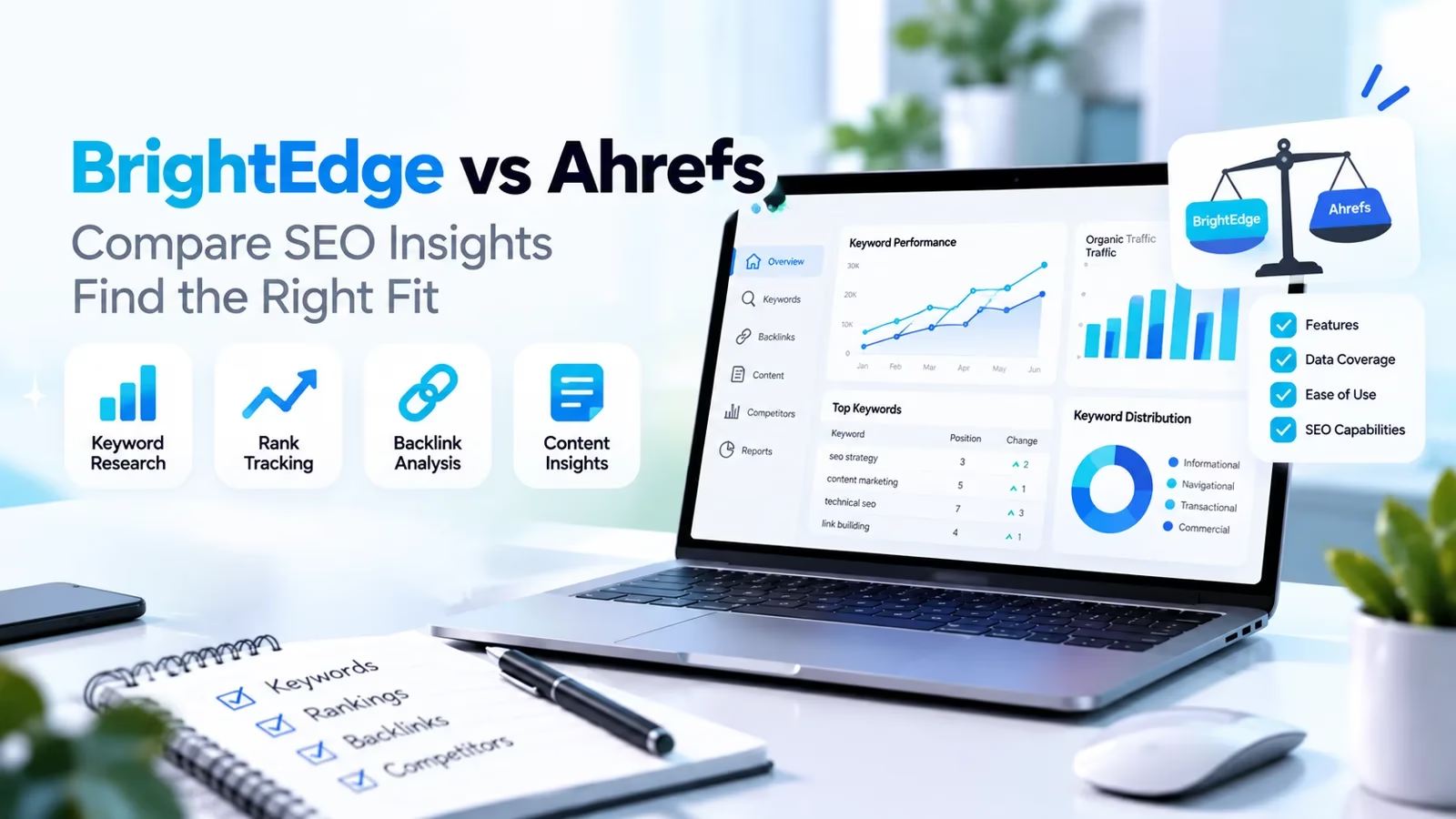

Picture the budget meeting. Someone points at the SEO line item and asks why one quote is $129 a month and the other requires a procurement process. Both tools promise to grow your search traffic. Both now talk about AI search. And yet BrightEdge and Ahrefs are barely the same product, sold in completely different ways to completely different buyers.
I have spent real time in both worlds: self-serve SEO suites you buy with a credit card, and enterprise platforms you buy with a contract. This comparison is written for the person who has to defend the choice later.
Prices and limits below were checked on the vendors’ own pages on Oct 16, 2026, and I flag every place where a number is not public.
The 30-second answer
Ahrefs is a self-serve SEO data suite. You sign up online, pay $29 to $449 per month (Enterprise at $1,499), and get keyword research, backlinks, site audits, rank tracking, and AI visibility tracking in one login. It fits freelancers, in-house marketers, and agencies up to mid-size.
BrightEdge is an enterprise SEO and AI-search platform. There is no public pricing and no self-serve signup – you request a demo, negotiate an annual contract, and get a unified workflow across Google and AI engines, automated optimizations, and executive reporting. It fits large companies with dedicated SEO teams or an enterprise SEO consulting partner.
If you are asking “which one can I start using this afternoon,” that is Ahrefs. If you are asking “which one can run SEO governance for a 5,000-page site across ten markets,” that is BrightEdge. The rest of this page is the evidence behind that split.
What each tool is actually built for
The fastest way to understand this matchup is to stop thinking of them as two versions of the same thing. Ahrefs started as a backlink index and grew into a full marketing toolkit sold per subscription.
BrightEdge started as an enterprise rank-tracking and recommendation platform and grew into what it now calls an AI-powered AEO and SEO platform – AEO being answer engine optimization, the practice of showing up inside AI-generated answers.
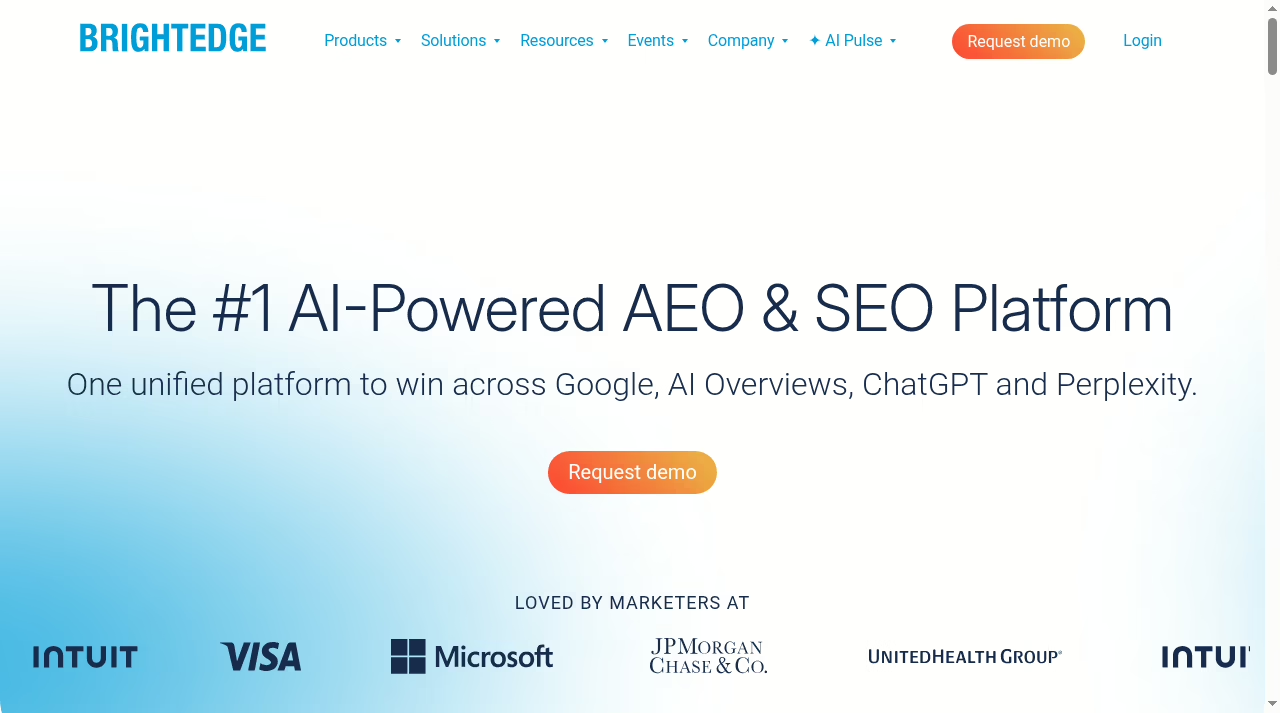
The customer logos on BrightEdge’s homepage tell you who it is for: Intuit, Visa, Microsoft, JPMorgan Chase, UnitedHealth Group. That is the buyer profile – companies where SEO is a department, not a task. The product is sold through a demo request, and every workflow assumes multiple stakeholders: an SEO lead, content teams, and an executive who wants a report.
Ahrefs in one paragraph
- Self-serve signup, public pricing, monthly or annual billing
- Core tools: Site Explorer, Keywords Explorer, Site Audit, Rank Tracker, Content Explorer, Web Analytics
- Brand Radar tracks how AI engines and the web talk about any brand
- Powered by what Ahrefs calls the world’s second-most active crawler and 10+ years of web-scale data
- Free tier (Ahrefs Webmaster Tools) for your own site
BrightEdge in one paragraph
- Demo-led enterprise sales, custom annual contracts, no public price list
- Core modules: Data Cube X keyword research, ContentIQ site auditing, StoryBuilder reporting
- Copilot suggests optimizations; Site Agents Suite (formerly Autopilot) applies them automatically
- AI Catalyst measures brand presence, citations, and sentiment across ChatGPT, Perplexity, Google AI Overviews, AI Mode, and Gemini
- Built-in governance, integrations, and executive-ready reporting
Where Ahrefs earns its subscription
Ahrefs wins on speed to value. You can go from signup to a full competitor backlink gap analysis in under an hour, and the interface assumes one person doing the work.
If your job is “grow organic traffic for this site,” the loop is tight: find keywords with realistic difficulty in Keywords Explorer, check who ranks and why in Site Explorer, fix technical issues in Site Audit, and watch positions move in Rank Tracker.
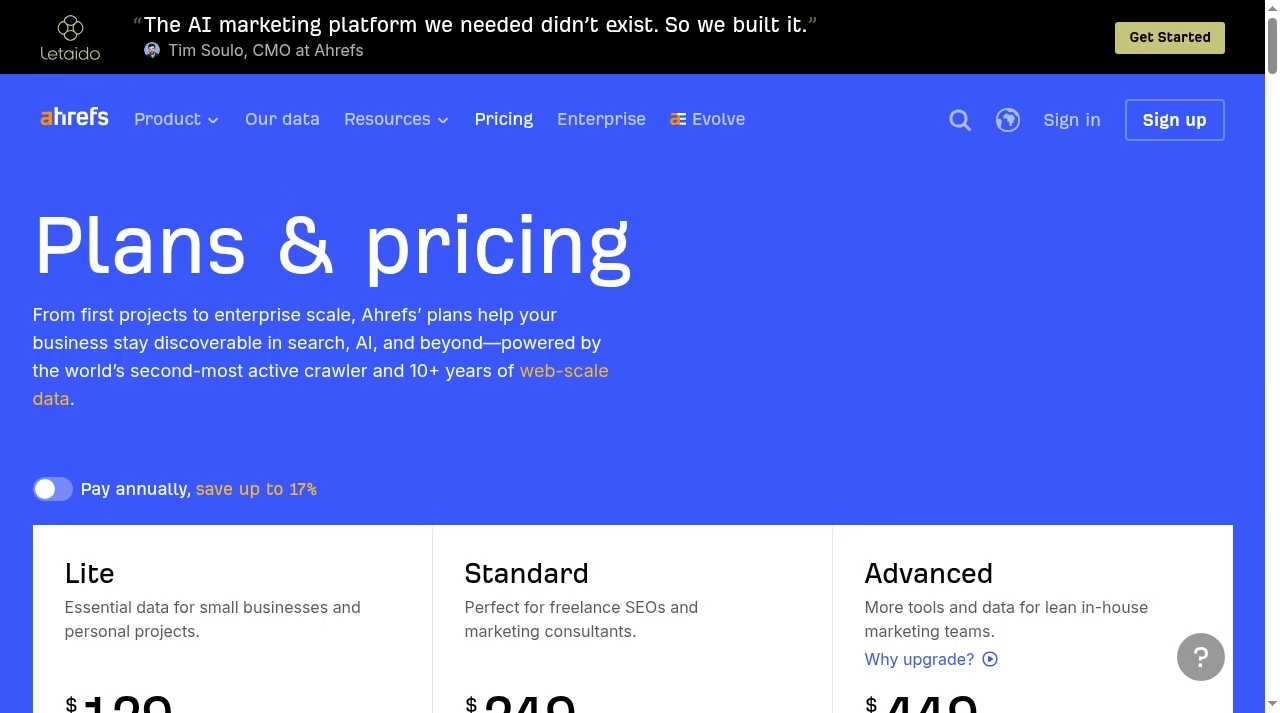
The data underneath is the selling point. Ahrefs runs the web’s second-most active crawler after Google, which means its backlink index and keyword database are refreshed at a scale only a handful of companies can match.
In practice that shows up as fresher link data and keyword metrics you can trust enough to plan a quarter around. We use similar competitive-data workflows across our own tool comparisons, like the AccuRanker vs Ahrefs and Sistrix vs Ahrefs breakdowns, and Ahrefs’ index depth is consistently why people pick it.
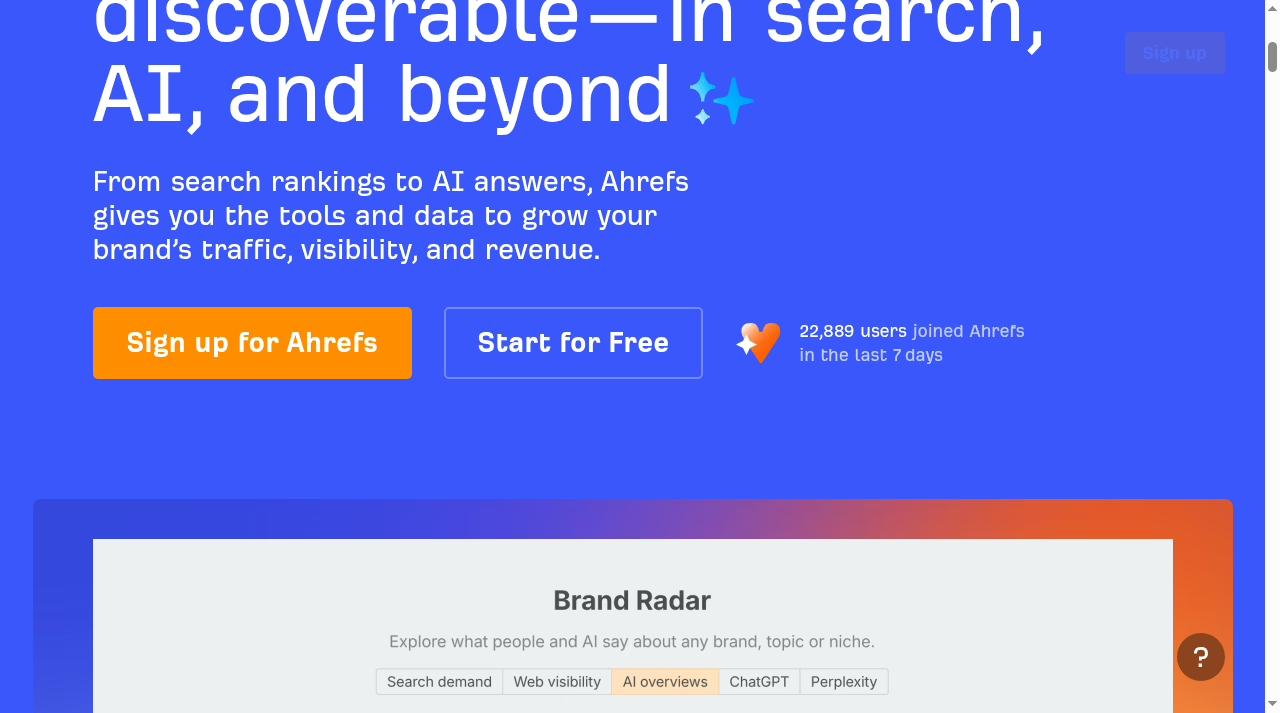
The other underappreciated advantage: Ahrefs sells to individuals. A freelance SEO can expense the Lite plan. A startup founder can run the free Webmaster Tools tier on their own domain before spending anything.
Nobody at Ahrefs needs to approve you, and there is no annual contract unless you choose annual billing for the discount of up to 17%. For a small business weighing whether SEO services are worth the money at all, being able to test the data first changes the risk calculation.
Where BrightEdge earns its contract
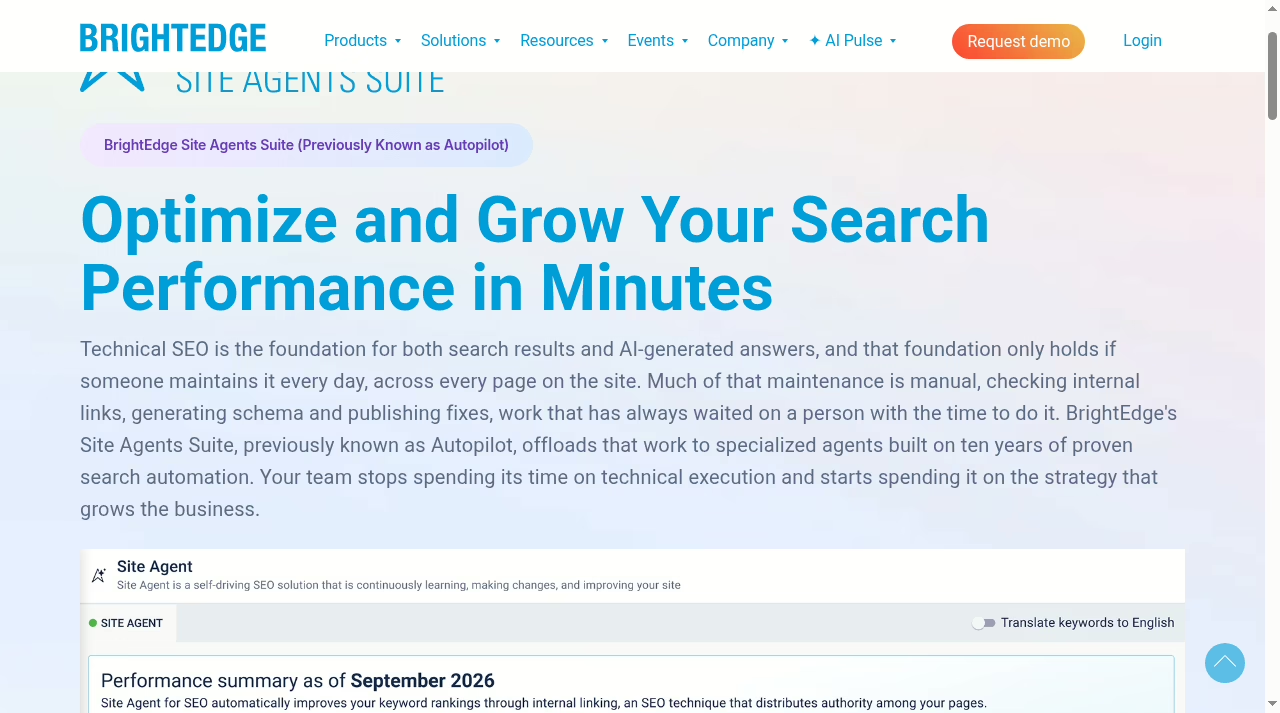
BrightEdge wins when SEO is an operation, not a project. Its Data Cube X keyword research engine holds over 4 billion data points with 10 years of historical context, and the platform is built to turn that data into assigned work: Copilot surfaces recommendations, Site Agents Suite – the module formerly known as Autopilot – can apply technical optimizations to your site automatically, and StoryBuilder turns performance into dashboards an executive can read without translation.
The governance layer is the real differentiator. Role-based access, integrations into enterprise analytics stacks, security review paperwork, and a customer success team are unglamorous things that matter enormously when a regulated company changes thousands of pages. A $129 tool cannot and does not try to do this.
If you manage SEO for a large site with many stakeholders, the technical SEO benefits only materialize when fixes actually ship – and Autopilot-style automation plus accountability is BrightEdge’s core pitch.
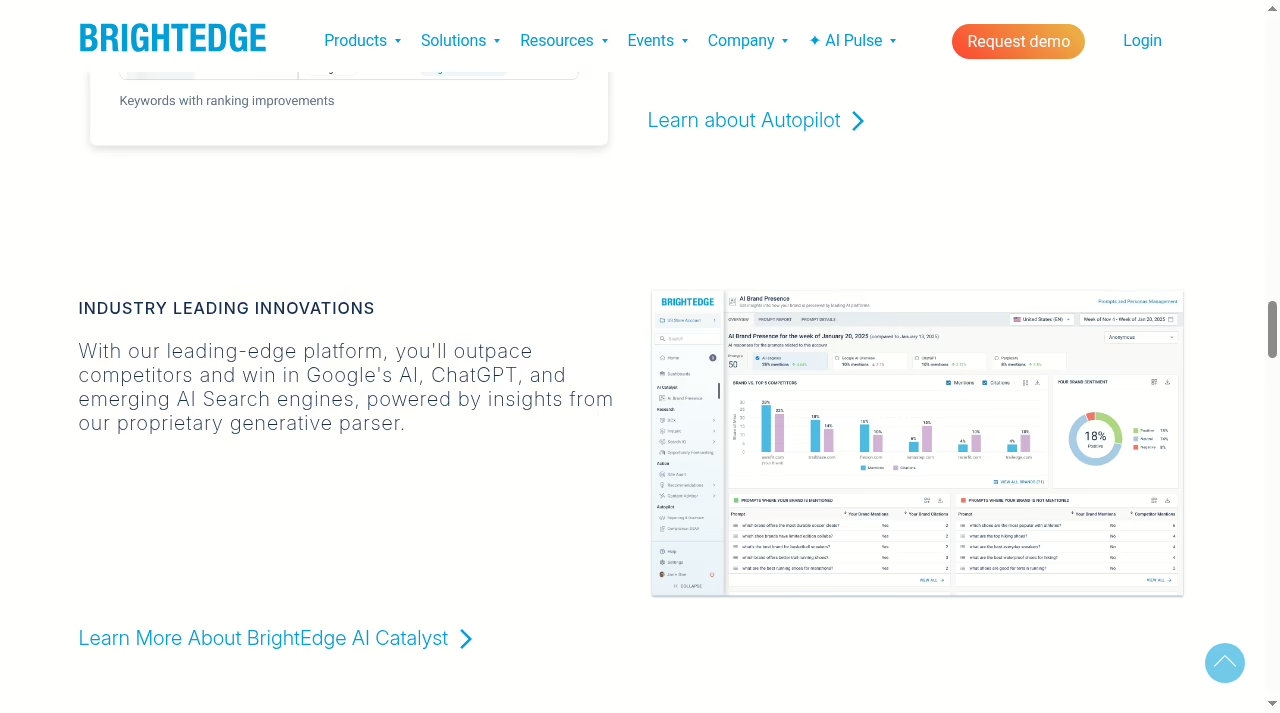
The screenshot above shows the AI Brand Presence view inside the platform: weekly mention counts by engine, sentiment splits, and the prompts where your brand did or did not appear. That operational depth – the thing a team would actually work from every Monday – is what the contract buys. The trade-off is weight.
Everything assumes process: onboarding, taxonomy decisions, keyword group setup, and stakeholder training before the value compounds. Teams that skip that groundwork end up paying enterprise prices for a fancy rank tracker, which is the single most common BrightEdge regret you will hear from practitioners.
The money: what you will actually pay
This is where the comparison stops being symmetrical. Ahrefs publishes every price. BrightEdge publishes none. Both approaches are rational for their buyers, but you should know exactly what you are walking into on each side.
Ahrefs pricing, as listed on Oct 16, 2026
All self-serve prices below are monthly rates on annual billing – Ahrefs advertises savings of up to 17% for paying annually, so month-to-month costs more.
| Plan | Price (annual billing) | Key limits |
|---|---|---|
| Free (Webmaster Tools) | $0 | Site Audit and Site Explorer for your own verified site only |
| Starter | $29/mo | Entry-level keyword and competitor research for small projects |
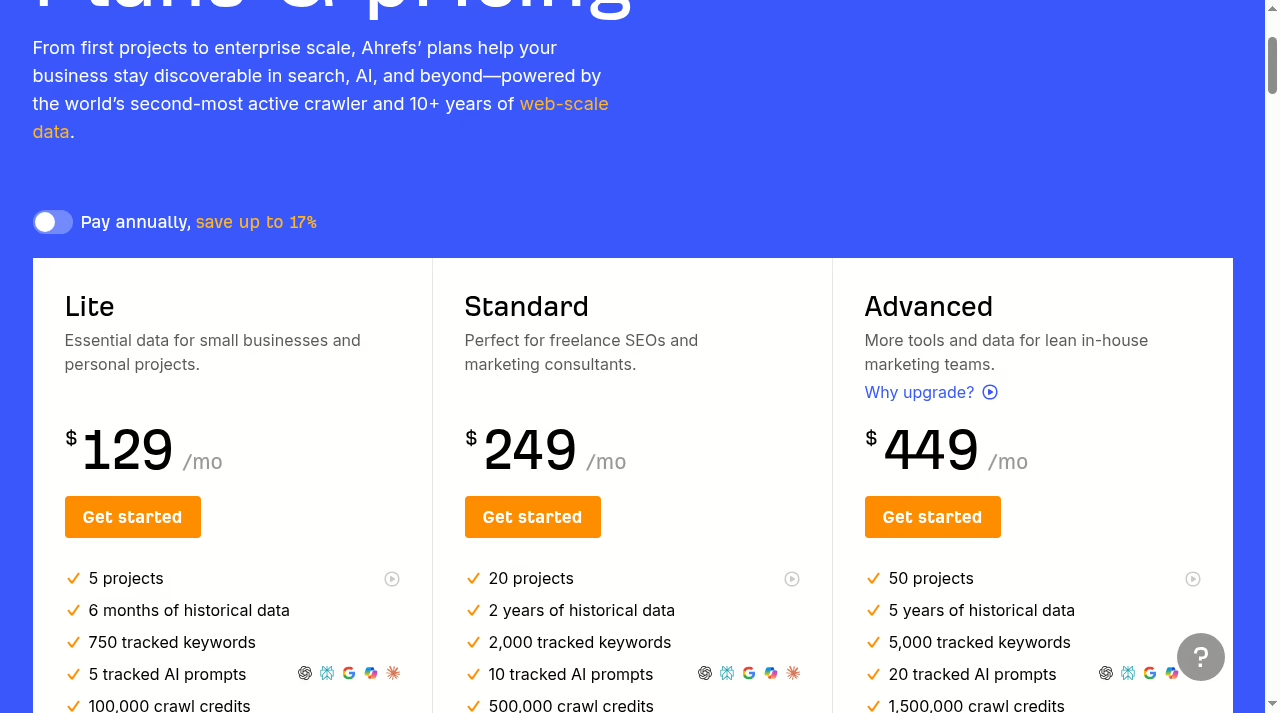
| Lite | $129/mo | 5 projects, 6 months historical data, 750 tracked keywords, 5 tracked AI prompts, 100,000 crawl credits, 1 user (+2 at $40/mo each) |
| Standard | $249/mo | 20 projects, 2 years history, 2,000 keywords, 10 AI prompts, 500,000 crawl credits, +5 users at $60/mo each |
| Advanced | $449/mo | 50 projects, 5 years history, 5,000 keywords, 20 AI prompts, 1,500,000 crawl credits, +10 users at $80/mo each |
| Enterprise | $1,499/mo (annual commitment) | Uncapped API, SSO, access management and audit log, unlimited historical data, no training on your data |
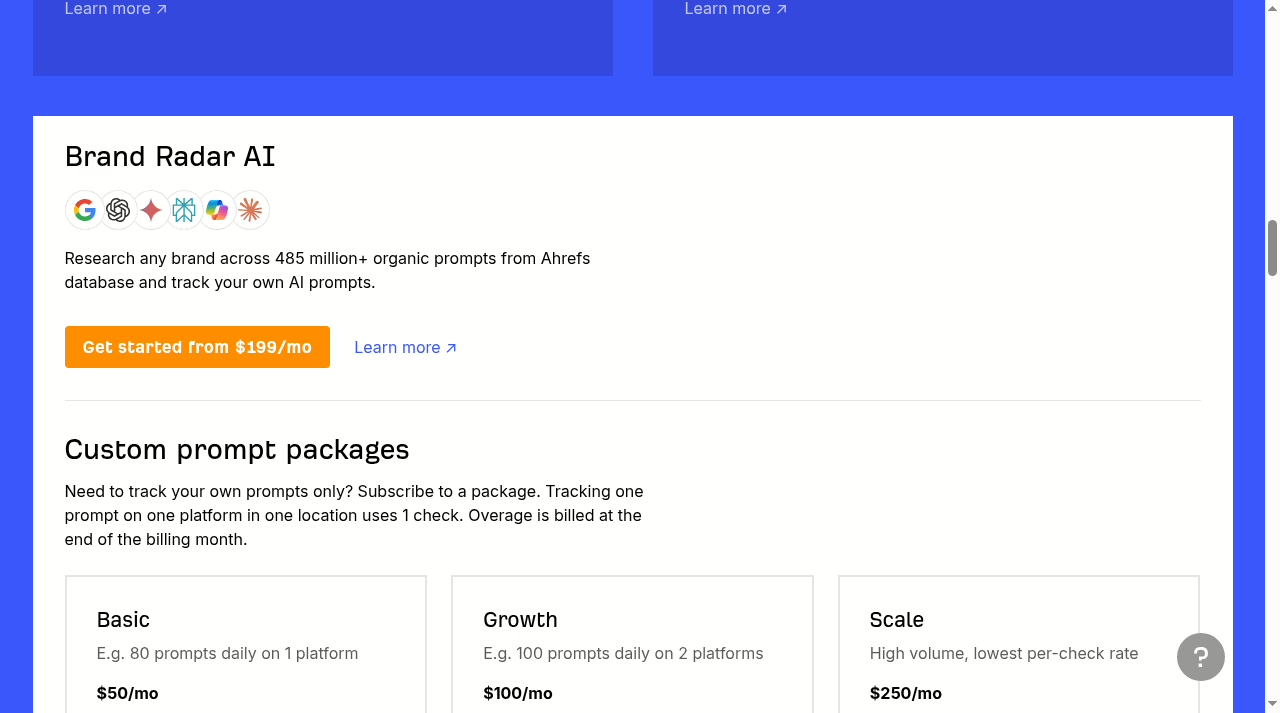
Two add-ons matter for this comparison. Brand Radar – the AI visibility tracker covered below – starts at $199/mo as a standalone product, with custom prompt-tracking packages at $50, $100, or $250 per month depending on check volume. A Content Kit with AI writing helpers starts at $99/mo.
Seat pricing is the classic gotcha: every plan includes one user, and extra seats run $40 to $80 per month each depending on tier, so a five-person team on Standard really pays $249 plus $240 in seats.
BrightEdge pricing: the honest answer
BrightEdge does not publish pricing. There is no pricing page in its navigation – the buying motion is a “Request demo” button, a sales conversation, and a custom annual contract sized to your domains, markets, and modules.
I will not quote third-party rumor numbers here, because contract pricing varies too much by scope to state responsibly. What I can say structurally: expect an enterprise procurement process, an annual commitment, onboarding, and a price that reflects a platform replacing several point tools plus agency hours.
The practical implication: if you need a number for a spreadsheet before talking to sales, you cannot get one from BrightEdge, and that alone disqualifies it for many small teams.
If you are building a business case, ask the sales team to map the contract against what you would otherwise spend on a tool stack plus the technical SEO consulting hours the automation replaces.
AI search visibility: Brand Radar vs AI Catalyst
Both vendors have pivoted hard toward AI search, and this is now the sharpest functional difference between them. The question each answers is different: Ahrefs asks “how visible is any brand in AI answers,” while BrightEdge asks “how is my brand doing, and what exactly do we fix.”
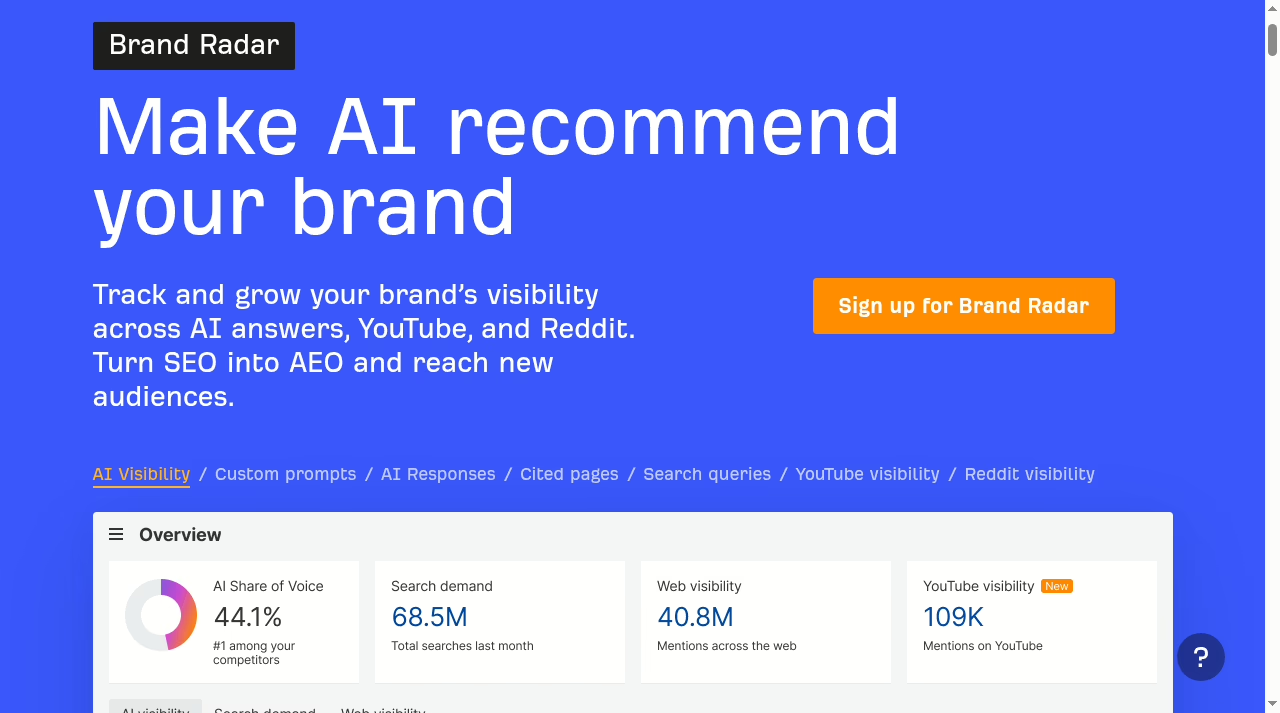
Ahrefs Brand Radar is a research database, closer in spirit to the reporting tools in our Databox alternatives roundup than to a monitoring suite. It tracks brand visibility across AI Overviews, ChatGPT, Perplexity, YouTube, and Reddit, built on what Ahrefs says is a database of 485 million-plus organic prompts.
You can research any brand – yours or a competitor’s – without tracking setup, and see AI Share of Voice, search demand, and web mention volumes. Within the main plans, tracked AI prompts (5 on Lite, 10 on Standard, 20 on Advanced) let you monitor specific questions over time. It is fast, broad, and priced as an add-on from $199/mo.
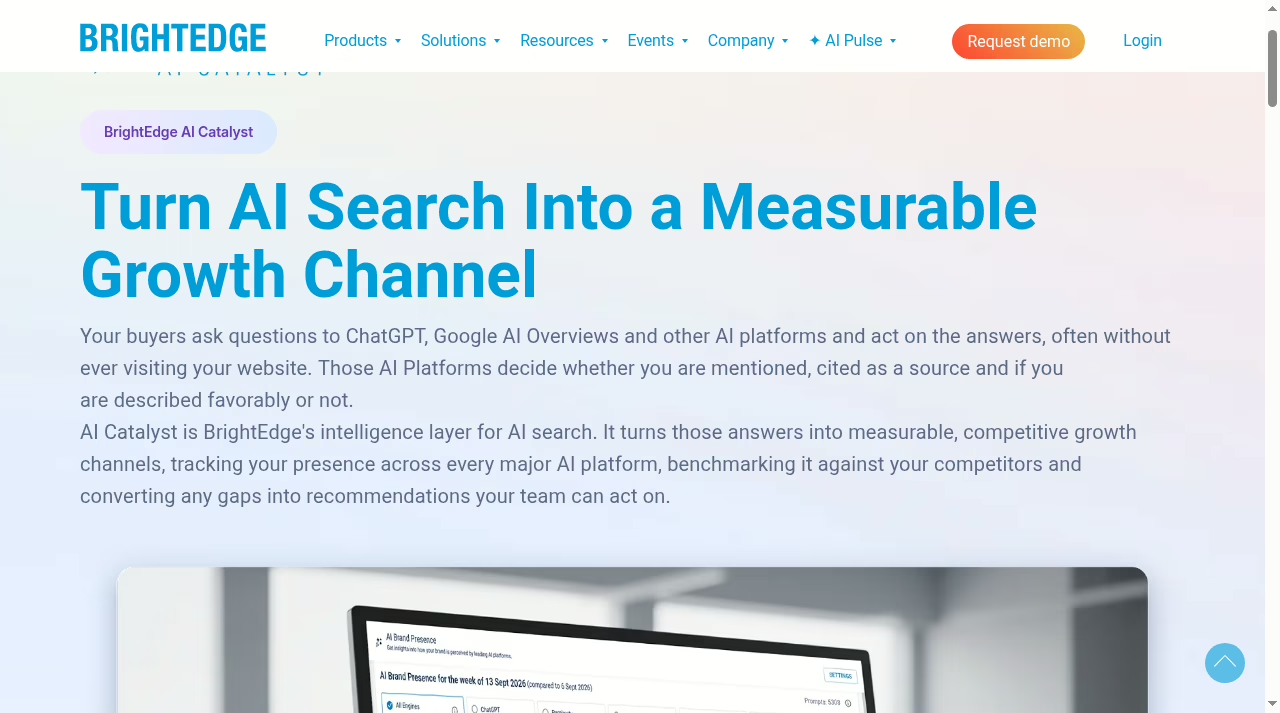
BrightEdge AI Catalyst is an intelligence layer wired into the rest of the platform. It tracks how often your brand is mentioned and cited across ChatGPT, Perplexity, Google AI Overviews, AI Mode, and Gemini, benchmarks that against named competitors, and splits presence into mentions versus citations so you can see which one is driving a shift.
The distinctive piece is sentiment: every AI response naming your brand gets rated positive, neutral, or negative with the reasoning shown, and when a competitor earns a better rating on a buyer question, you can read the exact prompt and response that caused it.
Those findings feed back into recommendations your content team can act on – the loop from measurement to fix is the product. BrightEdge’s newer AI Hyper Cube and Agent Edge push the same idea further into demand intelligence.
For a single marketer who wants to spot-check AI visibility alongside classic SEO data, Brand Radar inside an Ahrefs subscription is the efficient path. For an enterprise that needs AI visibility reporting to stand up in a board meeting and route fixes into a governed workflow, AI Catalyst is built for exactly that.
We are seeing the same pattern across the tools we track in our AI tools coverage: measurement is commoditizing, but the action layer is where enterprise platforms justify their cost.
A same-task test you can run in one afternoon
Feature lists blur together – our apps directory is full of them – so here is a concrete exercise that exposes the difference between the two philosophies. Take one keyword your company cares about and run it through both evaluation paths.
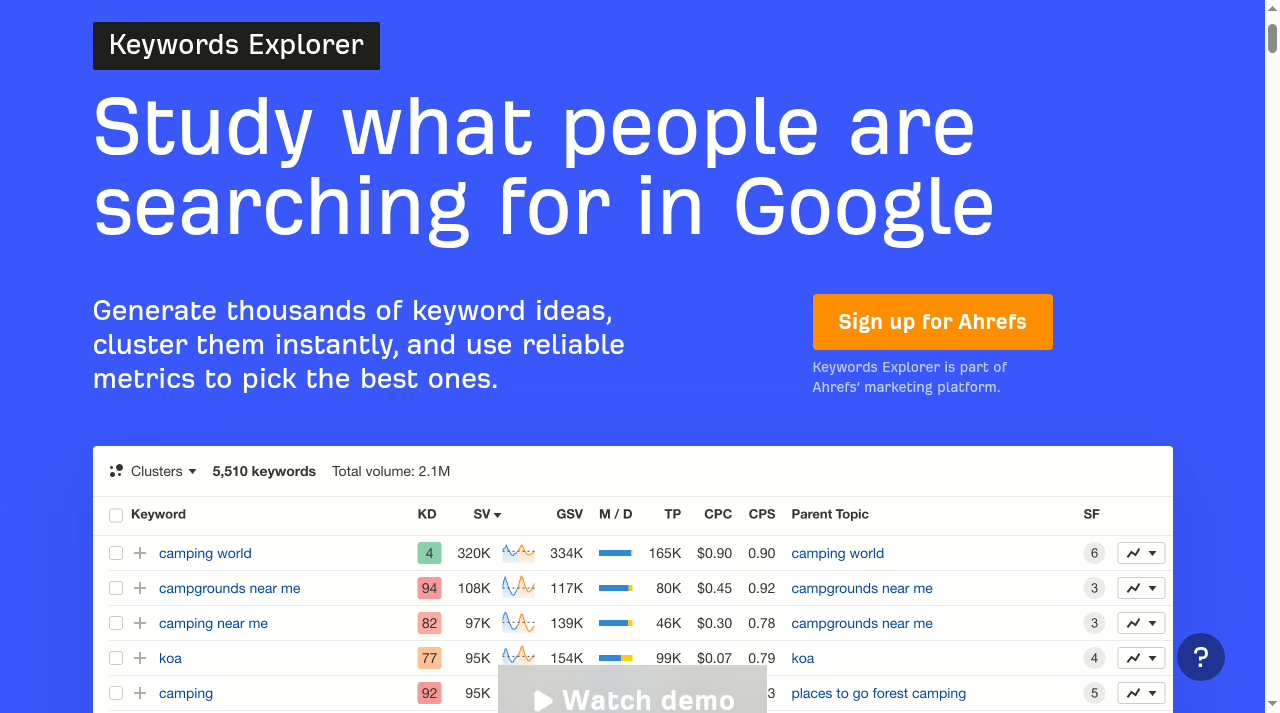
- Sign up for Ahrefs (the trial path starts with Webmaster Tools or a Starter plan) and enter the keyword in Keywords Explorer. Note the difficulty score, the SERP overview, and whether the top results are beatable. This takes about 15 minutes and nobody talks to you.
- Check Brand Radar or the AI prompt tracking for whether your brand appears in AI answers for that topic. Note the AI Share of Voice metric and which engines mention you.
- Request a BrightEdge demo and bring the same keyword. Ask them to show it in Data Cube X, then ask how Copilot would turn it into a recommendation and whether Site Agents could act on it without your developers.
- Ask BrightEdge to show the same topic in AI Catalyst: how your brand is mentioned, cited, and described across ChatGPT, Perplexity, and Google AI Overviews versus your top competitor.
- Compare what you walked away with. From Ahrefs: data you can act on yourself today. From BrightEdge: a workflow your whole team would operate inside – the same lens we applied to marketing automation platforms – plus a contract decision.
If step 1 and 2 already feel like enough, that is your answer. If steps 3 and 4 made you think “this is how we should run the whole program,” the demo was worth your hour.
The limits to confirm before you sign anything
Whichever direction you lean, these are the constraints that bite later. Confirm each one in writing before committing budget.
| Constraint | Ahrefs | BrightEdge |
|---|---|---|
| Contract length | Monthly or annual; annual saves up to 17% | Custom annual contract; demo-led sales |
| Seats | 1 included; extras $40-$80/mo each by plan | Scoped in contract; confirm per-seat and role pricing |
| Usage caps | Crawl credits and tracked keyword caps per plan; unlimited credits on Standard+ | Scoped by domains, keywords, and modules in contract |
| Historical data | 6 months (Lite) to 5 years (Advanced); unlimited on Enterprise | Data Cube X advertises 10 years of historical context |
| AI tracking | 5-20 tracked AI prompts per plan; Brand Radar from $199/mo | AI Catalyst coverage across major engines; scope in contract |
| Exit cost | Cancel before renewal; export your data | Annual term; confirm renewal and cancellation windows |
For teams comparing monitoring depth against price, our Databox alternatives roundup applies the same limits-first framework to reporting tools.
Who should choose which
Choose Ahrefs if you…
- Are a freelancer, consultant, in-house marketer, or agency under mid-size
- Want to start today with a credit card and a public price
- Live in keyword research, backlink analysis, and site audits
- Need competitor research on demand, not just monitoring of your own properties
- Want AI visibility tracking without an enterprise contract
- Prefer monthly billing you can cancel when a project ends
Choose BrightEdge if you…
- Run SEO for a large site or a portfolio across markets and languages
- Have multiple teams that need one governed workflow, not ten logins
- Want automated optimizations (Site Agents Suite, formerly Autopilot) with accountability
- Need AI search measurement that rolls up cleanly into analytics reporting
- Require SSO, security review, integrations, and a customer success team
- Can fund an annual enterprise contract and will use the platform daily
One more honest note: many companies use both categories at once. An enterprise might run BrightEdge as its system of record while individual SEOs keep Ahrefs logins for ad-hoc research. If that hybrid sounds like your situation, it is not indecision – it is a recognition that the two tools answer different questions.
The bottom line
Ahrefs is the best-funded self-serve option in SEO: transparent pricing from free to $1,499 per month, a crawler and index that anchor its data quality, and AI visibility research through Brand Radar. BrightEdge is an enterprise operating system for search: Data Cube X, Copilot, Autopilot, and AI Catalyst wrapped in governance and reporting, sold through contracts that price accordingly.
The decision is rarely about features. It is about who does the work and how the company buys software. One person with a credit card should not sit through enterprise demos. A global SEO team should not run its program on a $129 login.
Pick the buying motion that matches your organization and the tool choice makes itself. If you are still weighing adjacent options, our Moz Local vs BrightLocal and Databox alternatives pages follow the same evidence-first approach, and the apps directory has the full index of what we have tested.
Frequently asked questions
Does BrightEdge publish pricing?
No. BrightEdge sells through a demo request and a custom annual contract scoped to your domains, markets, and modules. There is no pricing page or self-serve checkout. Treat any specific number you see on third-party sites as a rumor unless BrightEdge quotes it to you directly.
How much does Ahrefs cost?
On annual billing, Ahrefs Lite is $129/mo, Standard is $249/mo, Advanced is $449/mo, and Enterprise is $1,499/mo with an annual commitment. A Starter plan costs $29/mo, Webmaster Tools is free for your own site, and Brand Radar starts at $199/mo as an add-on.
Extra seats cost $40 to $80 per month depending on the plan, and annual billing saves up to 17% versus monthly.
Is BrightEdge better than Ahrefs?
Neither is universally better – they serve different buyers. BrightEdge is stronger for enterprise governance, automated optimization, and board-level AI search reporting. Ahrefs is stronger for hands-on research, backlink data, and fast self-serve work. The buying motion usually decides: if you can put it on a credit card, Ahrefs; if it goes through procurement, BrightEdge.
Can a small business use BrightEdge?
Technically yes, but practically it is built and priced for enterprise teams. A small business will get far more value per dollar from Ahrefs or from the free tiers and focused tools we cover in our AI writing tools and marketing automation platforms roundups. BrightEdge makes sense once SEO is a multi-person operation.
Which tool is better for AI search visibility?
Both are credible but answer different questions. Ahrefs Brand Radar researches any brand’s AI Share of Voice across AI Overviews, ChatGPT, Perplexity, YouTube, and Reddit from a 485M-plus prompt database, starting at $199/mo. BrightEdge AI Catalyst monitors your brand’s mentions, citations, and sentiment across the major AI engines and routes gaps into recommendations.
One useful caveat: as we explain in our piece on how AI search confuses similar brand names, any AI visibility metric needs a clean brand entity behind it or the data misleads.
Do I need an SEO tool at all?
If you publish content and care about search traffic, yes – but the tier matters. Start with free data: Google Search Console plus Ahrefs Webmaster Tools covers the basics for a single site.
Pair that with solid on-page SEO technique and a working setup in Google Analytics 4, and upgrade to a paid suite only when the free data stops answering your questions. The broader strategy context is in our guide to SEO strategies reshaping business growth.
How do I compare more tools than these two?
Start with the limits matrix above and score each candidate against it: contract terms, seats, usage caps, historical data, AI tracking, and exit cost. Our other head-to-heads, including AccuRanker vs Ahrefs and Sistrix vs Ahrefs, use the same framework, and the apps directory lists every tool we have reviewed.


Leave a Reply