


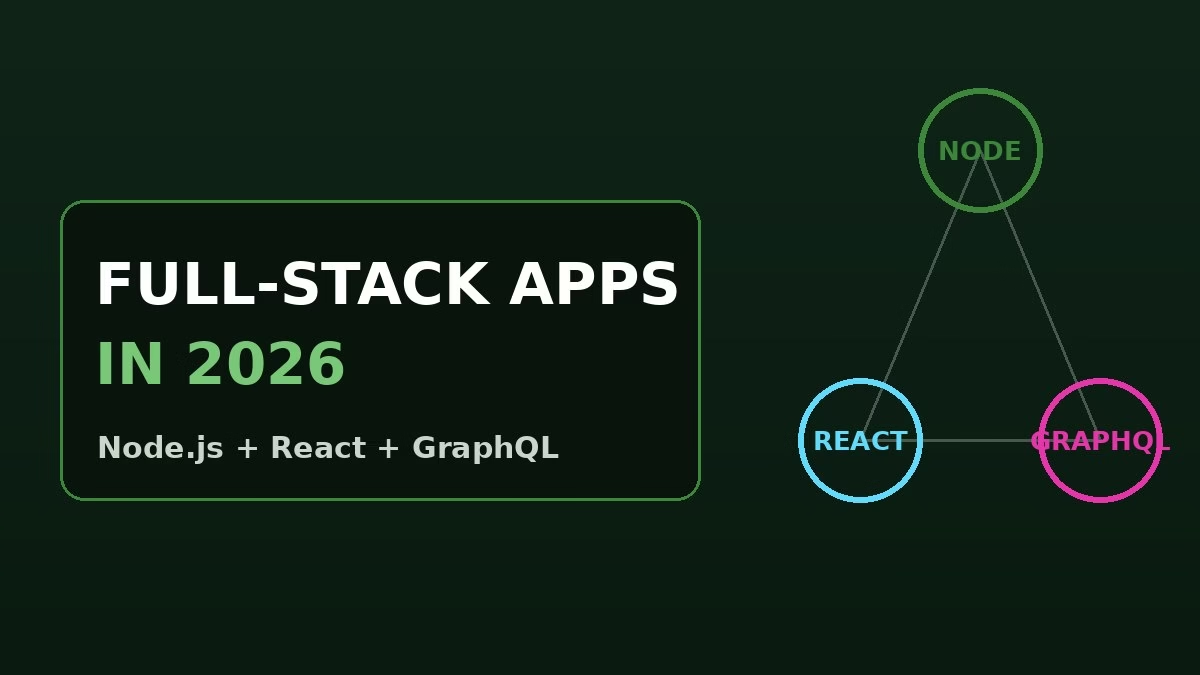

The combination of Node.js, React, and GraphQL has survived every “next big thing” thrown at it, and in 2026 it is still one of the most productive ways to ship a full-stack application. One language across the stack, a component model that now optimizes itself, and an API layer that gives clients exactly the data they ask for – the reasons it became popular are still the reasons it works.
What has changed is the tooling. Node.js 24 entered Active LTS in October 2025 and now runs TypeScript natively through type stripping. React 19.2 shipped in October 2025 with the Activity component and useEffectEvent, and the React Compiler hit stable v1.0 the same month, so memoization is increasingly the build’s job rather than yours. On the API side, Apollo Server 5 and Apollo Client 4.0 both landed in the second half of 2025 with leaner bundles and stronger TypeScript safety. This guide builds a full-stack app on the current versions of all three, step by step. If you would rather have a team build it for you, our lists of Node.js development companies and ReactJS development companies are the place to compare partners.
Why this stack still wins in 2026
Each piece of the stack answers a specific pain, and the pains have not gone away:
- Node.js gives you JavaScript (or TypeScript) on the server with an enormous package ecosystem and first-class async I/O. The 2026 baseline is Node 24 LTS (24.22.1 at the time of writing), the current LTS line; Node 26 is the Current release, and Node 22 remains in maintenance. Modern Node also ships with a built-in test runner, watch mode, and native TypeScript type stripping, so a simple API server needs far less build plumbing than it used to. Choosing an editor is easier too – our roundup of top Node.js IDEs covers the options.
- React owns the UI. With React 19 (19.3.1 at the time of writing) and the stable React Compiler, the framework now handles most render optimization automatically, and Server Components are the default mental model in the big frameworks. Our piece on the future of React JS goes deeper on where the library is heading.
- GraphQL replaces a sprawl of REST endpoints with one typed schema. Clients request exactly the fields they need, the schema doubles as living documentation, and features like incremental delivery (@defer and @stream) let slow fields stream in after the fast ones. When teams weigh GraphQL against alternatives, the comparison is really about data-shape complexity – the same trade-off we cover in framework comparisons like Angular vs React: pick per problem, not per hype.
One more 2026 wrinkle worth naming: the ecosystem has spent the year orienting itself around AI coding agents – GraphQL now markets itself as “the API language for humans and agents,” and typed schemas turn out to be exactly what agent-driven development consumes best. A strongly typed stack is no longer just for humans reading docs.
Together they mean one language from database call to button click, one typed contract between frontend and backend, and a hiring pool that is the largest in web development – which matters whether you build in-house or through web app development companies.
What is actually new in the 2026 versions
The stack’s bones are the same, but every layer shipped something in the last year that changes how you write the code:
| Layer | Current release | What it changes for you |
|---|---|---|
| Node.js | 24.x LTS (24.22.1); Node 26 is Current | Native TypeScript type stripping, built-in test runner and watch mode – less build tooling for the server |
| React | 19.3.1 (October 2026); 19.2 shipped October 2025 | Activity component for show/hide without losing state; useEffectEvent; Performance Tracks in DevTools |
| React Compiler | v1.0 stable (October 2025) | Automatic memoization – stop hand-writing useMemo/useCallback in most components |
| Apollo Server | v5 (July 2025) | Current major for the Node GraphQL server; cleaner Express integration |
| Apollo Client | 4.x (4.3.5); 4.0 shipped August 2025 | Leaner bundles, stronger TypeScript inference, link-based architecture |
| Vite | 8.x (8.3.5); 8.0 shipped March 2026 | Standard React scaffolding and dev server – what npm create vite gives you today |
The pattern across all of them: less manual wiring. The server needs fewer packages, the client needs fewer optimization hooks, and the types flow from schema to component almost for free.
The architecture at a glance
The app we will build is a small project tracker: users, projects, and tasks. The shape is the same one you would use for almost any CRUD-plus-auth product:
- React client (Vite + TypeScript) renders the UI and talks to one GraphQL endpoint via Apollo Client 4.
- Node.js API server (Apollo Server 5 on top of Express, or GraphQL Yoga) executes queries and mutations against a schema.
- Data layer – PostgreSQL accessed through an ORM such as Prisma or Drizzle.
- Auth – a signed JWT in an httpOnly cookie or Authorization header, resolved into context on every request.
- Realtime (optional) – GraphQL subscriptions over WebSocket for live task updates.
The schema sits in the middle as the contract. Design it first and both sides can build against it in parallel – one of the genuinely underrated wins of this stack, especially on teams structured like the ones in our guide to proven software development best practices.
Step 1: Set up the project
Keep the client and server in one repository with two packages. The classic trio of tools: npm workspaces, Vite for the React client, and plain Node for the server.
mkdir project-tracker && cd project-tracker
npm init -y
npm pkg set --json workspaces='["server","client"]'

mkdir server client
cd client
npm create vite@latest . -- --template react-ts
cd ../server
npm init -y
npm install @apollo/server @as-integrations/express5 express graphql cors bcryptjs jsonwebtoken
npm install -D typescript tsx @types/express @types/cors
Two notes on this setup. First, tsx runs TypeScript on Node with zero config during development; on Node 24 you can also run .ts files directly thanks to type stripping, but tsx remains the smoother dev experience. Second, if you are starting something greenfield today, start in TypeScript – the GraphQL schema types and the generated client types will pay for the setup within a week. If your project starts smaller, our MVP guide explains how to scope the first version without painting yourself into a corner.
Step 2: Design the GraphQL schema first
The schema is the API contract, so write it before any resolver. For the project tracker:
# server/schema.graphql
type User {
  id: ID!
  name: String!
  email: String!
  projects: [Project!]!
}

type Project {
  id: ID!
  title: String!
  owner: User!
  tasks: [Task!]!
}

type Task {
  id: ID!
  title: String!
  done: Boolean!
  project: Project!
}

type Query {
  me: User
  project(id: ID!): Project
}

type Mutation {
  signup(email: String!, name: String!, password: String!): AuthPayload!
  login(email: String!, password: String!): AuthPayload!
  createProject(title: String!): Project!
  addTask(projectId: ID!, title: String!): Task!
  toggleTask(id: ID!): Task!
}

type AuthPayload {
  token: String!
  user: User!
}

type Subscription {
  taskUpdated(projectId: ID!): Task!
}
Rules of thumb that hold up: name fields for what the UI needs, not how tables look; return non-null lists of non-null items ([Task!]!) so clients never guard against half-empty arrays; and keep mutations verb-first and specific. Resist nesting queries five levels deep in practice – depth limiting exists for a reason.
Step 3: Build the Node.js backend
Apollo Server 5, released in July 2025, is the current major and pairs cleanly with Express. (GraphQL Yoga from The Guild is a fully valid alternative with the same schema-first flow; everything below transfers.)
// server/index.ts
import { ApolloServer } from "@apollo/server";
import { expressMiddleware } from "@as-integrations/express5";
import express from "express";
import cors from "cors";
import { readFileSync } from "node:fs";
import { resolvers } from "./resolvers.js";
import { getUserFromToken } from "./auth.js";

const typeDefs = readFileSync("./schema.graphql", "utf8");

const server = new ApolloServer({ typeDefs, resolvers });
await server.start();

const app = express();
app.use(cors({ origin: "http://localhost:5173", credentials: true }));
app.use(express.json());

app.use(
  "/graphql",
  expressMiddleware(server, {
    context: async ({ req }) => {
      const token = req.headers.authorization?.replace("Bearer ", "") ?? "";
      const user = await getUserFromToken(token);
      return { user };
    },
  })
);

app.listen(4000, () =>
  console.log("API ready at http://localhost:4000/graphql")
);
Start the API with tsx, which you installed in step 1: npx tsx watch index.ts. tsx maps the .js import suffixes onto your .ts sources and restarts on change – the same import style keeps working if you later compile with tsc. You should see “API ready at http://localhost:4000/graphql”.
Resolvers are plain functions that fetch data. Keep them thin – all business logic belongs in a service layer you can test without GraphQL:
// server/resolvers.ts
export const resolvers = {
  Query: {
    me: (_: unknown, __: unknown, ctx: any) => ctx.user,
    project: (_: unknown, { id }: { id: string }) =>
      projectService.findById(id),
  },
  Mutation: {
    createProject: (_: unknown, { title }: { title: string }, ctx: any) => {
      if (!ctx.user) throw new Error("Not authenticated");
      return projectService.create({ title, ownerId: ctx.user.id });
    },
    addTask: (_: unknown, args: any, ctx: any) => {
      if (!ctx.user) throw new Error("Not authenticated");
      return taskService.add(args);
    },
    toggleTask: (_: unknown, { id }: { id: string }, ctx: any) => {
      if (!ctx.user) throw new Error("Not authenticated");
      return taskService.toggle(id);
    },
  },
  Project: {
    tasks: (parent: any) => taskService.forProject(parent.id),
    owner: (parent: any) => userService.findById(parent.ownerId),
  },
};
One thing these resolvers deliberately do not do is check ownership. ctx.user proves who is calling, not which records they may touch – so the service layer must verify that the project or task ID belongs to that user before reading or writing it. Authentication without that check lets any logged-in user pass someone else's IDs.
For the data layer, Prisma and Drizzle are the two ORMs most teams pick between for PostgreSQL in 2026; either generates typed queries that keep resolvers boring. If database design is the part your team is least sure about, it is also the part most Node.js development companies in the USA will happily own as a discrete piece of work.
Step 4: Wire up authentication
Auth in this stack is conventional: bcrypt-hashed passwords, a signed JWT, and the token resolved into context on every request (you saw getUserFromToken in the server file). The mutation side:
// server/resolvers.ts (auth part)
import bcrypt from "bcryptjs";
import jwt from "jsonwebtoken";

signup: async (_: unknown, { email, name, password }: any) => {
  const hash = await bcrypt.hash(password, 12);
  const user = await userService.create({ email, name, passwordHash: hash });
  const token = jwt.sign({ userId: user.id }, process.env.JWT_SECRET!, {
    expiresIn: "7d",
  });
  return { token, user };
},
login: async (_: unknown, { email, password }: any) => {
  const user = await userService.findByEmail(email);
  if (!user || !(await bcrypt.compare(password, user.passwordHash))) {
    throw new Error("Invalid credentials");
  }
  const token = jwt.sign({ userId: user.id }, process.env.JWT_SECRET!, {
    expiresIn: "7d",
  });
  return { token, user };
},
Store the token in an httpOnly cookie when the client is same-site (better XSS posture), or in memory plus sessionStorage as a pragmatic default for separated deployments. Never localStorage for long-lived tokens on anything that handles money or personal data.
Step 5: Build the React frontend
Apollo Client 4.0, released in August 2025, is leaner and more TypeScript-strict than v3. Setup is three pieces: the client, the provider, and queries.
// client/src/apollo.ts
import { ApolloClient, InMemoryCache, HttpLink } from "@apollo/client";
import { SetContextLink } from "@apollo/client/link/context";

const httpLink = new HttpLink({ uri: "http://localhost:4000/graphql" });

const authLink = new SetContextLink((prevContext) => {
  const token = sessionStorage.getItem("token");
  return {
    headers: {
      ...prevContext.headers,
      authorization: token ? `Bearer ${token}` : "",
    },
  };
});

export const client = new ApolloClient({
  link: authLink.concat(httpLink),
  cache: new InMemoryCache(),
});
// client/src/main.tsx
import { ApolloProvider } from "@apollo/client/react";
import { client } from "./apollo";
createRoot(document.getElementById("root")!).render(
<ApolloProvider client={client}>
<App />
</ApolloProvider>
);
Then components declare their own data. A project page:
// client/src/ProjectPage.tsx
import { useQuery } from "@apollo/client/react";
import { gql } from "@apollo/client";

const GET_PROJECT = gql`
  query GetProject($id: ID!) {
    project(id: $id) {
      id
      title
      owner { name }
      tasks { id title done }
    }
  }
`;

export function ProjectPage({ id }: { id: string }) {
  const { data, loading, error } = useQuery(GET_PROJECT, {
    variables: { id },
  });

  if (loading) return <p>Loading…</p>;
  if (error) return <p>Error: {error.message}</p>;
  if (!data?.project) return <p>Project not found.</p>;

  return (
    <section>
      <h2>{data.project.title}</h2>
      <p>Owner: {data.project.owner.name}</p>
      <ul>
        {data.project.tasks.map((t: any) => (
          <li key={t.id}>{t.done ? "✅" : "⬜"} {t.title}</li>
        ))}
      </ul>
    </section>
  );
}
Two 2026-specific notes here. First, add GraphQL codegen (graphql-codegen) as soon as the schema stabilizes – it generates TypeScript types for every operation from the schema, which removes the any types you see above and catches field renames at build time. Second, with the React Compiler now stable, resist hand-optimizing with useMemo and useCallback; write plain components and let the compiler memoize. If you are cross-shopping UI frameworks at this point, our React Native vs Swift comparison is a good example of how we frame the “which tech” decision when the target moves to mobile.
Step 6: Mutations and optimistic UI
Mutations mirror queries, and Apollo’s cache updates the UI when you return the changed object with its id. For instant-feeling toggles, use optimisticResponse:
const TOGGLE_TASK = gql`
  mutation ToggleTask($id: ID!) {
    toggleTask(id: $id) { id title done }
  }
`;

function TaskRow({ task }: { task: any }) {
  const [toggle] = useMutation(TOGGLE_TASK, {
    variables: { id: task.id },
    optimisticResponse: {
      toggleTask: { ...task, done: !task.done },
    },
  });
  return (
    <li onClick={() => toggle()}>
      {task.done ? "✅" : "⬜"} {task.title}
    </li>
  );
}
The normalized cache is why this stack feels fast without extra state management: every returned object with an id merges into one store, so the toggle updates every component showing that task, everywhere.
Step 7: Realtime with subscriptions (optional but easy)
For live updates – a teammate completing a task, a dashboard moving – GraphQL subscriptions over WebSocket are a hundred lines of work, not a new system. Server side, add graphql-ws alongside Apollo Server and publish events from your mutations; client side, split the link so subscriptions travel over the WebSocket transport while queries and mutations stay on plain HTTP.
Keep subscriptions for genuinely live data. Polling useQuery every 30 seconds is honestly fine for most dashboards, simpler to reason about, and survives load balancers that kill idle sockets. The moment several users edit the same object at once, though, subscriptions are the difference between “refresh to see changes” and a product that feels alive – and they are the reason the schema-first investment keeps paying off after launch.
Step 8: Testing and quality
The stack splits testing cleanly:
- Server: Node’s built-in test runner (node –test) covers service-layer logic without extra dependencies; resolver tests call resolvers with a mocked context.
- Schema: a snapshot test on the printed schema catches accidental breaking changes before clients do.
- Client: Vitest + React Testing Library, with MockedProvider to stub GraphQL responses per component.
- End to end: a handful of Playwright flows – signup, create project, add task – beats a hundred shallow unit tests for confidence. Our piece on how continuous testing helps in app development covers how teams fold this into CI, and API-first automated testing explains why the GraphQL layer is the best place to invest those tests.
Step 9: Deployment
The boring, reliable 2026 deployment shape:
- Client: npm run build in Vite produces static files; serve them from a CDN (Vercel, Netlify, Cloudflare Pages, or an S3 + CloudFront pair).
- Server: a small always-on Node process – a container on Fly.io/Railway/ECS, or a VM with pm2. Keep it behind HTTPS and point the client’s uri at the public URL.
- Database: managed PostgreSQL (Neon, Supabase, RDS) with connection pooling via PgBouncer or the vendor’s pooler.
- Environment: JWT_SECRET and the database URL come from the platform’s secret store, never the repo.
For anything beyond a single region, the playbook in our guide to building scalable cloud applications applies unchanged – stateless API processes, the database as the only stateful piece, and caching at the CDN edge. Broader platform shifts are tracked in our future of cloud computing trends piece.
The production checklist
- Depth and complexity limits on incoming queries (graphql-depth-limit or armor-style tooling).
- Persisted queries or an operation allowlist once the client ships, so arbitrary query cost is bounded.
- DataLoader on every relationship resolver that serves lists.
- Error masking in production – log the real error server-side, return a clean message to clients.
- CORS locked to your real client origin; credentials only if you use cookie auth.
- Health endpoint and request logging from day one; GraphQL errors hide in 200 responses by design, so alert on the errors array, not status codes.
- Introspection disabled or gated in production if the API is not public.
When this stack is the wrong choice
Skip it when the app is content-first (a marketing site or blog wants a static generator, not a GraphQL server), when the team already knows another ecosystem well (a Laravel or Rails team ships faster staying put), or when the API surface is three trivial endpoints – REST plus fetch is less machinery for that. The stack earns its complexity on apps with rich, interlinked data and multiple clients consuming the same API, which is most real products. And if the blocker is people rather than technology, our questions to ask before hiring Node.js developers will help you vet the team, and current software development hiring trends shows what the market looks like before you write the job post.
FAQs about building a full-stack app with Node.js, React, and GraphQL
Is Node.js + React + GraphQL still a good stack in 2026?
Yes. All three are on their current majors in October 2026 – Node 24 LTS, React 19.3 with the stable React Compiler, and Apollo Server 5 / Apollo Client 4. The ecosystem is mature, hiring is easy, and the TypeScript story is the strongest it has ever been.
Should I start with JavaScript or TypeScript?
TypeScript. Node 24 strips types natively, Vite scaffolds react-ts by default, and GraphQL codegen generates operation types straight from your schema. The type safety between schema and UI is the biggest practical upgrade this stack has gotten in years.
Is GraphQL better than REST for a new app?
For apps with interlinked data and several screens consuming the same entities, usually yes – one endpoint, typed contract, no over-fetching. For a tiny CRUD API or a public API where HTTP caching matters most, REST is simpler. Many production systems run both: GraphQL for the app, REST for webhooks and public integrations.
How long does it take to build a full-stack app this way?
A working prototype with auth, one entity, and a deployed client-server pair takes a focused developer days. A production MVP with proper testing, CI, and hardening is typically measured in weeks, and the number depends far more on scope discipline than on the stack.
Do I need Apollo, or are there alternatives?
Apollo is the default but not a requirement. GraphQL Yoga is a respected server alternative, and on the client, urql and Relay are real options – Relay especially for very large apps with strict data discipline. The schema-first workflow in this guide transfers to all of them.
How do I handle file uploads with GraphQL?
Keep files out of GraphQL. Upload directly from the client to object storage (S3 or compatible) using a presigned URL that you get from a mutation, then save the resulting file key on the entity through a normal mutation. GraphQL stays fast and your server never proxies megabytes.
What does it cost to have a company build this for me?
Cost depends on scope, team location, and how much design and QA you include – a focused MVP and an enterprise platform are different orders of magnitude. The realistic path is a scoped estimate from two or three vetted partners; our company lists linked above are built for exactly that comparison.
Vite client or a full framework like Next.js?
This guide uses a Vite single-page client because it keeps the architecture visible – one React app, one API server, one clear boundary. If your app needs server-side rendering for SEO, route-level data streaming, or edge rendering, a React framework such as Next.js or TanStack Start is the better foundation, and the same GraphQL server and Apollo Client setup carry over unchanged – only where the client renders moves. The decision rule is simple: app behind a login, Vite SPA; public pages that must rank, framework with SSR. You can start on Vite and migrate later, but picking by requirement up front is cheaper.
Common mistakes to avoid
Four account for most of the pain we see teams walk into. Putting business logic inside resolvers, which makes it untestable and couples it to GraphQL forever. Returning database rows straight from resolvers, which leaks internal field names into a public contract. Skipping codegen and drifting into any-typed components that break silently when the schema changes. And shipping without persisted queries or depth limits, which leaves the endpoint one curious script away from an expensive day. All four are cheap to prevent at the start and annoying to retrofit.
Going past the tutorial
The app above is deliberately the smallest version that is still real. Growing it is mostly about adding discipline in a few predictable places.
Start with the schema. Treat every change as a contract change: additive fields are safe, renames and type changes are breaking, and codegen will catch the client-side fallout of both at build time. When a query starts returning more than a screen of items, switch that field to cursor-based pagination – Apollo Client’s field policies merge incoming pages for you, so the UI code barely changes.
Next, the resolvers. Keep them thin and push real work into a data layer, whether plain functions or a Prisma-style ORM, so authorization, validation, and caching live in one place instead of being smeared across resolver files. Add DataLoader the day a list page shows the N+1 pattern, not before.
Then operations. Put the server behind structured logging and request tracing early; GraphQL’s single endpoint makes per-operation timing easy to collect and painful to retrofit. Turn on persisted operations before you have real traffic, so the API only serves queries your own clients have registered, and add rate limiting plus a query depth or cost limit at the same time – the cheapest protection a public GraphQL endpoint can have.
Finally, delivery. Run type generation, lint, and the Node test runner in CI on every push, and deploy schema and client together so a renamed field never reaches production ahead of its consumers. If the API later has to serve more than one team, that is the moment to look at federation – not the start.
None of this changes the fundamentals: schema first, thin resolvers, batched data fetching, boring deployment. Teams that struggle with this stack are almost never fighting GraphQL itself; they are fighting a schema that was allowed to grow without a contract mindset.
The bottom line
Building a full-stack app with Node.js, React, and GraphQL in 2026 is a well-paved road: one language end to end, a schema that doubles as the contract, and tooling – Node 24 LTS, React 19 with the Compiler, Apollo Server 5 and Client 4 – that quietly removed most of the boilerplate this stack was once criticized for. Design the schema first, keep resolvers thin, batch with DataLoader, and lean on the React Compiler instead of hand-tuning. The result is an app that is fast to build, pleasant to change, and easy to hire for – which is what a stack is actually for. Build the small version first, put it in front of users, and let the schema grow with what they ask for.



Leave a Reply