



Nobody wakes up wanting to buy an enterprise CMS. You end up here because the current stack cracked: the marketing site fell over during a launch, the editors are publishing through three different tools, or procurement finally noticed that the “temporary” WordPress install runs forty percent of company revenue.
The two names that survive every shortlist are WordPress VIP and Adobe Experience Manager, and they could not sell themselves more differently.
Both are excellent products with real pedigrees, and both can be the wrong purchase for your team. I have sat through both sales processes and run content operations on both kinds of platform.
Everything below was checked on the vendors’ own pages on Oct 16, 2026, including what they will and will not say about price. If your build will be delivered with a partner rather than in-house, the shortlists of top web development companies and digital transformation companies are the natural companion reading.
The scorecard at a glance
| WordPress VIP | Adobe Experience Manager Sites | |
|---|---|---|
| What it is | Managed enterprise WordPress platform with hosting, security, and support | Enterprise CMS inside Adobe’s Experience Cloud, sold as cloud service |
| Pricing | Three tiers (Standard, Enhanced, Signature), all “request pricing” | Quote only, no public tiers |
| Uptime SLA | 99.95% to 99.99% by tier | Set in contract, not published on the product page |
| Best-fit team | Teams that already think in WordPress | Enterprises standardized on Adobe |
| Headless | WordPress APIs under managed infrastructure | Explicit headless, headful, or hybrid modes |
| Security story | FedRAMP Moderate, SOC 2 Type 2, published on site | Enterprise compliance via Adobe’s trust documentation |
What each platform actually is
The category confusion starts with naming, so let us be precise. “WordPress VIP” is not WordPress with a support plan, and “Adobe Experience Manager” is not one product. Comparing them fairly means comparing VIP with AEM Sites – the CMS – while remembering that every Adobe rep is incentivized to sell the suite around it.
WordPress VIP is the enterprise platform from the team that builds WordPress. It is not a plugin or a theme; it is managed infrastructure, security review, and engineering support wrapped around the WordPress your team already knows, plus Parse.ly analytics inside the editor – adjacent to the dashboard tooling we cover in our Databox alternatives roundup.
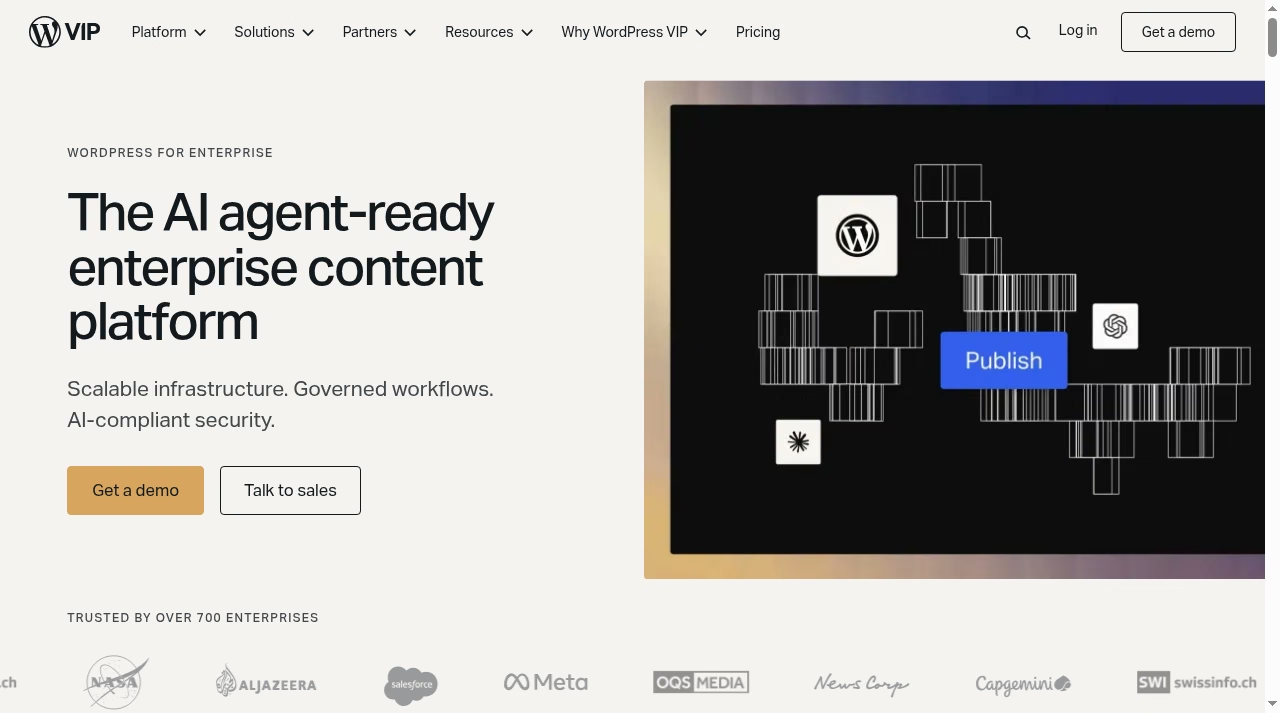
The homepage pitch as of today is blunt: “The AI agent-ready enterprise content platform,” trusted by over 700 enterprises, with logos like NASA, Al Jazeera, Salesforce, Meta, and News Corp on the front page.
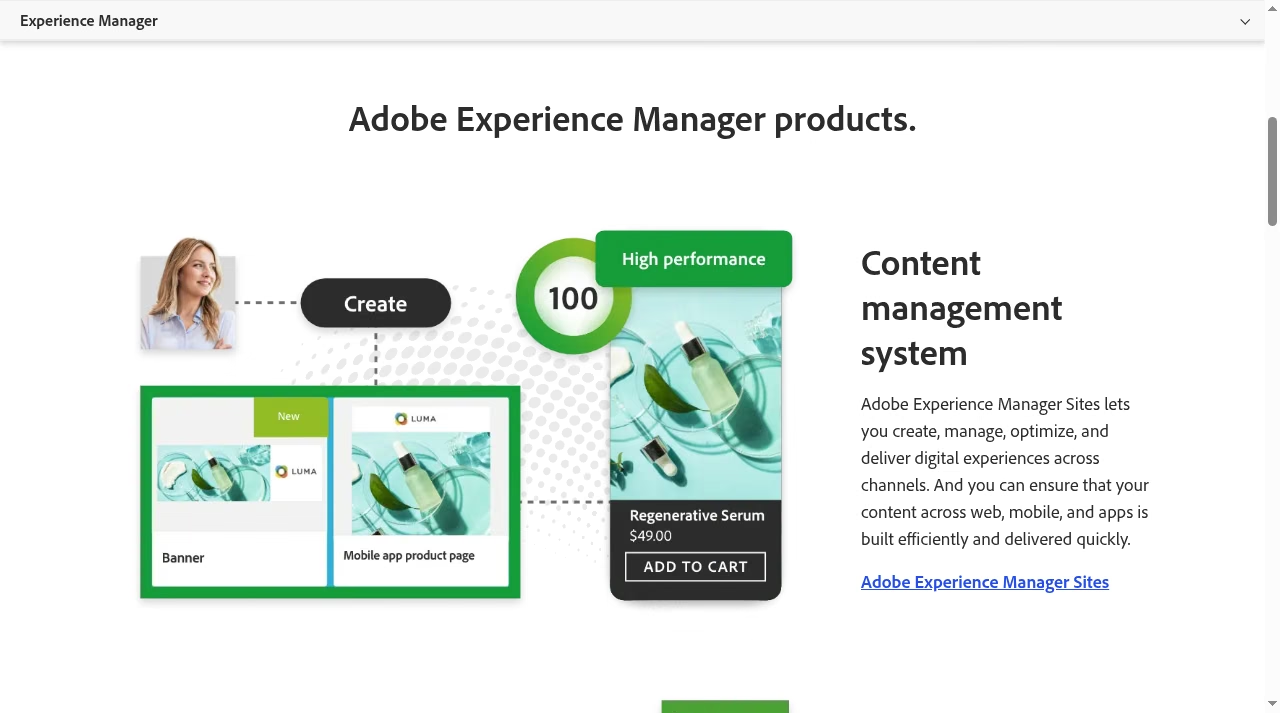
Adobe Experience Manager Sites is the CMS piece of Adobe’s Experience Cloud. The current positioning calls it “an agentic CMS to structure and scale modern experiences,” built on a decoupled architecture that can deliver to any channel, front end, or AI agent.
AEM is rarely bought alone: it sits next to Assets (the DAM), Forms, Guides, and the rest of the Adobe catalogue, which is exactly why scoping matters – as the product family page shows, Sites is one product in a suite.
A useful mental model before the details: VIP is a productized service around open-source WordPress, so what you buy is operations and assurance. AEM is licensed enterprise software delivered as a cloud service, so what you buy is capability and integration depth.
That one distinction explains almost every downstream difference – in staffing, in contracts, and in how each demo feels.
Where WordPress VIP earns its place
VIP’s first advantage is familiarity compounding. WordPress powers an enormous share of the web – VIP’s own marketing says 41% – which means editors, freelancers, and the UI/UX design firms you hire already know the interface. Training time is measured in days, not quarters.
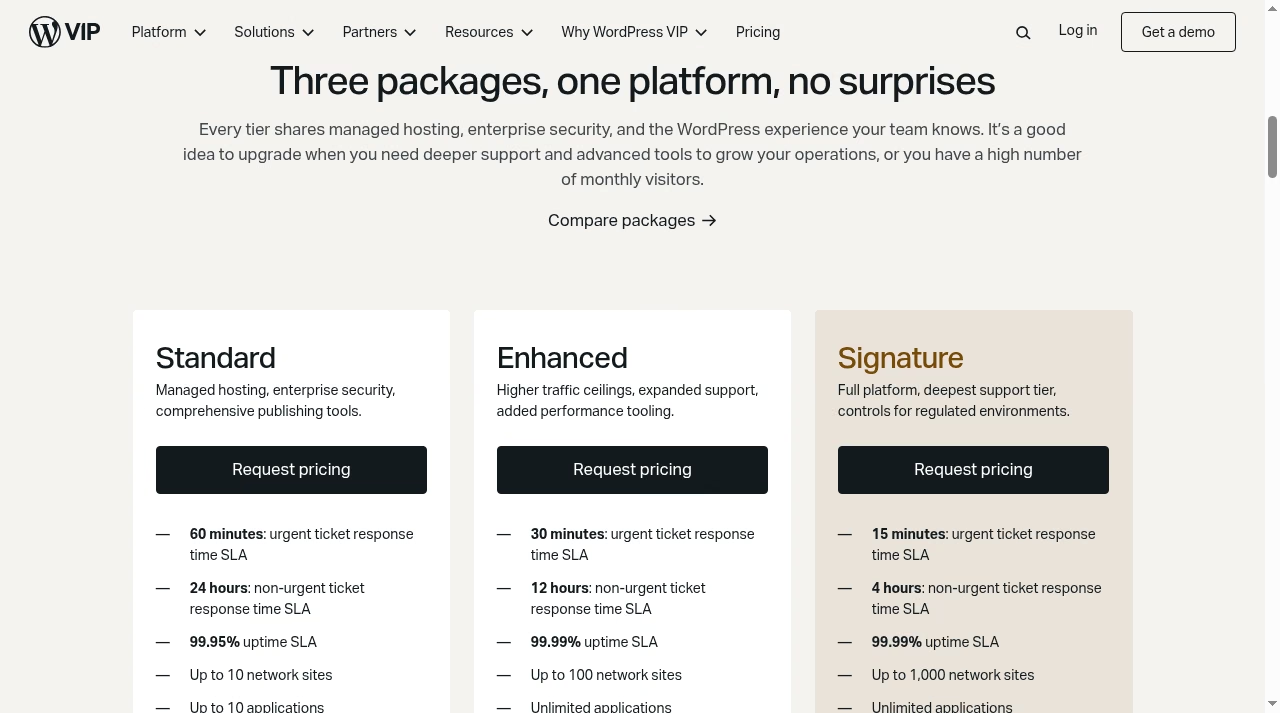
The second advantage is the published operating envelope: VIP’s pricing page lists three packages – Standard, Enhanced, and Signature – and even though every tier says “request pricing,” the page tells you exactly what changes between them.
Standard carries a 60-minute urgent ticket response SLA, 99.95% uptime, up to 10 network sites and 10 applications. Enhanced drops the urgent SLA to 30 minutes, raises uptime to 99.99%, allows 100 network sites and unlimited applications, and adds APM monitoring, database backup shipping, GitHub codespaces, and failover for disaster recovery.
Signature is the regulated-industry tier: 15-minute urgent response, up to 1,000 network sites, and the deepest support. Those are concrete, comparable numbers you can take into procurement before a single sales call.
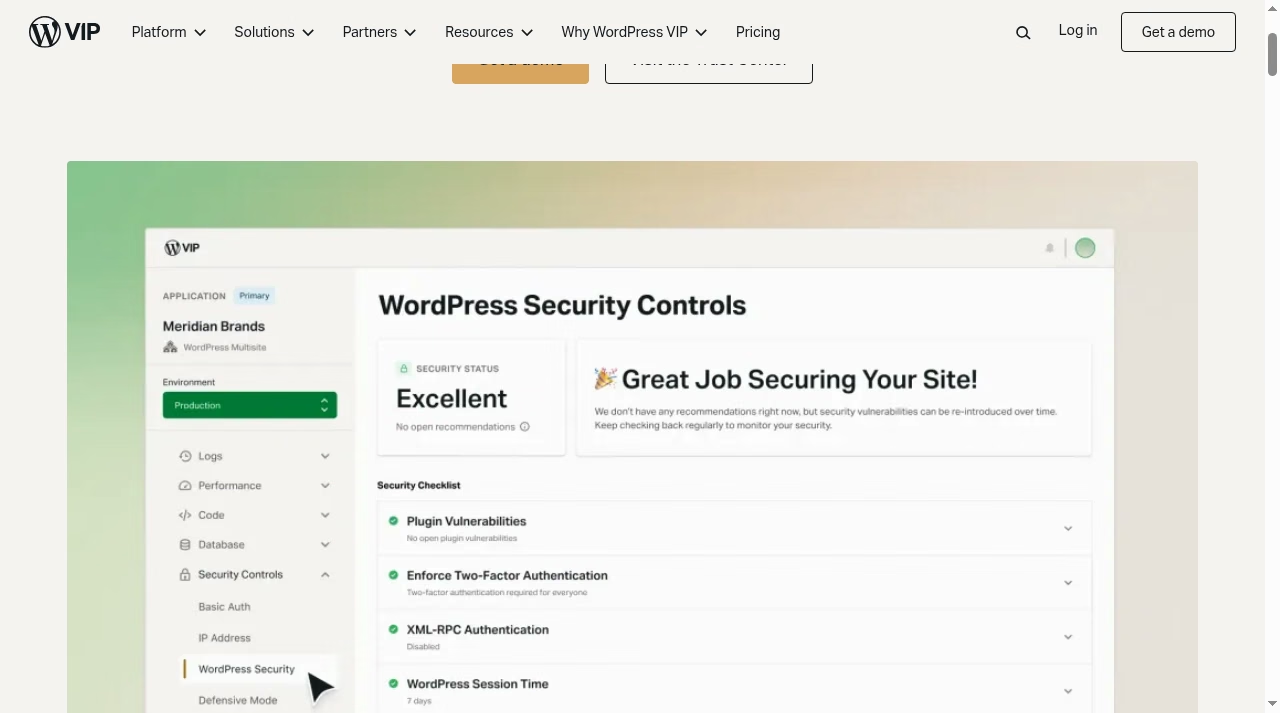
The security posture is equally public: VIP advertises FedRAMP Moderate authorization – it says the only enterprise WordPress platform with it – plus SOC 2 Type 2 compliance and a defense-in-depth model across infrastructure, operations, application, access, and network layers. For government-adjacent buyers and anyone tired of questionnaire ping-pong, that matters.
Teams running revenue-critical WordPress at scale, including shops that grew up with WooCommerce development, will recognize the shape of the offer immediately.
Where AEM earns its (much bigger) contract
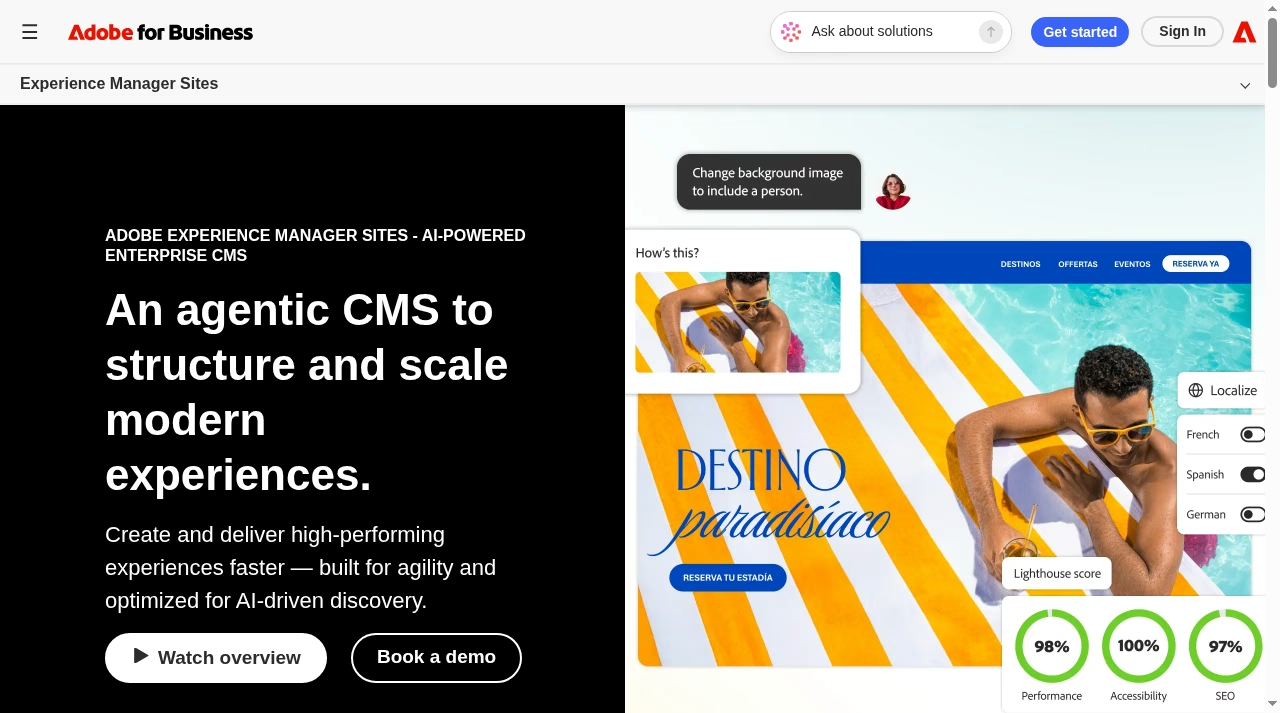
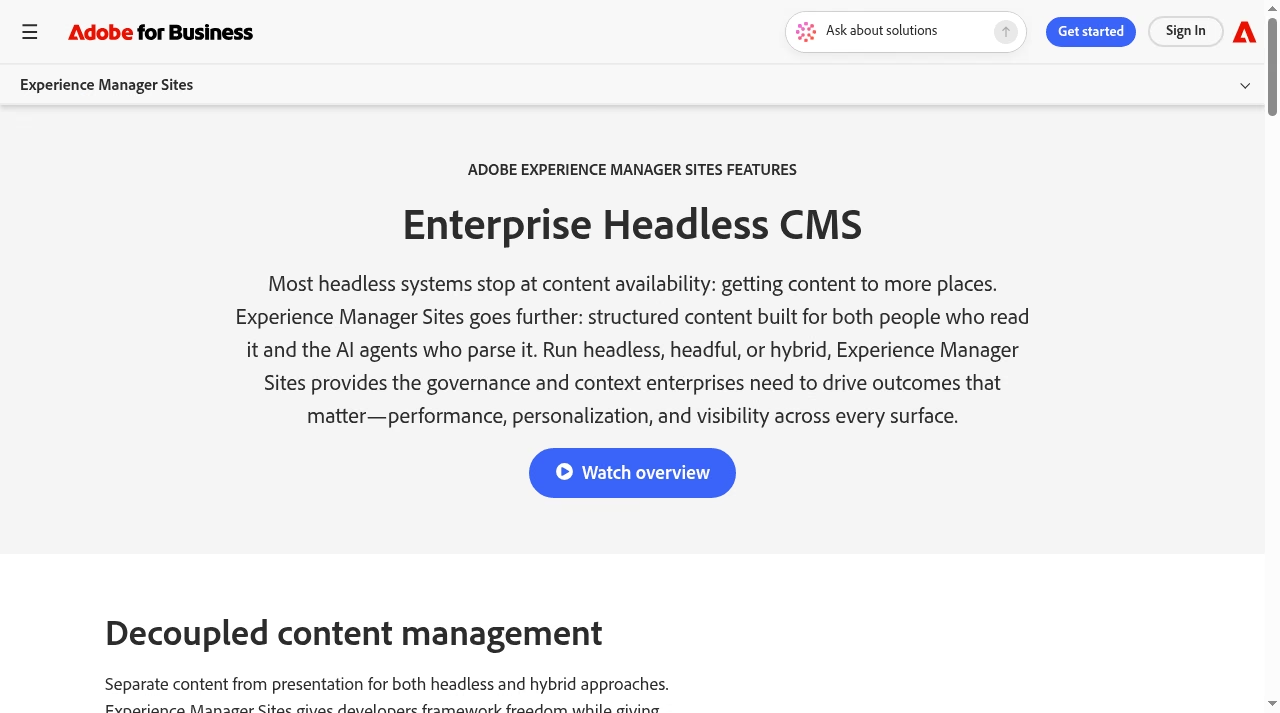
AEM’s case is not “better WordPress”; it is a different operating model. Adobe sells structured, reusable content delivered everywhere: web, mobile apps, kiosks, and now AI surfaces. The Sites product page is explicit about running headless, headful, or hybrid, and about structuring content for both human readers and AI agents that parse it.
If your company publishes one product description into twelve regional sites, three apps, and a partner portal, that architecture is the point.
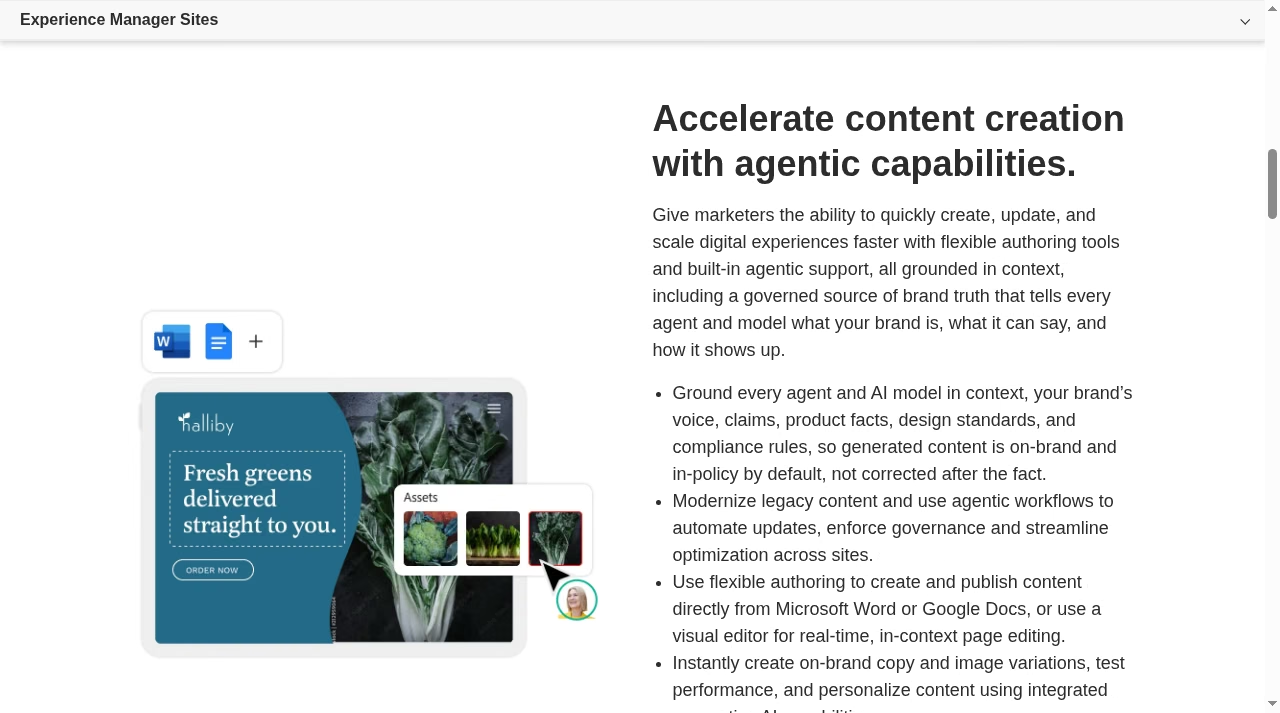
The authoring story is genuinely strong: marketers can create directly from Microsoft Word or Google Docs, use a visual editor for in-context page editing, and lean on what Adobe calls a governed source of brand truth so generated content stays on-brand and in-policy.
For organizations with hundreds of content authors across time zones – the exact profile of the digital transformation companies in the UK and elsewhere that Adobe courts – that governance layer is what justifies the contract.
And then there is gravity. If the company already pays for Adobe Analytics, Target, Creative Cloud, and Experience Platform, AEM snaps into an existing universe of identity, assets, and personalization – the reason so many retail ecommerce development companies end up implementing it for brands already deep in Adobe contracts.
Nobody gets fired for adding the CMS that shares a vendor with the rest of the marketing stack. The honest counterweight: that same gravity is how enterprises end up licensing shelfware, so scope the deal to AEM Sites unless you have budgeted for the suite.
Content modeling and editorial governance
This is the section where the two platforms stop looking alike. WordPress thinks in posts, pages, and custom post types; VIP adds editorial workflow polish and Parse.ly insight on top. That model is fast to learn and forgiving, but it encourages every site to invent its own structure.
AEM thinks in reusable content fragments and components governed by templates and policies: an author assembles approved pieces rather than inventing pages. Teams prototyping a lighter custom build first can borrow the thinking in our KeystoneJS vs WordPress comparison. For a ten-person editorial team, WordPress’s looseness is speed.
For a five-hundred-person, multi-brand organization where legal needs to approve the fragment once and reuse it in forty places, AEM’s rigidity is the feature. Governance in AEM is an acceptance test you can actually script; in WordPress it is a process you agree to follow.
Integrations and the wider stack
Count integration surface area before you count features. VIP connects to the WordPress plugin ecosystem and standard APIs, and its extensibility story is strongest for web-first stacks: CRM, analytics, marketing automation, and the media tools publishers live in.
AEM connects natively to the Adobe universe – Analytics, Target, Experience Platform, Creative Cloud, Workfront – which is either exactly your stack or mostly irrelevant.
Edge delivery and traffic management sit in front of both; if your infrastructure conversations involve the vocabulary in our guides to load balancers and cloud-native SaaS builders, both platforms will slot into that architecture, but AEM will expect more of it to be Adobe-shaped.
One integration question to ask explicitly in every demo: how does content leave the platform? Export formats, API completeness, and webhook support decide how painful the next migration is. The answer is decent for both – WordPress through its REST API and export tooling, AEM through its headless delivery APIs – but you want to hear it demonstrated, not promised.
AI readiness: what the claims actually mean
Both vendors now lead with AI. VIP calls itself “the AI agent-ready enterprise content platform” with governed workflows and AI-compliant security; Adobe calls AEM Sites “an agentic CMS” that delivers to AI agents and AI-generated answers.
Strip the marketing grammar and the claims converge on the same three things: structured content machines can parse, governance over what AI features may do to your content, and delivery into AI surfaces.
We apply the same skepticism to every AI category we review, from CMS platforms to the tools in our best AI presentation design tools roundup.
Test each claim the same way – bring a real content type from your own site to the demo, ask them to show it rendered for an AI agent, and ask what the AI features cost on top of the base quote. The vendors who answer in specifics are the ones whose features exist.
One genuine difference: VIP’s AI story rides on the WordPress ecosystem, so new capabilities arrive as platform updates and plugins you can trial quickly. AEM’s story is deeper but roadmapped through Adobe’s release cycle and your implementation partner. Neither is automatically better; they fail differently, and you want to know which failure mode your team absorbs more easily.
The money: comparable quotes, different transparency
Neither vendor publishes a price. VIP at least publishes the shape of the deal: the three tiers above, with their SLAs, so your “request pricing” conversation starts from a known configuration. Adobe publishes nothing – every AEM conversation starts with a demo request and ends in a negotiated contract.
Both are annual enterprise agreements, and both will dwarf what you currently pay for hosting. (For products that do publish numbers, we break them down line by line – see our Calendly pricing guide for the format.)
Budget for implementation too: AEM projects in particular are typically delivered with a systems integrator or one of the top IT outsourcing companies in the USA, and the services line can exceed the license.
Practical rule: get the VIP quote first, because its tiers force specificity (sites, traffic, support level). Then make Adobe quote against the same written requirements. A quote you cannot compare line by line is a quote you cannot negotiate.
The same task on both: a multi-region campaign
Take the task that breaks lesser platforms: launch a product campaign across four regional sites, in three languages, with legal sign-off, on a fixed date.
On VIP, your editors work in the WordPress block editor they already know, multilingual and multisite are well-trodden WordPress patterns, and Parse.ly analytics live in the same editor for the post-launch read.
On AEM, the campaign is modeled once as structured content with translation workflows and brand governance baked in, then pushed to every channel – including app surfaces and AI answers – from one place. VIP wins on editorial speed and staffing; AEM wins on orchestration depth. Neither is “better”; they are optimized for different bottlenecks.
The dry run matters as much as the launch. On both platforms, stage the campaign a week early with real content and make the people who will actually publish it run the rehearsal. The platform that looks slower in the demo is often the one that is faster on launch night, because the editors are not improvising.
Performance under load is part of the same task. VIP publishes its uptime SLAs (99.95% to 99.99% by tier) and its whole pitch is absorbing traffic spikes without your team touching infrastructure – the same edge-delivery territory we cover in our Azure Front Door vs CloudFront comparison.
AEM’s cloud service carries Adobe’s contracted SLAs, negotiated per deal. For a campaign with a hard launch date and press attention, ask both vendors what happens at ten times normal traffic, in writing.
Worth saying plainly: if your delivery ambitions stop at “fast websites in a few languages,” VIP covers it without the orchestration overhead. If the roadmap genuinely includes apps, in-product content, and personalization across an Adobe stack, AEM’s headless and hybrid modes are built for it – Adobe’s headless CMS page lays out that architecture in its own words.
Migration, operations, and the year after
Moving to VIP is a WordPress-to-WordPress migration: content export, media, redirects, theme rebuild on VIP’s coding standards, and a plugin review against its platform requirements. VIP sells migration and launch services for exactly this. Moving to AEM is a re-platform: content models get redesigned, templates become components, and editors are retrained.
Both are survivable; only one is routine. Either way, treat content safety as its own workstream – our explainer on incremental vs differential backup is the vocabulary check before you sign off on anyone’s migration runbook.
The operational question that outlives launch day: who touches the platform weekly? VIP assumes WordPress-literate editors and developers, a talent pool that is deep and global – from in-house teams to custom software development companies in Australia to the Next.js development companies building decoupled front ends.
AEM assumes certified AEM developers, a smaller and pricier market. Line up the operating team before the contract, not after. If you need that team externally, DevOps consulting companies and IT architecture consulting firms can carry the platform side while your editors learn the authoring side.
Budget the invisible costs while you are at it: redirect mapping for SEO equity, asset library cleanup before anyone moves ten thousand images, editor training time, and the parallel-running period where both systems are live. In my experience the parallel-running line is the one every estimate forgets, and it is the one that burns the quarter after launch.
The buyer checklist
Both procurement processes will try to rush you past the questions that matter. Slow them down. The checklist below is the order I would actually work through them, and none of it requires a consultant – though if you want one, that is a legitimate use of the advisory firms mentioned earlier.
- Write down the five tasks editors do weekly, and watch a real editor do them in both demos – not the sales engineer, your editor.
- Price both platforms against the same written requirements: sites, languages, traffic, support SLA, and integrations.
- Scope Adobe quotes to AEM Sites unless the budget genuinely covers the wider Experience Cloud, and sanity-check what VIP’s tier boundaries would cost at your traffic.
- Confirm the security paperwork early: VIP publishes FedRAMP Moderate and SOC 2 Type 2 on its site; Adobe routes equivalent answers through its trust documentation and account team.
- Staff the year after launch: WordPress-literate operators are everywhere, from MVP development companies to enterprise integrators; AEM-certified ones are a hiring plan.
- Run the proof of concept on the ugliest workflow you have – the multilingual campaign with legal review – because the pretty demo workflow always works.
For adjacent decisions that tend to arrive in the same quarter, the wider app directory maps the rest of the stack. Teams leaning on external builders can also scan the SaaS application development companies shortlist for implementation partners.
The bottom line
And if you are reading this for a company that is not actually enterprise yet – a ten-person team with one marketing site – the honest answer is neither: a quality managed WordPress host from a comparison like FastComet vs SiteGround covers you until the operating model genuinely strains.
Choose WordPress VIP when the organization thinks in websites and editorial speed, wants the WordPress talent pool, and values a published tier structure with real SLAs before the sales call.
Choose AEM Sites when the organization thinks in reusable content across every channel, already lives in Adobe’s universe, and can staff and budget the operating model it demands. Both will still be here in five years.
The wrong choice is not picking the weaker product – it is buying an operating model your team cannot run. Verify the current terms on the vendors’ own pages: wpvip.com, its pricing and security pages, and Adobe’s AEM Sites page.
Frequently asked questions
Is WordPress VIP the same as regular WordPress?
No. VIP is a managed enterprise platform built on WordPress: hosting, security review, performance tooling, support SLAs, and Parse.ly analytics, run by the team behind WordPress itself. Your editors see a familiar WordPress admin, but the infrastructure and support model are enterprise-grade.
Do WordPress VIP or Adobe AEM publish their prices?
Neither publishes a number. WordPress VIP publishes three tiers – Standard, Enhanced, and Signature – with defined SLAs and limits, all priced by quote. Adobe sells AEM entirely through demo requests and negotiated contracts. Always collect both quotes against the same written requirements.
Is AEM only for building websites?
No. AEM Sites is the web CMS, and the wider family includes Assets for digital asset management, Forms, and Guides for structured content. Sites itself delivers to web, mobile apps, and other channels, with headless, headful, and hybrid modes.
Can Adobe Experience Manager run headless?
Yes. Adobe’s own headless CMS page describes running AEM Sites headless, headful, or hybrid, with structured content designed for both human readers and AI agents consuming it through APIs.
Which platform is easier for an existing WordPress team?
WordPress VIP, clearly. Editors keep the block editor they know, developers keep WordPress patterns, and hiring stays simple in almost every market. AEM requires learning its component model, template policies, and authoring interface, and typically involves certified AEM developers – a smaller, more expensive talent pool that you should line up before signing rather than after.
What support SLAs does WordPress VIP publish?
As of Oct 16, 2026: Standard responds to urgent tickets in 60 minutes with 99.95% uptime; Enhanced in 30 minutes with 99.99% uptime plus APM and failover tooling; Signature in 15 minutes with 99.99% uptime and up to 1,000 network sites. Confirm current terms on the VIP pricing page.
How should we make the final call?
Run a bounded proof of concept with your actual editors on your ugliest real workflow – the multilingual campaign with legal review, not the polished demo flow. Price both platforms against identical written requirements, verify the SLAs and certifications on the vendors own pages, and staff the operating team before signing.
The right answer is the platform your organization can actually run for the next five years, not the one with the longer feature list.


Leave a Reply